September 27, 2012

Most heated clothing is designed for cold-weather sports and activities, such as motorcycle riding, downhill skiing, winter biking, and snowmobiling, trekking and for outdoor workers such as construction workers and carpenters. Normal insulation works by trapping body heat, so if it gets wet from sweat or rain, or if a person stops exercising, the insulation may not keep them warm.
With heated garments, a person can keep warm even if they are resting and not producing heat, or if their coat is damp from sweat. The most widely-available types of heated clothing are products for the extremities- the hands and feet. These body parts are the most likely to suffer frostbite or frostnip in severe cold. As such, many manufacturers make heated gloves, mittens, socks, and boot liners, and they can be purchased at workers’ supply stores (serving construction workers) and motor sports stores. Heated torso coverings (vests or jackets) or leggings are available from specialty retailers that cater to motorcyclists and downhill skiers.
read more »
Posted in Games, Money, Technology |
Leave a Comment »
September 27, 2012

Home automation (also called domotics) is the residential extension of ‘building automation’ (electronic which monitor and control the mechanical, electronics, and lighting systems in a building). ‘Building Automation Systems’ (BAS) keep the building climate within a specified range, provides lighting based on an occupancy schedule, and monitors system performance and device failures and provides email and/or text notifications to building staff.
Home automation may include centralized control of lighting, HVAC (heating, ventilation and air conditioning), appliances, and other systems, to provide improved convenience, comfort, energy efficiency, and security. Home automation for the elderly and disabled can provide increased quality of life for persons who might otherwise require caregivers or institutional care.
read more »
Posted in Money, Technology |
Leave a Comment »
September 24, 2012


The Atheist Bus Campaign aims to place ‘peaceful and upbeat’ messages about atheism on transport media in Britain, in response to evangelical Christian advertising. It was created by comedy writer Ariane Sherine and launched in 2008, with official support from the British Humanist Association and Richard Dawkins. The campaign’s original goal was to raise £5,500 to run 30 buses across London for four weeks early in 2009 with the slogan: ‘There’s probably no God. Now stop worrying and enjoy your life.’
Richard Dawkins, author of ‘The God Delusion,’ agreed to match all donations up to a maximum of £5,500, providing a total of £11,000 if the full amount were to be raised. The campaign closed in April 2009, having raised a total of £153,516.51. The first buses started running on in January 2009 – 800 are running around the whole of the UK and it is also planned to place 1,000 adverts on the London Underground featuring quotations from famous atheists. Subsequently, two large LCD screens were placed on Oxford Street, central London.
read more »
Posted in Money, Philosophy, World |
Leave a Comment »
September 24, 2012

Frugal innovation is the process of reducing the complexity and cost of a good and its production. Usually this refers to removing nonessential features from a durable good, such as a car or phone, in order to sell it in developing countries. Designing products for such countries may also call for an increase in durability, and unconventional distributions channels. Sold to so-called ‘overlooked consumers,’ firms hope volume will offset razor-thin profit margins.
Rising incomes in developing countries may also drive frugal innovation. Many terms are used to refer to the concept. ‘Frugal engineering’ was coined by Carlos Ghosn, the joint chief of Renault and Nissan, who stated, ‘frugal engineering is achieving more with fewer resources.’ Frugal innovation isn’t solely the domain of large multinational corporations. While General Electric may win plaudits for its $800 EKG machines, cheap cell phones made by local, no-name companies and no-frills wire frame eyeglasses are equally good examples of frugal innovation.
read more »
Posted in Money, Technology, World |
Leave a Comment »
September 20, 2012

Happiness economics is the quantitative study of happiness, positive and negative affect, well-being, quality of life, life satisfaction, and related concepts, typically combining economics with other fields such as psychology and sociology. It typically treats such happiness-related measures, rather than wealth, income or profit, as something to be maximized.
The field has grown substantially since the late 20th century, for example by the development of methods, surveys and indices to measure happiness and related concepts. Given its very nature, reported happiness is subjective. It is difficult to compare one person’s happiness with another. It can be especially difficult to compare happiness across cultures. However, many happiness economists believe they have solved this comparison problem. Cross-sections of large data samples across nations and time demonstrate consistent patterns in the determinants of happiness.
read more »
Posted in Health, Money, World |
Leave a Comment »
September 18, 2012

A groupie is a person who seeks emotional and sexual intimacy with a musician or other celebrity or public figure. ‘Groupie’ is derived from group in reference to a musical group, but the word is also used in a more general sense, especially in casual conversation. The word ‘groupie’ is commonplace, a derisive term used to describe a particular kind of female fan assumed to be more interested in sex with rock stars than in their music.
Groupies became prominent in the music scene in the 1960s and 1970s. This was prior to the murder of John Lennon in 1980, and before security levels for bands increased significantly. Female groupies in particular have a long-standing reputation of being available to celebrities, pop stars, rock stars, and other public figures. Led Zeppelin singer Robert Plant is quoted as distinguishing between fans who wanted brief sexual encounters, and ‘groupies’ who traveled with musicians for extended periods of time, acting as a surrogate girlfriend or mother, often taking care of the musician’s valuables, drugs, wardrobe, and social life.
read more »
Posted in Games, Money, Sex |
1 Comment »
September 18, 2012

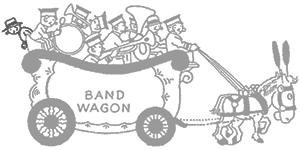
Basking in reflected glory (BIRGing) is a self-serving cognition whereby an individual associates themself with successful others such that another’s success becomes their own. What is interesting about BIRGing is that the simple affiliation of another’s success is enough to stimulate self glory. The person engaging in BIRGing does not even need to have been personally involved in the successful action with which they are affiliating themselves.
Examples of BIRGing include anything from sharing a home state with a past or present famous person, to religious affiliations, to sports teams. For example, a parent with a bumper sticker reading ‘My child is an honor student’ is basking in the reflected glory of their child. Within social psychology, BIRGing is thought to enhance self-esteem and to be a component of self-management.
read more »
Posted in Health, Language, Money |
Leave a Comment »
September 17, 2012
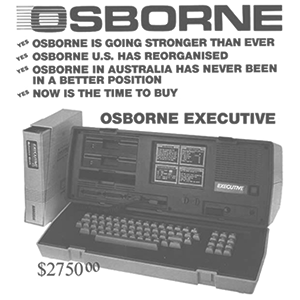
The Osborne effect is a term referring to the unintended consequence of the announcement of a future product ahead of its availability and its impact upon the sales of the current product.
Pre-announcement is done for several reasons: to reassure current customers that there is improvement or lower cost coming, to increase the interest of the media and investors in the company’s future prospects, and to intimidate or confuse competitors. When done correctly, the sales or cash flow impact to the company is minimal, as the revenue drop for the current product is replaced by orders or completed sales of the new product as it becomes available.
read more »
Posted in Money, Technology |
Leave a Comment »
September 17, 2012

The Culture of Narcissism: American Life in an Age of Diminishing Expectations is a book by the cultural historian Christopher Lasch, first published in 1979. It explores the roots and ramifications of the normalizing of pathological narcissism in 20th century American culture using psychological, cultural, artistic, and historical synthesis.
The book proposes that post-war, late-capitalist America, through the effects of ‘organized kindness’ on the traditional family structure, has produced a personality-type consistent with clinical definitions of ‘pathological narcissism.’ This pathology is not akin to everyday narcissism — a hedonistic egoism — but rather a very weak sense of self requiring constant external validation. For Lasch, ‘pathology represents a heightened version of normality.’
read more »
Posted in Health, Language, Money |
1 Comment »
September 17, 2012

In psychology, compensation is a strategy whereby one covers up, consciously or unconsciously, weaknesses, frustrations, desires, feelings of inadequacy or incompetence in one life area through the gratification or (drive towards) excellence in another area.
Compensation can cover up either real or imagined deficiencies and personal or physical inferiority. The compensation strategy, however does not truly address the source of this inferiority. Positive compensations may help one to overcome one’s difficulties. On the other hand, negative compensations do not, which results in a reinforced feeling of inferiority.
read more »
Posted in Health, Humor, Money |
1 Comment »
September 17, 2012
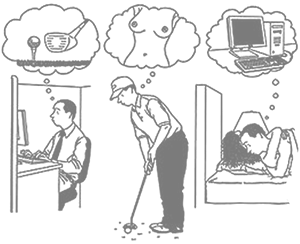

Opportunity cost is the value of the next best thing after making a decision; the utility of the decision has to outweigh the opportunity cost for it to be a good choice.
For example, opportunity cost describes leisure time given up to work, because leisure and income are both valued. Going to work implies more income but less leisure.
read more »
Posted in Money, Politics |
Leave a Comment »
September 16, 2012

To have one’s cake and eat it too is a popular English idiomatic proverb or figure of speech most often used negatively, to connote the idea of consuming a thing whilst managing to preserve it. This may also indicate having or wanting more than one can handle or deserve, or trying to have two incompatible things. The proverb’s meaning is similar to the phrases, ‘you can’t have it both ways’ and ‘you can’t have the best of both worlds.’
Conversely, in the positive sense, it would refer to ‘having it both ways’ or ‘having the best of both worlds.’ This concept, known as opportunity cost, is one of the most important economic concepts. The phrase’s earliest recording is from 1546 as ‘wolde you bothe eate your cake, and have your cake?’ (John Heywood’s ‘A dialogue Conteinyng the Nomber in Effect of All the Prouerbes in the Englishe Tongue’). This phrase alludes to the impossibility of eating your cake and still having it afterwards.
read more »
Posted in Food, Language, Money |
Leave a Comment »



