April 18, 2012

Vertical farming is a concept that argues that it is economically and environmentally viable to cultivate plant or animal life within skyscrapers, or on vertically inclined surfaces.
The idea of a vertical farm has existed at least since the early 1950s and built precedents are well documented by John Hix in his canonical text ‘The Glass House.’
read more »
Posted in Food, Money, Technology |
1 Comment »
April 18, 2012

A food desert is any area in the industrialized world where healthy, affordable food is difficult to obtain. Food deserts are prevalent in rural as well as urban areas and are most prevalent in low-socioeconomic minority communities. They are associated with a variety of diet-related health problems. Food deserts are also linked with supermarket shortage.
The food desert concept was first introduced in the United Kingdom in the early 1990s to examine disparities in food pricing and to describe geographical areas with limited access to retail grocery stores. A food desert is a food environment unsupportive of health; it is defined by barriers which restrict access to healthful foods. Barriers may include lack of access to food retailers, availability of nutritious foods, or affordability of foods. Research has defined food deserts quantitatively or by neighborhood characteristics such as economic and social barriers.
read more »
Posted in Food, Health, Money |
1 Comment »
April 18, 2012

A spectrum auction is a process whereby a government uses an auction system to sell the rights (licences) to transmit signals over specific bands of the electromagnetic spectrum and to assign scarce spectrum resources. Depending on the specific auction format used, a spectrum auction can last from a single day to several months from the opening bid to the final winning bid.
With a well-designed auction, resources are allocated efficiently to the parties that value them the most, the government securing revenue in the process. Spectrum auctions are a step toward market-based spectrum management, and are a way for governments to allocate scarce resources. Alternatives to auctions include administrative licensing, such as the comparative hearings conducted historically (sometimes referred to as ‘beauty contests’), or lotteries.
read more »
Posted in Money, Politics, Technology |
Leave a Comment »
April 18, 2012

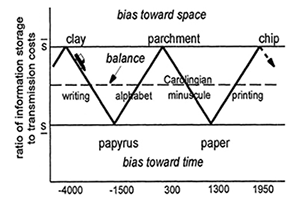
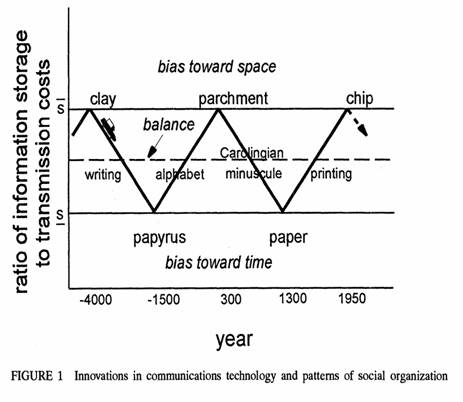
The Canadian economic historian Harold Innis developed the concept of monopolies of knowledge in his later writings on communications; they arise when ruling classes maintain political power through control of key communications technologies. In ancient Egypt, for example, a complex writing system conferred a monopoly of knowledge on literate priests and scribes. Mastering the art of writing and reading required long periods of apprenticeship and instruction, confining knowledge to this powerful class.
This theory suggests that monopolies of knowledge gradually suppress new ways of thinking. Entrenched hierarchies become increasingly rigid and out of touch with social realities. Challenges to elite power are often likely to arise on the margins of society. The arts, for example, are often seen as a means of escape from the sterility of conformist thought.
read more »
Posted in Education, Money, Politics |
Leave a Comment »
April 17, 2012

Media Consolidation is a process whereby progressively fewer individuals or organizations control increasing shares of the mass media. As of 2010, The Walt Disney Company is the largest media conglomerate in the US, with News Corporation, Time Warner, and Viacom ranking second, third and fourth respectively. Net neutrality is at stake when media mergers are occurring. Net neutrality involves a lack of restrictions on content on the internet, however, with big businesses supporting campaigns financially they tend to have influence over political issues, which can translate into their mediums.
Critics of consolidation raise the issue of whether monopolistic or oligopolistic control of a local media market can be fully accountable and dependable in serving the public interest. On the local end, reporters have often seen their stories refused or edited beyond recognition. An example would be the repeated refusal of networks to air ‘ads’ from anti-war advocates to liberal groups like MoveOn.org, or religious groups like the United Church of Christ. Journalists and their reports may be directly sponsored by parties who are the subject of their journalism leading to reports which favor the sponsor. Consequently, if the companies dominating a media market choose to suppress stories that do not serve their interests, the public suffers, since they are not adequately informed of some crucial issues that may affect them.
Posted in Money, Politics, World |
Leave a Comment »
April 17, 2012

Electric Daisy Carnival is an annual electronic dance music festival held in the South West United States on the last weekend of June. The first Electric Daisy Carnival was held in 1997 at the Shrine Expo Hall in Southern California. The name usage was acquired by Insomniac’s partner Philip Blaine. This refers to the name borrowed from Steve Kool-Aid’s original creation from several years prior whom Philip knew through his colleague Gary (Steve’s partner) at 1500 Records.
In 2010, the event drew criticism from local authorities and promoters alike after minors gained entrance and numerous people were taken to the hospital by paramedics, and as well after an underage (15 year old female) attendee who died of an overdose of ecstasy. The city of Los Angeles began to consider banning all raves from being held in the city. The Coliseum Commission put a moratorium on booking any future events, pending the outcome of the use of new security and safety provisions. Those new provisions include a minimum age of 18 on all future events and the presence of on-site doctors.
Posted in Art, Drugs, Money |
Leave a Comment »
April 17, 2012

Prison–industrial complex is a term used to attribute the rapid expansion of the US inmate population to the political influence of private prison companies and businesses that supply goods and services to government prison agencies. The term is analogous to the military–industrial complex that President Dwight D. Eisenhower warned of in his famous 1961 farewell address.
Such groups include corporations that contract prison labor, construction companies, surveillance technology vendors, lawyers, and lobby groups that represent them. Activists have described the prison industrial complex as perpetuating a belief that imprisonment is a quick fix to underlying social problems such as homelessness, unemployment, drug addiction, mental illness, and illiteracy.
read more »
Posted in Money, Politics |
Leave a Comment »
April 16, 2012

The Bling Ring, sometimes called the ‘Hollywood Hills Burglar Bunch,’ were a group, mostly of teenagers based in and around Calabasas, California, who burglarized the homes of several celebrities in 2008 – 2009. In total, their activities resulted in the theft of about $3 million in cash and belongings, most of it from Paris Hilton, whom they robbed several times. However, over 50 homes were reportedly targeted for potential burglary.
The alleged ringleader of the group, Rachel Lee is the daughter of divorced Korean immigrants. Both parents own successful businesses. Lee lived in Calabasas with her mother, who owns a franchise of Kumon, a tutoring company. Her father is based in Las Vegas. Lee and her older sister Candace had a privileged upbringing, and she drove an Audi A4 to school, where she was named ‘Best Dressed’ in the 2007 yearbook. A year after graduation, she was fined and put on probation for a petty theft incident in which she and a friend, Diana Tamayo, stole $85 of merchandise from a Sephora cosmetics store.
read more »
Posted in Money |
Leave a Comment »
April 13, 2012

Sager Midern Computer, Inc., is an American OEM (original equipment manufacturer) computer manufacturer specializing in laptop computers. Sager laptops are manufactured by Clevo which are also sold under many other brand names. Sager is the biggest Clevo retailer. In addition to selling physical hardware, Sager also offers support and repair services for all Clevo based Laptops. This service is offered even if the laptop was not ordered through Sager, although in that case the user must pay in full for all services provided.
The company was founded in 1985 by Shung Song Yuan in City of Industry, California. While ‘A-brands’ such as Dell, Toshiba, IBM, or HP are manufactured on a contract basis where so-called contract manufacturers assemble laptop computers as specified by the brand, Sager instead purchases finished and generic chassis designed and built by Original Design Manufacturers or ODMs (such as Clevo). Sager then assembles the laptop with parts chosen by the final customer, puts its logo on the chassis and sells them under the brand Sager. Sager then provides support to these computers.
Posted in Games, Money, Technology |
Leave a Comment »
April 13, 2012

Clevo is a Taiwanese OEM/ODM (original equipment and design manufacturer) computer manufacturer which exclusively produces laptop computers. They manufacture and sell complete laptops under their own brand; they also sell laptop chassis to other OEMs who build laptops on the chassis, often customized for each customer.
Companies which rebrand Clevo chassis or have in the past include Sager, iBuypower, and OriginPC. Alienware also used to sell rebranded Clevo notebooks, although it is unclear whether they still do.
Posted in Money, Technology, World |
Leave a Comment »
April 13, 2012

Mole [moh-ley] (from the Aztec word for ‘sauce’) is the generic name for a number of sauces used in Mexican cuisine, as well as for dishes based on these sauces. Outside of Mexico, it often refers to a specific sauce which is known in Spanish by the more specific name ‘mole poblano.’ In contemporary Mexico, the term is used for a number of sauces, some quite dissimilar to one another, including black, red, yellow, colorado, green, almendrado, and pipián. The sauce is most popular in the central and southern regions of the country, but eaten nationwide, particularly during celebrations.
In Mexico, to say ‘to go to a mole’ (‘ir a un mole’) means to go to a wedding. Three states in Mexico claim to be the origin of mole, Puebla, Oaxaca, and Tlaxcala. The states with the best known moles are Puebla and Oaxaca, but other regions in Mexico also make various types of mole sauces. Moles come in various flavors and ingredients, with chili peppers as the common factor. A classic mole poblano is a dark red or brown sauce served over meat. Mole has a strong flavor, especially the dark ones, and is considered to be an acquired taste for most. This has spawned another saying, ‘en su mero mole,’ which means something like ‘one’s cup of tea.’
read more »
Posted in Food, Money, World |
1 Comment »
April 12, 2012

User innovation refers to innovation by intermediate users (e.g. user firms) or consumer users (individual end-users or user communities), rather than by suppliers (producers or manufacturers).
Eric von Hippel of MIT and others observed that many products and services are actually developed or at least refined, by users, at the site of implementation and use. These ideas are then moved back into the supply network. This is because products are developed to meet the widest possible need; when individual users face problems that the majority of consumers do not, they have no choice but to develop their own modifications to existing products, or entirely new products, to solve their issues. Often, user innovators will share their ideas with manufacturers in hopes of having them produce the product, a process called free revealing.
read more »
Posted in Money, Technology |
Leave a Comment »



 The Daily Omnivore