April 22, 2012
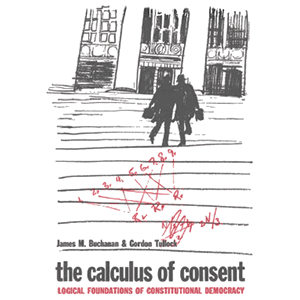
Rational ignorance occurs when the cost of educating oneself on an issue exceeds the potential benefit that the knowledge would provide. Ignorance about an issue is said to be ‘rational’ when the cost of educating oneself about the issue sufficiently to make an informed decision can outweigh any potential benefit one could reasonably expect to gain from that decision, and so it would be irrational to waste time doing so.
This has consequences for the quality of decisions made by large numbers of people, such as general elections, where the probability of any one vote changing the outcome is very small. The term is most often found in economics, particularly public choice theory, but also used in other disciplines which study rationality and choice, including philosophy (epistemology) and game theory. The term was coined by Anthony Downs in ‘An Economic Theory of Democracy’ (1957).
read more »
Posted in Money, Philosophy, Politics |
1 Comment »
April 22, 2012

The Pebble E-Paper Watch, known now as the Pebble Classic, is an American smartwatch developed by Pebble Technology Corporation, and is the first generation of the Pebble watch lineup. The smartwatch was pledged from a Kickstarter campaign, proving massively successful, collecting around $10 million for development of the smartwatch.
Pebble connects to both Android and iOS phones, so they can display notifications from the phone, control music, view calendar events, and create reminders. An online app store makes the Pebble compatible with apps tailored for them from many third party sellers, for many purposes especially sports. In 2015, Pebble Technology released its second-generation Time, with a color e-paper display, microphone, and updated design.
Posted in Money, Technology |
Leave a Comment »
April 19, 2012


Superfood is an unscientific marketing term used in various contexts. For example, it is sometimes used to describe food with high nutrient or phytochemical content that may confer health benefits, with few properties considered to be negative, such as being high in saturated fats or artificial ingredients, food additives, or contaminants. An often-cited example of a superfruit is blueberries which contain moderate-rich concentrations of anthocyanins, vitamin C, manganese, dietary fiber, pterostilbene (an undefined phytochemical under preliminary research), and low calorie content.
Other examples of superfoods include broccoli, spinach, pumpkin, and tomatoes which are rich in various nutrients. All these fruits and vegetables contain a variety of nutrients and phytochemicals in varying amounts as do common plant foods like bananas, pineapples and potatoes which have only rarely been called superfoods. Fish may be considered a superfood due to their omega-3 fatty acids which may promote cognitive development.
read more »
Posted in Food, Health, Money |
Leave a Comment »
April 18, 2012

Keep Austin Weird is the slogan adopted by the Austin Independent Business Alliance to promote small businesses in Austin, Texas. The phrase has long been believed to have been coined in 2000 by Red Wassenich, who says he made the comment after giving a pledge to an Austin radio station. He later began printing bumper stickers, and now operates the website keepaustinweird.com and published ‘Keep Austin Weird: A Guide to the Odd Side of Town.’ Despite a challenge from Wassenich, the slogan was later trademarked by Outhouse Designs and used to market T-shirts, hats, and mugs. A recently released book on the topic, ‘Weird City,’ discusses the cultural evolution of the movement as well as its commercialization and socio-political significance.
Austin is the self-proclaimed ‘live music capital of the world’ and the people of Austin reflect a friendly, accepting culture of artistic and individual expression that maintains the city as a vibrant and eclectic creative center and haven for an LGBT community, intellectual community, community of naturalists and environmentalists, and for subcultures and people(s) who are not mainstream. In a mostly conservative Texas, Austin is ‘Weird’ because of that and because it continues to be liberal and progressive politically, socially, in culture, in the arts and in music, among other things. ‘Keep Austin Weird’ moves beyond a mere slogan, to reflect the dynamics that encompass Austin.
Posted in Humor, Money, Politics |
Leave a Comment »
April 18, 2012


Slow Food is an international movement founded by Carlo Petrini in 1986. Promoted as an alternative to fast food, it strives to preserve traditional and regional cuisine and encourages farming of plants, seeds and livestock characteristic of the local ecosystem. It was the first established part of the broader Slow movement, and has since expanded globally. Its goals of sustainable foods and promotion of local small businesses are paralleled by a political agenda directed against globalization of agricultural products.
Slow Food began in Italy with the founding of its forerunner organization, Arcigola, in 1986 to resist the opening of a McDonald’s near the Spanish Steps in Rome. In 1989, the founding Manifesto of the international Slow Food movement was signed in Paris by delegates from 15 countries. This was done not so much a protest against the restaurant chain as a protest against big international business interests. The movement has expanded to include chapters in over 150 countries.
read more »
Posted in Food, Money |
Leave a Comment »
April 18, 2012

Rooftop farming is the practice of cultivating food on the rooftop of buildings. Rooftop farming is usually done using green roof, hydroponics, aeroponics, or air-dynaponics systems or container gardens. Besides using the already present space at the roof itself, additional platforms could possibly be created between high-rise buildings called ‘aero-bridges.’ Besides the decorative benefit, roof plantings may provide food, temperature control, hydrological benefits, and habitats for wildlife.
‘In an accessible rooftop garden, space becomes available for localized small-scale urban agriculture, a source of local food production.’ At Trent University in Ontario, there is currently a working rooftop garden which provides food to the student café and local citizens.
read more »
Posted in Food, Money, Technology |
Leave a Comment »
April 18, 2012

Vertical farming is a concept that argues that it is economically and environmentally viable to cultivate plant or animal life within skyscrapers, or on vertically inclined surfaces.
The idea of a vertical farm has existed at least since the early 1950s and built precedents are well documented by John Hix in his canonical text ‘The Glass House.’
read more »
Posted in Food, Money, Technology |
1 Comment »
April 18, 2012
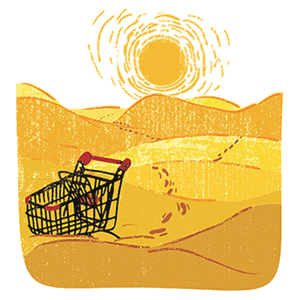
A food desert is any area in the industrialized world where healthy, affordable food is difficult to obtain. Food deserts are prevalent in rural as well as urban areas and are most prevalent in low-socioeconomic minority communities. They are associated with a variety of diet-related health problems. Food deserts are also linked with supermarket shortage.
The food desert concept was first introduced in the United Kingdom in the early 1990s to examine disparities in food pricing and to describe geographical areas with limited access to retail grocery stores. A food desert is a food environment unsupportive of health; it is defined by barriers which restrict access to healthful foods. Barriers may include lack of access to food retailers, availability of nutritious foods, or affordability of foods. Research has defined food deserts quantitatively or by neighborhood characteristics such as economic and social barriers.
read more »
Posted in Food, Health, Money |
1 Comment »
April 18, 2012

A spectrum auction is a process whereby a government uses an auction system to sell the rights (licences) to transmit signals over specific bands of the electromagnetic spectrum and to assign scarce spectrum resources. Depending on the specific auction format used, a spectrum auction can last from a single day to several months from the opening bid to the final winning bid.
With a well-designed auction, resources are allocated efficiently to the parties that value them the most, the government securing revenue in the process. Spectrum auctions are a step toward market-based spectrum management, and are a way for governments to allocate scarce resources. Alternatives to auctions include administrative licensing, such as the comparative hearings conducted historically (sometimes referred to as ‘beauty contests’), or lotteries.
read more »
Posted in Money, Politics, Technology |
Leave a Comment »
April 18, 2012

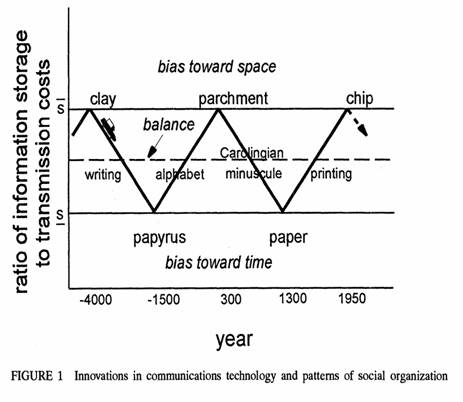
The Canadian economic historian Harold Innis developed the concept of monopolies of knowledge in his later writings on communications; they arise when ruling classes maintain political power through control of key communications technologies. In ancient Egypt, for example, a complex writing system conferred a monopoly of knowledge on literate priests and scribes. Mastering the art of writing and reading required long periods of apprenticeship and instruction, confining knowledge to this powerful class.
This theory suggests that monopolies of knowledge gradually suppress new ways of thinking. Entrenched hierarchies become increasingly rigid and out of touch with social realities. Challenges to elite power are often likely to arise on the margins of society. The arts, for example, are often seen as a means of escape from the sterility of conformist thought.
read more »
Posted in Education, Money, Politics |
Leave a Comment »
April 17, 2012

Media Consolidation is a process whereby progressively fewer individuals or organizations control increasing shares of the mass media. As of 2010, The Walt Disney Company is the largest media conglomerate in the US, with News Corporation, Time Warner, and Viacom ranking second, third and fourth respectively. Net neutrality is at stake when media mergers are occurring. Net neutrality involves a lack of restrictions on content on the internet, however, with big businesses supporting campaigns financially they tend to have influence over political issues, which can translate into their mediums.
Critics of consolidation raise the issue of whether monopolistic or oligopolistic control of a local media market can be fully accountable and dependable in serving the public interest. On the local end, reporters have often seen their stories refused or edited beyond recognition. An example would be the repeated refusal of networks to air ‘ads’ from anti-war advocates to liberal groups like MoveOn.org, or religious groups like the United Church of Christ. Journalists and their reports may be directly sponsored by parties who are the subject of their journalism leading to reports which favor the sponsor. Consequently, if the companies dominating a media market choose to suppress stories that do not serve their interests, the public suffers, since they are not adequately informed of some crucial issues that may affect them.
Posted in Money, Politics, World |
Leave a Comment »
April 17, 2012

Electric Daisy Carnival is an annual electronic dance music festival held in the South West United States on the last weekend of June. The first Electric Daisy Carnival was held in 1997 at the Shrine Expo Hall in Southern California. The name usage was acquired by Insomniac’s partner Philip Blaine. This refers to the name borrowed from Steve Kool-Aid’s original creation from several years prior whom Philip knew through his colleague Gary (Steve’s partner) at 1500 Records.
In 2010, the event drew criticism from local authorities and promoters alike after minors gained entrance and numerous people were taken to the hospital by paramedics, and as well after an underage (15 year old female) attendee who died of an overdose of ecstasy. The city of Los Angeles began to consider banning all raves from being held in the city. The Coliseum Commission put a moratorium on booking any future events, pending the outcome of the use of new security and safety provisions. Those new provisions include a minimum age of 18 on all future events and the presence of on-site doctors.
Posted in Art, Drugs, Money |
Leave a Comment »