February 20, 2012

George Liquor (often taking his epithet as George Liquor, American), most famous for his appearances on ‘The Ren and Stimpy Show,’ is a cartoon character created by John Kricfalusi and is a mascot for Kricfalusi’s defunct animation studio, Spümcø. Kricfalusi portrayed George Liquor as a patriotic, outspoken, politically conservative blowhard. Kricfalusi described Liquor as his favorite character to animate.
Kricfalusi described George Liquor as ‘the greatest American’ who is so conservative ‘that he thinks the Republicans are Commies.’ George harbors a deep antipathy for the political left; in one issue of Spümcø’s ‘Comic Book,’ George Liquor becomes enraged after a fish calls him a Democrat. George is a middle-aged, crass, religious, ultra-patriotic American who favors his nephew, Jimmy The Idiot Boy, and tries to teach Jimmy how to be ‘a Real Man.’
read more »
Posted in Art, Humor, Money |
Leave a Comment »
February 20, 2012


Michael John Kricfalusi [kris-fuh-loo-see] better known as John K., is a Canadian animator. He is creator of ‘The Ren & Stimpy Show,’ its adults-only spin-off ‘Ren & Stimpy ‘Adult Party Cartoon,” ‘The Ripping Friends’ animated series, and ‘Weekend Pussy Hunt,’ an interactive web-based cartoon, as well as the founder of animation studio Spümcø.
He spent his early childhood in Germany and Belgium, while his father served in the Canadian air force. At age seven he returned with his family to Canada. Having moved in the middle of a school season, he spent much of his time that year at home, watching Hanna-Barbera cartoons and drawing them. Kricfalusi’s interest in Golden Age animation crystallized during his stay at Sheridan College, where an acquaintance of his held weekly screenings of old films and cartoons, among them the cartoons of Bob Clampett and Tex Avery, which left a deep impression on him.
read more »
Posted in Art, Humor, Money |
Leave a Comment »
February 17, 2012
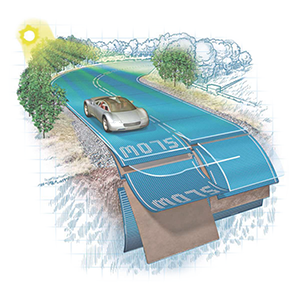
A solar roadway is a road surface, that generates electricity by solar photovoltaics. One current proposal is for panels including solar panels and LED signage, that can be driven on. Parking lots, driveways, and eventually highways are all targets for the panels. If the entire United States Interstate Highway system were surfaced with Solar Roadways panels, it would produce more than three times the amount of electricity currently used nationwide.
The United States Department of Transportation awarded Solar Roadways Incorporated a $100,000 research contract in 2009. This Small Business Innovation Research (SBIR) contract enabled Solar Roadways to prototype Solar Road Panels. After successful completion of the Phase I SBIR contract, it was awarded it a follow-up $750,000 Phase II contract to take it to the next step: a solar parking lot. Constructed out of multiple 12′ x 12′ panels, this smart parking lot will also warm itself in cold weather to melt away snow and ice.
read more »
Posted in Money, Politics, Technology |
1 Comment »
February 15, 2012
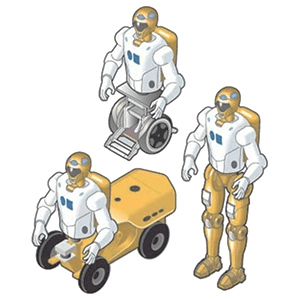
Robonaut is a humanoid robotic development project conducted by the Dextrous Robotics Laboratory at NASA’s Johnson Space Center (JSC) in Houston. Robonaut differs from other current space-faring robots (such as robotic arms, cranes and exploration rovers), which are designed to move large objects; Robonaut’s tasks require more dexterity. The core idea behind the Robonaut series is to have a humanoid machine work alongside astronauts. Its form factor and dexterity are designed such that Robonaut can use space tools and work in similar environments suited to astronauts.
The latest Robonaut version, R2, the first US-built robot on the ISS, delivered by the Space Shuttle in 2011, is a robotic torso designed to assist with crew EVA’s. However, Robonaut 2 does not have adequate protection needed to exist outside the space station and enhancements and modifications would be required to allow it to move around the station’s interior.
read more »
Posted in Money, Technology |
Leave a Comment »
February 15, 2012

The concept of Cool Japan, along with that of ‘Gross National Cool,’ was coined in 2002 as an expression of Japan’s emergent status as a cultural superpower. Gaining broad exposure in the media and academia, the brand of ‘Cool Japan’ has been adopted by the Japanese government as well as trade bodies seeking to exploit the commercial capital of the country’s culture industry. It has been described as a form of soft power, ‘the ability to indirectly influence behaviour or interests through cultural or ideological means.’
In a 2002 article in ‘Foreign Policy’ entitled ‘Japan’s Gross National Cool,’ Douglas McGray wrote of Japan ‘reinventing superpower’ as its cultural influence expanded internationally despite the economic and political problems of the ‘lost decade.’ Surveying youth culture and the role of manga, anime, fashion, film, consumer electronics, architecture, cuisine, J-pop, and phenomena of cuteness such as Hello Kitty, McGray highlighted Japan’s considerable soft power, posing the question of what message the country might project. He also argued that Japan’s recession may even have boosted its national cool, due to the partial discrediting of erstwhile rigid social hierarchies and big-business career paths.
Posted in Art, Money, World |
Leave a Comment »
February 15, 2012
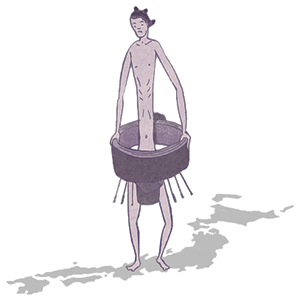
The Lost Decade is the time after the Japanese asset price bubble’s collapse within the Japanese economy, which occurred gradually rather than catastrophically. The term originally referred to the years 1991 to 2000, but recently the decade from 2001 to 2010 is also sometimes included, so that the whole period of the 1990s and 2000s is referred to as the Lost Decades or the Lost Years.
The strong economic growth of the 1980s ended abruptly at the start of the 1990s. In the late 1980s, abnormalities within the Japanese economic system had fueled a massive wave of speculation by Japanese companies, banks and securities companies. A combination of exceptionally high land values and exceptionally low interest rates briefly led to a position in which credit was both easily available and extremely cheap. This led to massive borrowing, the proceeds of which were invested mostly in domestic and foreign stocks and securities.
read more »
Posted in Money, Politics, World |
1 Comment »
February 14, 2012


A sockpuppet is an online identity used for purposes of deception. The term—a reference to the manipulation of a simple hand puppet made from a sock—originally referred to a false identity assumed by a member of an internet community who spoke to, or about himself while pretending to be another person.
The term now includes other uses of misleading online identities, such as those created to praise, defend or support a third party or organization. A significant difference between the use of a pseudonym and the creation of a sockpuppet is that the sockpuppet poses as an independent third-party unaffiliated with the puppeteer.
read more »
Posted in Language, Money, Technology |
2 Comments »
February 14, 2012

A shill, plant or stooge helps someone without disclosing that he or she has a close relationship with that person or organization. Shill typically refers to someone who purposely gives onlookers the impression that he or she is an enthusiastic independent customer of a seller that he or she is secretly working for. The person or group that hires the shill is using crowd psychology, to encourage other onlookers or audience members to make a purchase.
Shills are often employed by confidence artists. Plant and stooge more commonly refer to any person who is secretly in league with another person or organization while pretending to be neutral or actually a part of the organization he or she is planted in, such as a magician’s audience, a political party, or an intelligence organization (double agent).
read more »
Posted in Language, Money, Politics |
Leave a Comment »
February 13, 2012

Popular culture studies is the academic discipline studying popular culture from a critical theory perspective. It is generally considered as a combination of communication studies and cultural studies. Following the work of the Frankfurt School, popular culture has come to be taken more seriously as a terrain of academic inquiry and has also helped to change the outlooks of more established disciplines.
Conceptual barriers between so-called high and low culture have broken down, accompanying an explosion in scholarly interest in popular culture, which encompasses such diverse media as comic books, television, and the Internet. Reevaluation of mass culture in the 1970s and 1980s has revealed significant problems with the traditional view of mass culture as degraded and elite culture as uplifting. Divisions between high and low culture have been increasingly seen as political distinctions rather than defensible aesthetic or intellectual ones.
read more »
Posted in Education, Money, Politics |
Leave a Comment »
February 13, 2012


Culture industry is a term coined by critical theorists Theodor Adorno (1903–1969) and Max Horkheimer (1895–1973), who argued in the chapter of their book ‘Dialectic of Enlightenment, ‘The Culture Industry: Enlightenment as Mass Deception,’ that popular culture is akin to a factory producing standardized cultural goods – through film, radio and magazines – to manipulate the masses into passivity; the easy pleasures available through consumption of popular culture make people docile and content, no matter how difficult their economic circumstances.
Adorno and Horkheimer saw this mass-produced culture as a danger to the more difficult high arts. Culture industries may cultivate false needs; that is, needs created and satisfied by capitalism. True needs, in contrast, are freedom, creativity, or genuine happiness. This was reference to an earlier demarcation in needs by Herbert Marcuse.
read more »
Posted in Art, Money, Politics |
Leave a Comment »
February 10, 2012

‘Stevenote‘ is a colloquial term for the keynote speeches given by former Apple CEO Steve Jobs at events such as the Worldwide Developers Conference and previously the Macworld and Apple Expos. Jobs’ vibrant speaking style and manner of exciting the crowd was legendary. Because most Apple product releases were first revealed to the public in these keynotes, ‘Stevenotes’ often caused substantial swings in Apple’s stock price.
In late 1996, Apple purchased NeXT, and Steve Jobs returned to Apple after a 12-year hiatus following his forced resignation from the company in 1985. In mid-1997, he gave a keynote address in which he presented a detailed report on the company’s status. The keynote featured an appearance by Microsoft CEO Bill Gates by satellite. Jobs announced a partnership with Microsoft comprising several key agreements that, according to Jobs, would benefit Apple and allow it to recover from its prolonged decline during the early and mid 1990s.
read more »
Posted in Money, Technology |
Leave a Comment »
February 10, 2012

Reality distortion field (RDF) is a term coined by Bud Tribble (who still works at Apple) at Apple Computer in 1981, to describe company co-founder Steve Jobs’ charisma and its effects on the developers working on the Mac project. Tribble claimed that the term came from ‘Star Trek.’ Later the term has also been used to refer to perceptions of his keynote speeches (or ‘Stevenotes’) by observers and devoted users of Apple computers and products.
The RDF was said by Andy Hertzfeld (member of the original Apple team) to be Steve Jobs’ ability to convince himself and others to believe almost anything with a mix of charm, charisma, bravado, hyperbole, marketing, appeasement, and persistence. RDF was said to distort an audience’s sense of proportion and scales of difficulties and made them believe that the task at hand was possible. While RDF has been criticized as anti-reality, those close to Jobs have also illustrated numerous instances in which creating the sense that the seemingly impossible was possible led to the impossible being accomplished. Similarly, the optimism which Jobs sowed in those around him contributed to the loyalty of his colleagues and fans.
Posted in Humor, Money, Technology |
1 Comment »


 The Daily Omnivore