February 10, 2012

‘Stevenote‘ is a colloquial term for the keynote speeches given by former Apple CEO Steve Jobs at events such as the Worldwide Developers Conference and previously the Macworld and Apple Expos. Jobs’ vibrant speaking style and manner of exciting the crowd was legendary. Because most Apple product releases were first revealed to the public in these keynotes, ‘Stevenotes’ often caused substantial swings in Apple’s stock price.
In late 1996, Apple purchased NeXT, and Steve Jobs returned to Apple after a 12-year hiatus following his forced resignation from the company in 1985. In mid-1997, he gave a keynote address in which he presented a detailed report on the company’s status. The keynote featured an appearance by Microsoft CEO Bill Gates by satellite. Jobs announced a partnership with Microsoft comprising several key agreements that, according to Jobs, would benefit Apple and allow it to recover from its prolonged decline during the early and mid 1990s.
read more »
Posted in Money, Technology |
Leave a Comment »
February 10, 2012

Reality distortion field (RDF) is a term coined by Bud Tribble (who still works at Apple) at Apple Computer in 1981, to describe company co-founder Steve Jobs’ charisma and its effects on the developers working on the Mac project. Tribble claimed that the term came from ‘Star Trek.’ Later the term has also been used to refer to perceptions of his keynote speeches (or ‘Stevenotes’) by observers and devoted users of Apple computers and products.
The RDF was said by Andy Hertzfeld (member of the original Apple team) to be Steve Jobs’ ability to convince himself and others to believe almost anything with a mix of charm, charisma, bravado, hyperbole, marketing, appeasement, and persistence. RDF was said to distort an audience’s sense of proportion and scales of difficulties and made them believe that the task at hand was possible. While RDF has been criticized as anti-reality, those close to Jobs have also illustrated numerous instances in which creating the sense that the seemingly impossible was possible led to the impossible being accomplished. Similarly, the optimism which Jobs sowed in those around him contributed to the loyalty of his colleagues and fans.
Posted in Humor, Money, Technology |
1 Comment »
February 9, 2012

Ben Frost is an Australian visual artist who places common iconic images from advertising, entertainment, and politics into juxtapositions that are often confrontational and controversial. The collaborative exhibition ‘Colossus’ with Roderick Bunter in 2000 at the Institute of Modern Art in Brisbane featured a 12m x 2.4m mural by the artists, called ‘Where Do You Want To Go Today?’
Containing controversial imagery, including masturbating cartoon characters among a pastiche of advertising icons, the work was a statement on society’s continuing loss of innocence. In the final week of the exhibition, a disgruntled viewer entered the gallery and slashed one of the paintings with a knife.’ In 2005 he started the online art store and blog portal ‘Stupid Krap,’ which continues to support and represent a number of notable Australian emerging artists.
Posted in Art, Money |
Leave a Comment »
February 9, 2012
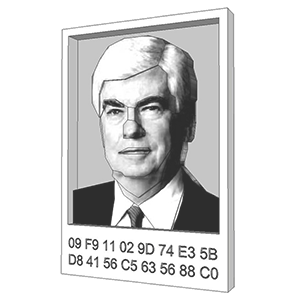
An illegal number is a number that represents information which is illegal to possess, utter or propagate. Any information that can be represented in binary format is representable as a number, and therefore if the information itself is illegal in some way, the pure number itself may be illegal. An illegal number may represent some type of classified information or trade secret, legal to possess only by certain authorized persons. An AACS encryption key that came to prominence in 2007 is an example of a number claimed to be a secret, and whose publication or inappropriate possession is claimed to be illegal in the United States. It allegedly assists in the decryption of any Blu-ray Disc.
As a protest of the DeCSS case, many people created ‘steganographic’ (hidden) versions of the illegal information. Dave Touretzky of Carnegie Mellon University created a ‘Gallery of DeCSS descramblers.’ In the AACS encryption key controversy, a ‘free speech flag’ was created. The illegal number was so short that a simple flag could be created by using the numbers as red-green-blue colors. The argument is that if short numbers can be made illegal, then anything based on those numbers also becomes illegal, like simple patterns of colors, etc.
Posted in Money, Politics, Technology |
1 Comment »
February 9, 2012

Prior art in most systems of patent law constitutes all information that has been made available to the public in any form before a given date that might be relevant to a patent’s claims of originality. If an invention has been described in prior art, a patent on that invention is not valid. Information kept secret, for instance, as a trade secret, is not usually prior art, provided that employees and others with access to the information are under a non-disclosure obligation. With such an obligation, the information will typically not be regarded as prior art. Therefore, a patent may be granted on an invention, although someone else already knew of the invention. A person who used an invention in secret may in some jurisdictions be able to claim ‘prior user rights’ and thereby gain the right to continue using the invention.
Prior art generally does not include unpublished work or mere conversations (though according to the European Patent Convention, oral disclosures also form prior art). It is disputed whether traditional knowledge (e.g., of medical properties of a certain plant) constitutes prior art. Patents disclose to society how an invention is practiced, in return for the right (during a limited term) to exclude others from manufacturing, selling, offering for sale or using the patented invention without the patentee’s licence. Patent offices deal with prior art searches in the context of the patent granting procedure. To assess the validity of a patent application, patent offices explore the prior art that was disclosed before the invention occurred (in the United States) or before the filing date (in the rest of the world).
Posted in Art, Money, Politics |
Leave a Comment »
February 9, 2012
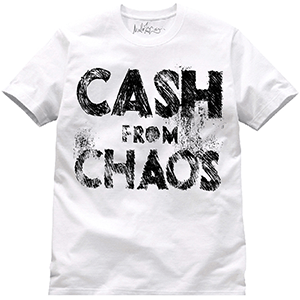
Malcolm McLaren (1946 – 2010) was an English performer, impresario, self-publicist and manager of the Sex Pistols and the New York Dolls. As a solo artist, McLaren had an innovative career that helped introduce hip hop to the United Kingdom.
About his contribution to music, McLaren has said about himself: ‘I have been called many things: a charlatan, a con man, or, most flatteringly, the culprit responsible for turning British popular culture into nothing more than a cheap marketing gimmick. This is my chance to prove that these accusations are true.’
read more »
Posted in Art, Money, World |
Leave a Comment »
February 9, 2012

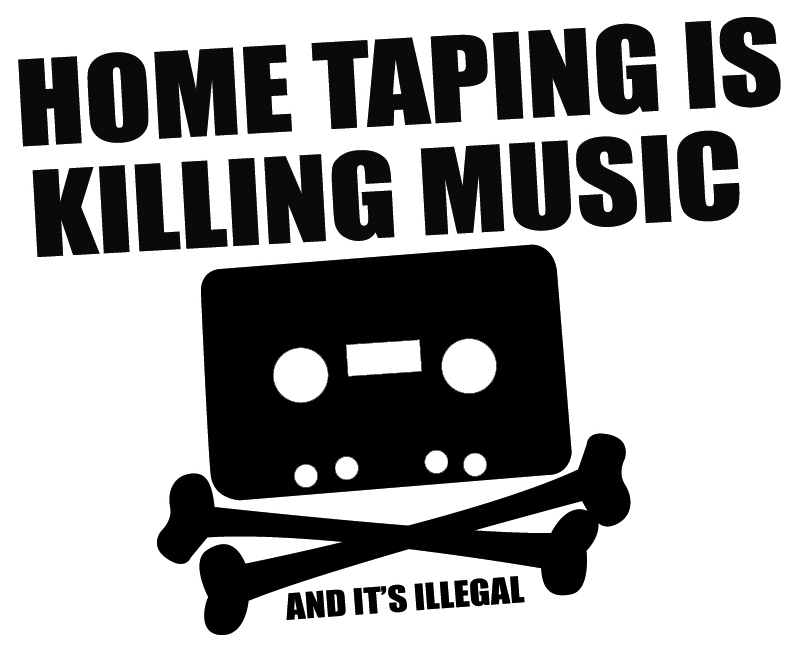
‘Home Taping Is Killing Music‘ was the slogan of a 1980s anti-copyright infringement campaign by the British Phonographic Industry (BPI), a British music industry trade group. With the rise in cassette recorder popularity, the BPI feared that people being able to record music from the radio onto cassettes would cause a decline in record sales. The logo, consisting of a Jolly Roger formed from the silhouette of a Compact Cassette, also included the words ‘And It’s Illegal.’ Similar rhetoric has continued; in 1982 Jack Valenti famously compared the VCR and its anticipated effect on the movie industry to the Boston Strangler, and in 2005 Mitch Bainwol of the RIAA claimed that CD burning is hurting music sales.
The slogan was often parodied, one example being the addendum ‘and it’s about time too!,’ used by Dutch anarcho-punk band The Ex. Another example was the early 1980s counter-slogan ‘Home Taping is Skill in Music,’ referring to early mixtapes, a precursor to sampling and remixes. In 1981 the Dead Kennedys printed ‘Home taping is killing record industry profits! We left this side blank so you can help’ on one side of their EP ‘In God We Trust, Inc.’ An early ‘proponent’ of home taping was Malcolm McLaren who was at the time managing the British band Bow Wow Wow. In 1980 the band released their single ‘C30, C60, C90 Go’ on a cassette that featured a blank other side that the buyer could record their own music on. The band’s record label, EMI, dropped the group shortly afterwards because the single allegedly promoted home taping.
Posted in Money, Politics, Technology |
Leave a Comment »
February 9, 2012

Don’t Copy That Floppy was an anti-copyright infringement campaign run by the Software Publishers Association (SPA) beginning in 1992.
The video for the campaign, starring M. E. Hart as ‘MC Double Def DP,’ was filmed at Cardozo High School in Washington, D.C. The commercial’s mention of the game ‘Tetris’ is ironic given the original version was copied and smuggled out of the Soviet Union then commercialized without any legal rights or payment to its creators (or to the Soviet Union, which had the copyrights of what its scientist produced).
Posted in Money, Politics, Technology |
Leave a Comment »
February 9, 2012

Dietrich Varez (b. 1939) is an iconoclastic printmaker-painter. His work is among the most widely-recognized of any artist in Hawaii. A long-time resident of the Big Island, he is known primarily for scenes of Hawaiian mythology and of traditional Hawaiian life and stylized designs from nature. The studio where Varez works and lives is in a rural forested area near the small town of Volcano, Hawaii a few miles from the entrance to Hawaii Volcanoes National Park.
He built the house himself after many years of living in tents or cabins on the land or in the Park. For most of his life there, he and his family have lived a self-sufficient pioneering life. They capture rainwater for their needs, and had no electricity for thirty years. The road to his home has been described as ‘barely passable.’ Varez and his wife rarely leave their homestead, virtually never travelling off-island.
read more »
Posted in Art, Money |
Leave a Comment »
February 8, 2012
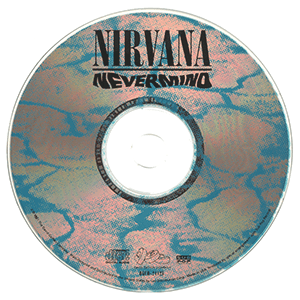
The pregap on a Red Book audio CD is the portion of the audio track that precedes ‘index 01’ for a given track in the table of contents (TOC). The pregap (‘index 00’) is typically two seconds long and usually, but not always, contains silence. Popular uses for having the pregap contain audio are live CDs, track interludes, and hidden songs in the pregap of the first track. On certain CDs, such as ‘Think Tank’ by Blur, the pregap contains a hidden track. The track is truly hidden in the sense that most conventional standalone players and software CD players will not see it. Such hidden tracks can be played by playing the first song and ‘rewinding’ (more accurately, seeking in reverse) until the actual start of the whole CD audio track. Not all CD drives can properly extract such hidden tracks. Some drives will report errors when reading these tracks, and some will seem to extract them properly, but the extracted file will contain only silence.
The pregap was used to hide computer data, tricking computers into detecting a data track whereas conventional CD players would continue to see the CD as an audio CD. This method was quickly made obsolete in late 1996 when an update to Windows 95 made the pregap track inaccessible. It is unclear whether or not this change in Microsoft Windows’ behavior was intentional: for instance, it may have been intended to steer developers away from the pregap method and encourage what became the Blue Book specification ‘CD Extra’ format.
Posted in Art, Money, Technology |
Leave a Comment »
February 8, 2012
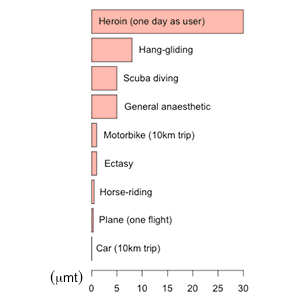
A micromort is a unit of risk measuring a one-in-a-million probability of death (from micro- and mortality). Micromorts can be used to measure riskiness of various day-to-day activities. A microprobability is a one-in-a million chance of some event; thus a micromort is the microprobability of death. The micromort concept was introduced by Ronald A. Howard who pioneered the modern practice of decision analysis.
An application of micromorts is measuring the value that humans place on risk: for example, one can consider the amount of money one would have to pay a person to get him or her to accept a one-in-a-million chance of death (or conversely the amount that someone might be willing to pay to avoid a one-in-a-million chance of death).
read more »
Posted in Death, Health, Money |
2 Comments »
February 8, 2012

Grigori Perelman (b. 1966) is a Russian mathematician who has made landmark contributions to geometry and topology (the study of geometric deformation). In 1992, Perelman proved the soul conjecture. In 2002, he proved Thurston’s geometrization conjecture. This consequently solved in the affirmative the Poincaré conjecture, posed in 1904, which before its solution was viewed as one of the most important and difficult open problems in topology.
In 2006, Perelman was awarded the Fields Medal, but declined to accept the award or to appear at the congress, stating: ‘I’m not interested in money or fame, I don’t want to be on display like an animal in a zoo.’ In 2010, it was announced that he had met the criteria to receive the first Clay Millennium Prize for resolution of the Poincaré conjecture. He turned down the prize ($1 million), saying that he considers his contribution to proving the Poincaré conjecture to be no greater than that of U.S. mathematician Richard Hamilton.
read more »
Posted in Education, Money, Science |
Leave a Comment »



 The Daily Omnivore