February 25, 2012
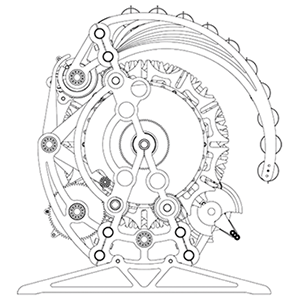
The Clock of the Long Now is a proposed mechanical clock designed to keep time for 10,000 years. The project to build it is part of the Long Now Foundation, a private organization that seeks to become the seed of a very long-term cultural institution. The project was conceived by American inventor Danny Hillis in 1986: ‘I want to build a clock that ticks once a year. The century hand advances once every one hundred years, and the cuckoo comes out on the millennium.I want the cuckoo to come out every millennium for the next 10,000 years.’
The first prototype of the clock began working on December 31, 1999, just in time to display the transition to the year 2000. At midnight on New Year’s Eve, the date indicator changed from 01999 to 02000, and the chime struck twice. That prototype, approximately two meters tall, is currently on display at the Science Museum in London. The first full-scale clock’s manufacture and site construction is being funded by Jeff Bezos, who has donated $42 million, and is located on his Texas land.
read more »
Posted in Money, Technology |
Leave a Comment »
February 25, 2012

Heroin chic was a look popularized in mid-1990s fashion and characterized by pale skin, dark circles underneath the eyes, and angular bone structure. This waifish, drug-addicted look was the basis of the 1993 advertising campaign of Calvin Klein featuring Kate Moss photographed by Vincent Gallo.
Emaciated features and androgyny were a reaction to ‘healthy’ and vibrant look of models such as Cindy Crawford, Claudia Schiffer, and Heidi Klum. A 1996 article in ‘The Los Angeles Times’ charged that the fashion industry had ‘a nihilistic vision of beauty’ that was reflective of drug addiction.
read more »
Posted in Art, Drugs, Money |
Leave a Comment »
February 25, 2012

Radical chic is a term coined by journalist Tom Wolfe in his 1970 essay ‘Radical Chic: That Party at Lenny’s,’ to describe the adoption and promotion of radical political causes by celebrities, socialites, and high society. The concept has been described as ‘an exercise in double-tracking one’s public image: on the one hand, defining oneself through committed allegiance to a radical cause, but on the other, vitally, demonstrating this allegiance because it is the fashionable, au courant way to be seen in moneyed, name-conscious Society.’
Unlike dedicated activists, revolutionaries, or dissenters, those who engage in radical chic remain frivolous political agitators. They are ideologically invested in their cause of choice only so far as it advances their social standing. ‘Terrorist chic’ is a modern expression with similar connotations. This derivative, however, de-emphasizes the class satire of Wolfe’s original term, instead accentuating concerns over the semiotics of radicalism (such as the aestheticization of violence).
read more »
Posted in Money, Politics |
Leave a Comment »
February 25, 2012

Moneybomb is a neologism coined in 2007 to describe a grassroots fundraising effort over a brief fixed time period, usually to support a candidate for election by dramatically increasing, concentrating, and publicizing fundraising activity during a specific hour or day. The term was first applied to a supporter-led fundraiser on behalf of presidential candidate Ron Paul.
The effort combines traditional and Internet-based fundraising appeals focusing especially on viral advertising through online vehicles such as YouTube, Facebook, and online forums. In the case of lesser-known candidates it is also intended to generate significant free mass media coverage the candidate would otherwise not receive. The term has also been used as a verb and apparently arose from analogy with the neologism ‘googlebomb,’ a method of search engine optimization.
Posted in Money, Politics, Technology |
Leave a Comment »
February 24, 2012
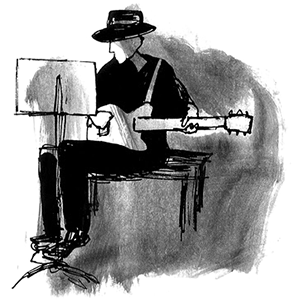
Outsider music, a term coined by music historian Irwin Chusid in the mid-1990s, are songs and compositions by musicians who are not part of the commercial music industry who write songs that ignore standard musical or lyrical conventions, either because they have no formal training or because they disagree with formal rules. This type of music, which often lacks typical structure and is emotionally stark, has few outlets; performers or recordings are often promoted by word of mouth or through fan chat sites, usually among communities of music collectors and music connoisseurs.
Outsider musicians usually have much ‘greater individual control over the final creative’ product either because of a low budget or because of their ‘inability or unwillingness to cooperate’ with modifications by a record label or producer. While a small number of outsider musicians became notable, such as Florence Foster Jenkins, an American soprano, the majority of outsider artists do not attain mainstream popularity.
read more »
Posted in Art, Language, Money |
1 Comment »
February 22, 2012
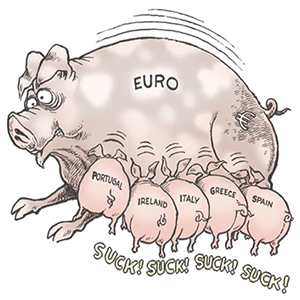
PIGS is a pejorative acronym used to refer to the economies of Portugal, Italy, Greece and Spain which are facing a financial crisis.
Since 2008, the term has included Ireland, either in place of Italy or with an additional I. Some news organizations have limited or banned use of the term because of criticism regarding perceived offensive connotations. The term has been used since at least the mid-1990s as an epithet.
Posted in Money, Politics, World |
1 Comment »
February 20, 2012


The Ren & Stimpy Show, often simply referred to as Ren & Stimpy, is an American animated television series, created by Canadian animator John Kricfalusi for Nickelodeon. The series focuses on the titular characters: Ren Höek, a psychotic chihuahua, and Stimpson J. Cat, a good-natured, dimwitted cat. The show premiered in 1991, on the same day as the debut of ‘Rugrats’ and ‘Doug,’ the three of which comprised the original Nicktoons. The show ran for five seasons on the network.
Throughout its run, the show was controversial for its off-color humor, black comedy, toilet humor, sexual innuendo, and violence, all of which contributed to the production staff’s altercations with Nickelodeon’s Standards and Practices department. The show developed a cult following during and after its run. It was pioneering for satirical animated shows like ‘Beavis and Butt-head’ and ‘South Park.’
read more »
Posted in Art, Humor, Money |
1 Comment »
February 20, 2012

George Liquor (often taking his epithet as George Liquor, American), most famous for his appearances on ‘The Ren and Stimpy Show,’ is a cartoon character created by John Kricfalusi and is a mascot for Kricfalusi’s defunct animation studio, Spümcø. Kricfalusi portrayed George Liquor as a patriotic, outspoken, politically conservative blowhard. Kricfalusi described Liquor as his favorite character to animate.
Kricfalusi described George Liquor as ‘the greatest American’ who is so conservative ‘that he thinks the Republicans are Commies.’ George harbors a deep antipathy for the political left; in one issue of Spümcø’s ‘Comic Book,’ George Liquor becomes enraged after a fish calls him a Democrat. George is a middle-aged, crass, religious, ultra-patriotic American who favors his nephew, Jimmy The Idiot Boy, and tries to teach Jimmy how to be ‘a Real Man.’
read more »
Posted in Art, Humor, Money |
Leave a Comment »
February 20, 2012


Michael John Kricfalusi [kris-fuh-loo-see] better known as John K., is a Canadian animator. He is creator of ‘The Ren & Stimpy Show,’ its adults-only spin-off ‘Ren & Stimpy ‘Adult Party Cartoon,” ‘The Ripping Friends’ animated series, and ‘Weekend Pussy Hunt,’ an interactive web-based cartoon, as well as the founder of animation studio Spümcø.
He spent his early childhood in Germany and Belgium, while his father served in the Canadian air force. At age seven he returned with his family to Canada. Having moved in the middle of a school season, he spent much of his time that year at home, watching Hanna-Barbera cartoons and drawing them. Kricfalusi’s interest in Golden Age animation crystallized during his stay at Sheridan College, where an acquaintance of his held weekly screenings of old films and cartoons, among them the cartoons of Bob Clampett and Tex Avery, which left a deep impression on him.
read more »
Posted in Art, Humor, Money |
Leave a Comment »
February 17, 2012
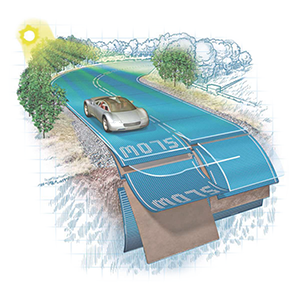
A solar roadway is a road surface, that generates electricity by solar photovoltaics. One current proposal is for panels including solar panels and LED signage, that can be driven on. Parking lots, driveways, and eventually highways are all targets for the panels. If the entire United States Interstate Highway system were surfaced with Solar Roadways panels, it would produce more than three times the amount of electricity currently used nationwide.
The United States Department of Transportation awarded Solar Roadways Incorporated a $100,000 research contract in 2009. This Small Business Innovation Research (SBIR) contract enabled Solar Roadways to prototype Solar Road Panels. After successful completion of the Phase I SBIR contract, it was awarded it a follow-up $750,000 Phase II contract to take it to the next step: a solar parking lot. Constructed out of multiple 12′ x 12′ panels, this smart parking lot will also warm itself in cold weather to melt away snow and ice.
read more »
Posted in Money, Politics, Technology |
1 Comment »
February 15, 2012
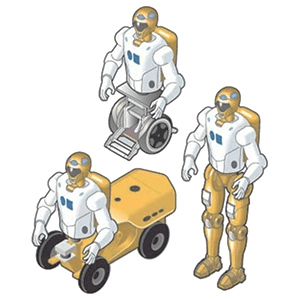
Robonaut is a humanoid robotic development project conducted by the Dextrous Robotics Laboratory at NASA’s Johnson Space Center (JSC) in Houston. Robonaut differs from other current space-faring robots (such as robotic arms, cranes and exploration rovers), which are designed to move large objects; Robonaut’s tasks require more dexterity. The core idea behind the Robonaut series is to have a humanoid machine work alongside astronauts. Its form factor and dexterity are designed such that Robonaut can use space tools and work in similar environments suited to astronauts.
The latest Robonaut version, R2, the first US-built robot on the ISS, delivered by the Space Shuttle in 2011, is a robotic torso designed to assist with crew EVA’s. However, Robonaut 2 does not have adequate protection needed to exist outside the space station and enhancements and modifications would be required to allow it to move around the station’s interior.
read more »
Posted in Money, Technology |
Leave a Comment »
February 15, 2012

The concept of Cool Japan, along with that of ‘Gross National Cool,’ was coined in 2002 as an expression of Japan’s emergent status as a cultural superpower. Gaining broad exposure in the media and academia, the brand of ‘Cool Japan’ has been adopted by the Japanese government as well as trade bodies seeking to exploit the commercial capital of the country’s culture industry. It has been described as a form of soft power, ‘the ability to indirectly influence behaviour or interests through cultural or ideological means.’
In a 2002 article in ‘Foreign Policy’ entitled ‘Japan’s Gross National Cool,’ Douglas McGray wrote of Japan ‘reinventing superpower’ as its cultural influence expanded internationally despite the economic and political problems of the ‘lost decade.’ Surveying youth culture and the role of manga, anime, fashion, film, consumer electronics, architecture, cuisine, J-pop, and phenomena of cuteness such as Hello Kitty, McGray highlighted Japan’s considerable soft power, posing the question of what message the country might project. He also argued that Japan’s recession may even have boosted its national cool, due to the partial discrediting of erstwhile rigid social hierarchies and big-business career paths.
Posted in Art, Money, World |
Leave a Comment »




