September 9, 2011
Laziness (also called indolence) is a disinclination to activity or exertion despite having the ability to do so. It is often used as a pejorative; related terms for a person seen to be lazy include couch potato, slacker, and in Australian slang, bludger.
Despite Sigmund Freud’s discussion of the pleasure principle, American psychologist Leonard Carmichael notes that ‘laziness is not a word that appears in the table of contents of most technical books on psychology… It is a guilty secret of modern psychology that more is understood about the motivation of thirsty rats and hungry pecking pigeons as they press levers or hit targets than is known about the way in which poets make themselves write poems or scientists force themselves into the laboratory when the good golfing days of spring arrive.’
read more »
Posted in Health, Language, Money |
Leave a Comment »
September 7, 2011

Hilti develops, manufactures, and markets products for the construction and building maintenance industries, primarily to the professional end-user. It concentrates primarily on hammer drills, firestops, and installation systems, but manufactures and markets an array of tools (including cordless electric drills, heavy angle drills, laser levels, power saws, and fasteners). Hilti is based in Liechtenstein, and is the principality’s largest employer. The company employs more than 20,000 people worldwide with over 2,500 employees in the United States. Hilti’s North American headquarters has been located in Tulsa, Oklahoma, since 1979.
The Hilti Group invests over US$160 million annually in researching and developing safer and more efficient building technologies. A recent example of this R&D in power tool technology is Hilti’s TPS (Theft Protection System), which relies on RF technology to prevent unauthorized users from activating power tools, thus discouraging theft. Similarly, Hilti’s ATC (Active Torque Control) technology monitors tool-body movement to prevent equipment from twisting out of the operator’s grip and causing injury. Other developments include improved design of chemical and mechanical anchors for better durability during seismic events, thus helping to save lives during natural disasters.
Posted in Money, Technology |
1 Comment »
September 7, 2011
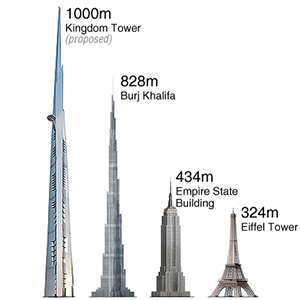
Kingdom Tower is a supertall skyscraper approved for construction in Jeddah, Saudi Arabia at a preliminary cost of US$1.23 billion. It will be the centerpiece and first phase of a US$20 billion proposed development known as Kingdom City that will be located along the Red Sea on the north side of Jeddah. If completed as planned, the tower will reach unprecedented heights, becoming the tallest building in the world, as well as the first structure to reach the one-kilometer mark. The design, created by American architect Adrian Smith, incorporates many unique structural and aesthetic features.
The creator and leader of the project is Saudi Arabian Prince Al-Waleed bin Talal, the wealthiest Arab in the Middle East, and nephew of King Abdullah. Talal is the chairman of Kingdom Holding Company (KHC), the largest company in Saudi Arabia, which owns the project, and a partner in Jeddah Economic Company (JEC), which was formed in 2009 for the development of Kingdom Tower and City. Reception of the proposal has been highly polarized, receiving high praise from some as a culturally significant icon that will symbolize the nation’s wealth and power, while others question its socioeconomic motives, and forecast that it will actually have negative financial consequences.
Posted in Money, Technology, World |
1 Comment »
September 7, 2011

Bowie Bonds are asset-backed securities of current and future revenues of the 25 albums (287 songs) that David Bowie recorded before 1990. Issued in 1997, the bonds were bought for US$55 million by the Prudential Insurance Company. The bonds paid an interest rate of 7.9% and had an average life of ten years. Royalties from the 25 albums generated the cash flow that secured the bonds’ interest payments. By forfeiting ten years worth of royalties, David Bowie was able to receive a payment of US$55 million up front. Bowie used this income to buy songs owned by his former manager.
The Bowie Bond issuance was perhaps the first instance of intellectual property rights securitization. The securitization of the collections of other artists, such as James Brown, Ashford & Simpson and the Isley Brothers, later followed. These Bonds are named Pullman Bonds after David Pullman, the banker who pushed the original Bowie deal. In March 2004, Moody’s Investors Service lowered the bonds from an A3 rating (the seventh highest rating) to Baa3, one notch above junk status. This downgrade was prompted by lower-than-expected revenue ‘due to weakness in sales for recorded music.’ A downgrade to an unnamed company that guarantees the issue was also cited as a reason for the downgrade. However, the success of Apple’s iTunes and other legal online music retailers has led to a renewed interest in Bowie and Pullman Bonds.
Posted in Art, Language, Money |
Leave a Comment »
September 7, 2011
Bubblegum is a type of elastic chewing gum, designed to be blown out of the mouth as a bubble. A 23-inch bubble blown by Susan Montgomery Williams of California in 1996 holds the Guinness World Record for largest bubble blown. Bubble gum was invented by Walter Diemer in 1928. Diemer was working as an accountant for the Fleer Chewing Gum Company in Philadelphia. In his spare time, he experimented with a new gum recipes. The gum he invented was less sticky than regular chewing gum, and stretched more easily. He sold his gum under the name Dubble Bubble in 1928. Original bubble gum was pink because that was the only dye Diemer had on hand at the time.
Bubblegum is available in many different colors and flavors. ‘Bubblegum flavor’ is the taste of the plain gum, an d it is made from synthetic chemicals, such as ethyl methylphenylglycidate, isoamyl acetate and others, and fruit extracts, the true ingredients being kept a mystery to customers. When blended, the chemicals and extracts fuse together to make a sweet, palatable flavor. Other flavors also include strawberry, apple, cherry, watermelon, cinnamon, banana, and grape. Strawberry and banana can be achieved with isoamyl acetate limonene and ethyl methylphenylglycidate, respectively. Malic acid can be used for apple flavor, allyl hexanoate for pineapple, ethyl propionate for fruit punch, cinnamic aldehyde for cinnamon, and acetophenone for cherry.
Posted in Food, Money |
Leave a Comment »
September 6, 2011

Unlike sunscreen but like tanning oil, indoor tanning lotions accelerate the tanning process, by promoting the production of melanin or by increasing blood flow to the skin, thereby increasing the amount of melanin that is brought to the top layers of the skin.
Indoor tanning lotions contain no sunscreen and offer no protection from the sun.
read more »
Posted in Health, Money |
Leave a Comment »
August 26, 2011

The Venus Project is an organization that advocates American futurist Jacque Fresco’s visions of the future with the aim of improving society by moving towards a global sustainable social design that they call a ‘resource-based economy.’ Such a system incorporates sustainable cities and values, energy efficiency, collective farms, natural resource management and advanced automation, focusing on the benefits they claim it will bring to humanity.
The name of the organization originates from Venus, Florida, where its research center is located, near Lake Okeechobee. Within the center are ten buildings, designed by Fresco, which showcase the architecture of the project.
read more »
Posted in Money, Politics, Technology |
Leave a Comment »
August 25, 2011

In decision making and psychology, decision fatigue refers to the deteriorating quality of decisions made by an individual, after a long session of decision making. It is now understood as one of the causes of irrational trade-offs in decision making. For instance, judges have been shown to make poorer decisions later in the day. Decision fatigue can not only results in fast and careless decisions, but even in decision paralysis where no decision is made at all. In the formal approach to decision quality management, specific techniques have been devised to help managers cope with decision fatigue.
Trade-offs, where either of two choices have positive and negative elements, are an advanced and energy consuming form of decision making. A person who is mentally depleted becomes reluctant to make trade-offs, or makes very poor choices. Jonathan Levav at Stanford University designed experiments showing how decision fatigue can leave a person vulnerable to sales and marketing strategies designed to time the sale.
read more »
Posted in Health, Money, Science |
Leave a Comment »
August 25, 2011

Snow Crash is Neal Stephenson’s third novel, published in 1992. Like many of Stephenson’s other novels it covers a large range of topics including: history, linguistics, anthropology, archaeology, religion, computer science, politics, cryptography, memetics, and philosophy. Stephenson explained the title of the novel in his 1999 essay ‘In the Beginning… was the Command Line’ as his term for a particular software failure mode on the early Apple Macintosh computer, ‘When the computer crashed and wrote gibberish into the bitmap, the result was something that looked vaguely like static on a broken television set — a ‘snow crash.”
The book presents the Sumerian language as the firmware programming language for the brainstem, which is supposedly functioning as the BIOS for the human brain. According to characters in the book, the semetic goddess Asherah is the personification of a ‘linguistic virus,’ similar to a computer virus. The Sumerian god Enki created a counter-program which he called a ‘nam-shub’ that caused all of humanity to speak different languages as a protection against Asherah (a re-interpretation of the ancient Near Eastern story of the Tower of Babel).
read more »
Posted in Art, Money, Technology |
Leave a Comment »
August 23, 2011

Infinite Jest is a 1996 novel by David Foster Wallace that presents a dystopian vision of North America in the near future. The intricate narrative treats elements as diverse as junior tennis, substance abuse and recovery programs, depression, child abuse, family relationships, advertising and popular entertainment, film theory, and Quebec separatism. The novel includes copious endnotes which explain or expound upon points in the story.
In an interview with Charlie Rose, Wallace characterized their use as a method of disrupting the linearity of the text while maintaining some sense of narrative cohesion. The novel’s title is from ‘Hamlet,’ who holds the skull of the court jester, Yorick, and says ‘Alas, poor Yorick! I knew him, Horatio: a fellow of infinite jest, of most excellent fancy: he hath borne me on his back a thousand times; and now, how abhorred in my imagination it is!’
read more »
Posted in Art, Language, Money |
Leave a Comment »
August 22, 2011

Georges Méliès [mey-lyes] (1861 – 1938) was a French filmmaker famous for leading many technical and narrative developments in the earliest cinema. He was very innovative in the use of special effects. He accidentally discovered the ‘stop trick,’ or substitution, in 1896, and was one of the first filmmakers to use multiple exposures, time-lapse photography, dissolves, and hand-painted color in his films. Because of his ability to seemingly manipulate and transform reality through cinematography, Méliès is sometimes referred to as the First ‘Cinemagician,’ and before making films, he was a stage magician at the Theatre Robert-Houdin.
His most famous film is ‘A Trip to the Moon’ (‘Le voyage dans la Lune’) made in 1902, which includes the celebrated scene in which a spaceship hits the eye of the man in the moon.
read more »
Posted in Art, Money, Technology |
Leave a Comment »
August 18, 2011

Alan Smithee was an official pseudonym used by film directors who wish to disown a project, coined in 1968. Until its use was formally discontinued in 2000, it was the sole pseudonym used by members of the Directors Guild of America (DGA) when a director dissatisfied with the final product proved to the satisfaction of a guild panel that he or she had not been able to exercise creative control over a film. The director was also required by guild rules not to discuss the circumstances leading to the move or even to acknowledge being the actual director.
Prior to 1968, DGA rules did not permit directors to be credited under a pseudonym. This was intended to prevent producers from forcing them upon directors, which would inhibit the development of their résumés. The guild also required that the director be credited, in support of the DGA philosophy that the director was the primary creative force behind a film.
read more »
Posted in Art, Humor, Money |
Leave a Comment »




 The Daily Omnivore