July 14, 2011
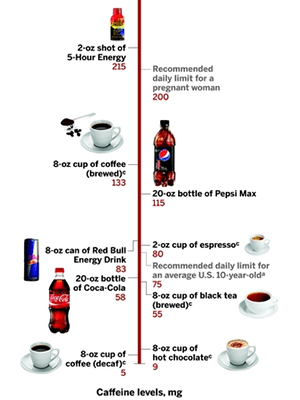
Energy shots are a specialized kind of energy drink. Sold in 59ml (2 fluid oz.) bottles, energy shots normally contain the same amount of caffeine, vitamins or other functional ingredients as their larger siblings, and therefore they may be considered concentrated forms of energy drinks. Also similar to energy drinks, energy shots contain caffeine, vitamins, and herbs such as guarana, ginseng or ginkgo biloba, taurine, maltodextrin, inositol, carnitine, creatine or glucuronolactone. Most energy shots contain sugar; however, many brands also offer artificially-sweetened ‘diet’ versions. The central ingredient in most energy shots is caffeine, the same stimulant found in coffee or tea. The average 50ml energy shot has about 80 mg of caffeine. This is approximately equivalent to a cup of coffee.
The idea of energy shots started decades ago in the Far East, notably in Japan, where small ‘tonics’ became very popular among consumers; they were highly concentrated and without carbonation. In 2004 the first suppliers, like 5-Hour Energy, Nitro2Go, and ZipFizz, took up the idea and launched these energy shots in the US, opening up a sub-segment in the energy drink market. Although originally marketed in the US, energy shots are becoming more popular in other parts of the world, like Europe, Asia and Australia.
Posted in Drugs, Health, Money |
Leave a Comment »
July 14, 2011
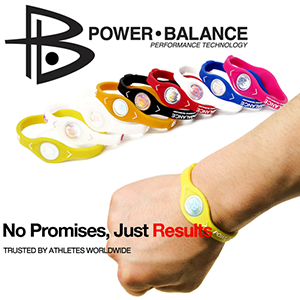
Hologram therapy is the pseudoscientific practice of adorning oneself with hologram jewelry for enhancement of athletic performance. Merchants claim it to be a method in alternative holistic medicine that can improve general physical fitness and athletic prowess. It centers around wearing plastic holograms purported to resonate with frequencies that react positively with the putative energy field of the human body.
Promoters borrow from concepts in crystal healing, vibrational medicine, energy medicine, and physics, but provide a sparse and disjointed scientific explanation. The holograms are printed on stickers, plastic wristbands, and pendants. Promoters rely heavily on the ritualistic superstition that often characterizes athletes.
Posted in Health, Money |
Leave a Comment »
July 14, 2011

The Big Green Egg is the brand name of a kamado-style ceramic charcoal cooker. Kamado barbecue originates in southern Japan. The kamado first came to the attention of Americans after World War II when US Air Force servicemen brought them back from Japan in empty transport planes. The Big Green Egg Company was founded in 1974 by Ed Fisher and is based in Georgia. The shape of the Egg is designed to contain the heat with only a small draft door at the bottom, and a daisy wheel damper unit on the top to give air flow control and therefore temperature regulation. Between the base and the lid is a felt gasket designed to maximize moisture retention during long cookouts.
Prices vary by model and start at approximately $700. Big Green Egg barbecues have quite an enthusiastic following of amateur chefs and the collective name given these enthusiasts is ‘Eggheads.’ Every October there is a global gathering called ‘Eggtoberfest’ held at the company’s headquarters in Tucker, GA. In addition, numerous other Big Green Egg Festivals occur throughout the US and the world, called ‘EggFests.’
Posted in Food, Money, Technology |
Leave a Comment »
July 13, 2011

Jordan Roseman aka DJ Earworm is a San Francisco/London-based mashup artist who has achieved recognition for his technically sophisticated, songwriting oriented music and video mashups. His annual ‘United State of Pop’ mashups, short mixes featuring the top 25 songs of the year according to Billboard magazine, have reached the Top 100 for national radio play. He began making mashups recreationally in 2003 using ACID (he announced in 2008 that he had switched to Abelton Live). After encouragement from DJ Adrian at Club Bootie, Roseman created the moniker DJ Earworm (‘earworm’ referencing a song that repeats uncontrollably in one’s mind) and began releasing mashups.
DJ Earworm has a unique mashup style that consists of a compositional, songwriting approach. He gradually layers samples on top of one another, matching keys and subtly altering melodies. His mashups often convey an entirely new meaning than the original material, such as a political message in ‘No More Gas.’ He has been contrasted with mashup artist Girl Talk, who has a more DJ-oriented style. He is the author of Audio Mashup Construction Kit (2006), a how-to manual for creating mashups.
Posted in Art, Money, Technology |
Leave a Comment »
July 13, 2011

Hustling is the deceptive act of disguising one’s skill in a sport or game with the intent of luring someone of lesser skill into gambling (or gambling for higher than current stakes) with the hustler, as a form of confidence trick. It is most commonly associated with pool, but also can be performed with regard to other sports and gambling activities. Hustlers may also engage in ‘sharking’ – distracting, disheartening, enraging or even threatening their opponents, to throw them off. Hustlers are thus often called ‘pool sharks.’
Professional and semi-pro hustlers sometimes work with a ‘stakehorse’ — a person who provides the money for the hustler to bet with (and who may assist in the hustling) — in exchange for a substantial portion of all winnings. Another form of hustling (often engaged in by the same hustlers who use the skill-disguising technique) is challenging ‘marks’ (swindle targets) to bet on trick shots that seem near-impossible but at which the hustler is exceptionally skilled.
read more »
Posted in Games, Language, Money |
Leave a Comment »
July 12, 2011

Artist’s Shit (Italian: ‘Merda d’artista’) is a 1961 artwork by the Italian artist Piero Manzoni. The work consists of 90 tin cans, each 30 grams, with a label in Italian, English, French, and German stating: ‘Artist’s Shit; Freshly preserved; Produced and tinned in May 1961.’ At the time the piece was created Manzoni was producing works that explored the relationship between art production and human production, Artist’s Breath (‘Fiato d’artista’), a series of balloons filled with Manzoni’s breath, being an example.
A tin was sold for €124,000 at Sotheby’s in 2007. The cans were originally to be valued according to their equivalent weight in gold — $37 each in 1961 — with the price fluctuating according to the market. One of Manzoni’s collaborators, Agostino Bonalumi, claimed that the tins are full not of faeces but plaster; but some cans have leaked and confirmed they are indeed faeces — though whether human or animal has not been verified.
Posted in Art, Humor, Money |
Leave a Comment »
July 12, 2011


Richard Kelly (b. 1975) is an American film director and writer. He won a scholarship to the University of Southern California to study at the USC School of Cinema-Television. He made two short films, ‘The Goodbye Place’ and ‘Visceral Matter,’ before graduating in 1997. His first feature film, ‘Donnie Darko’ (2001), a psychological thriller, was given a budget of just $4.5 million, received major critical acclaim. His fourth film, and second feature, ‘Southland Tales,’ (2006) is a science fiction dark comedy-drama, which was unsuccessful critically and financially. His most recent feature, ‘The Box’ (2009), is a psychological horror film.
Although Richard Kelly’s films differ considerably in setting and characters (‘Donnie Darko’ is about a suburban teenager, ‘Southland Tales’ is an L.A. epic, and ‘The Box’ is about a married couple in Richmond, Virginia), they share similar themes of time travel, existentialism, and spirituality. Kelly’s style is composed of Steadicam based tracking shots and camera movement in general, satirical elements (as seen sparsely in ‘Donnie Darko’ and much more prominently in ‘Southland Tales’), comedy, drama, and enigmatic plots. Music also plays a large role in Richard Kelly’s films; for example, the closing segment of ‘Donnie Darko’ is a montage of several characters awakening from their lucid dreams to Gary Jules’s version of the Tears for Fears song ‘Mad World.’
Posted in Art, Money |
1 Comment »
July 11, 2011

A MiniDisc (MD) is a magneto-optical disc-based data storage device initially intended for storage of up to 74 minutes and, later, 80 minutes, of digitized audio. In the form of Hi-MD, it has also developed into a general-purpose storage medium. MiniDisc was released in 1992, first in Japan, and then in Europe and the U.S. The music format was originally based exclusively on ATRAC audio data compression, but the option of linear PCM recording was later introduced to attain audio quality comparable to that of a compact disc.
Sony’s MiniDisc was one of two rival digital systems introduced in 1992, that were both targeted as a replacement for the Philips analog cassette audio tape system: the other was Digital Compact Cassette (DCC), created by Philips and Matsushita. Sony had originally intended for Digital Audio Tape (DAT) to be the dominant home digital audio recording format, replacing the analog cassette. Unfortunately, due to technical delays, DAT was not launched until 1989, and by then, the U.S. dollar had fallen so far in relation to the yen, the introductory DAT machine Sony had intended to market for about $400 in the late 1980s now had to retail for $800 or even $1000 to break even, putting it out of reach for most users. Relegating DAT for pro use, Sony immediately set to work to come up with a simpler, more economical digital home format.
read more »
Posted in Money, Technology, World |
Leave a Comment »
July 11, 2011

Turntable.fm was a social media website that allowed users to interactively share music. The site was run by Billy Chasen, who started it in January 2011 using revenue generated by his previous start-up. The service allowed users to create ‘rooms,’ which other users could join. Designated users, so-called ‘DJs,’ chose songs to be played to everyone in that room, while all users were able to talk with one another through a text interface.
The service opened to the public in May 2011, and by late June had already reached 140,000 active users. The company used the Digital Millennium Copyright Act to license the music that was played on the website; because of this, only individuals from the US were allowed to use the service.
Posted in Games, Money, Technology |
Leave a Comment »
July 9, 2011
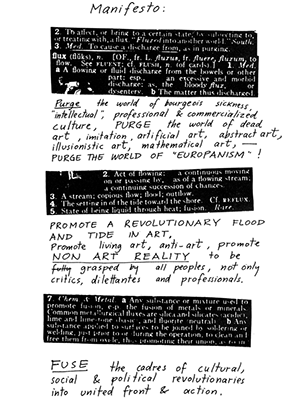
Fluxus—a name taken from a Latin word meaning ‘to flow’—is an international network of artists, composers and designers noted for blending different artistic media and disciplines in the 1960s. They have been active in Neo-Dada noise music and visual art as well as literature, urban planning, architecture, and design. Fluxus is sometimes described as intermedia.
The origins of Fluxus lie in many of the concepts explored by composer John Cage in his experimental music of the 1950s. Cage explored notions of indeterminacy in art, through works such as ‘4’ 33″,’ which influenced Lithuanian-born artist George Maciunas. Maciunas (1931–1978) organized the first Fluxus event in 1961 at the AG Gallery in New York City and the first Fluxus festivals in Europe in 1962.
read more »
Posted in Art, Language, Money |
Leave a Comment »
July 8, 2011

A perverse incentive is an incentive that has an unintended and undesirable result which is contrary to the interests of the incentive makers. Perverse incentives are a type of unintended consequences. For example, 19th century palaeontologists traveling to China used to pay peasants for each fragment of dinosaur bone (dinosaur fossils) that they produced. They later discovered that the peasants dug up the bones and then smashed them into many pieces, greatly reducing their scientific value, to maximise their payments. In Hanoi, under French colonial rule, a program paying people a bounty for each rat pelt handed in was intended to exterminate rats. Instead, it led to the farming of rats. Funding fire departments by the number of fire calls made is intended to reward the fire departments that do the most work. However, it may discourage them from fire-prevention activities, which reduce the number of fires.
In 1696, the English Parliament adopted a tax under which dwellings were to be assessed according their number of windows. Although the tax was intended to be progressive in that it exempted houses with fewer than ten windows from the bulk of the assessment, in operation it exacerbated the gap in living conditions between rich and poor as landlords were incentivized to brick up tenement windows to reduce their tax liability, leaving working-class tenants with insufficient light and ventilation. In 2007, the Bangkok, Thailand police switched to punitive pink armbands adorned with the cute Hello Kitty cartoon character when the tartan armbands that had been intended to be worn as a badge of shame for minor infractions were instead treated as collectibles by offending officers forced to wear them.
Posted in Language, Money, Politics |
Leave a Comment »
July 8, 2011


The cobra effect occurs when the solution to a problem, makes the problem worse. The term is used to illustrate the causes of wrong stimulation in economy and politics. The term stems from an anecdote set at the time of British rule of colonial India. The British government was concerned about the number of venomous cobra snakes. The Government therefore offered a reward for every dead snake. Initially this was a successful strategy as large numbers of snakes were killed for the reward. Eventually however the Indians began to breed cobras for the income.
When this was realized the reward was canceled, but the cobra breeders set the snakes free and the wild cobras consequently multiplied. The apparent solution for the problem made the situation even worse. A similar incident occurred in Hanoi, under French colonial rule, where a program paying people a bounty for each rat pelt handed in was intended to exterminate rats. Instead, it led to the farming of rats.
Posted in Humor, Money, Politics |
1 Comment »


 The Daily Omnivore