July 12, 2011

Artist’s Shit (Italian: ‘Merda d’artista’) is a 1961 artwork by the Italian artist Piero Manzoni. The work consists of 90 tin cans, each 30 grams, with a label in Italian, English, French, and German stating: ‘Artist’s Shit; Freshly preserved; Produced and tinned in May 1961.’ At the time the piece was created Manzoni was producing works that explored the relationship between art production and human production, Artist’s Breath (‘Fiato d’artista’), a series of balloons filled with Manzoni’s breath, being an example.
A tin was sold for €124,000 at Sotheby’s in 2007. The cans were originally to be valued according to their equivalent weight in gold — $37 each in 1961 — with the price fluctuating according to the market. One of Manzoni’s collaborators, Agostino Bonalumi, claimed that the tins are full not of faeces but plaster; but some cans have leaked and confirmed they are indeed faeces — though whether human or animal has not been verified.
Posted in Art, Humor, Money |
Leave a Comment »
July 12, 2011


Richard Kelly (b. 1975) is an American film director and writer. He won a scholarship to the University of Southern California to study at the USC School of Cinema-Television. He made two short films, ‘The Goodbye Place’ and ‘Visceral Matter,’ before graduating in 1997. His first feature film, ‘Donnie Darko’ (2001), a psychological thriller, was given a budget of just $4.5 million, received major critical acclaim. His fourth film, and second feature, ‘Southland Tales,’ (2006) is a science fiction dark comedy-drama, which was unsuccessful critically and financially. His most recent feature, ‘The Box’ (2009), is a psychological horror film.
Although Richard Kelly’s films differ considerably in setting and characters (‘Donnie Darko’ is about a suburban teenager, ‘Southland Tales’ is an L.A. epic, and ‘The Box’ is about a married couple in Richmond, Virginia), they share similar themes of time travel, existentialism, and spirituality. Kelly’s style is composed of Steadicam based tracking shots and camera movement in general, satirical elements (as seen sparsely in ‘Donnie Darko’ and much more prominently in ‘Southland Tales’), comedy, drama, and enigmatic plots. Music also plays a large role in Richard Kelly’s films; for example, the closing segment of ‘Donnie Darko’ is a montage of several characters awakening from their lucid dreams to Gary Jules’s version of the Tears for Fears song ‘Mad World.’
Posted in Art, Money |
1 Comment »
July 11, 2011

A MiniDisc (MD) is a magneto-optical disc-based data storage device initially intended for storage of up to 74 minutes and, later, 80 minutes, of digitized audio. In the form of Hi-MD, it has also developed into a general-purpose storage medium. MiniDisc was released in 1992, first in Japan, and then in Europe and the U.S. The music format was originally based exclusively on ATRAC audio data compression, but the option of linear PCM recording was later introduced to attain audio quality comparable to that of a compact disc.
Sony’s MiniDisc was one of two rival digital systems introduced in 1992, that were both targeted as a replacement for the Philips analog cassette audio tape system: the other was Digital Compact Cassette (DCC), created by Philips and Matsushita. Sony had originally intended for Digital Audio Tape (DAT) to be the dominant home digital audio recording format, replacing the analog cassette. Unfortunately, due to technical delays, DAT was not launched until 1989, and by then, the U.S. dollar had fallen so far in relation to the yen, the introductory DAT machine Sony had intended to market for about $400 in the late 1980s now had to retail for $800 or even $1000 to break even, putting it out of reach for most users. Relegating DAT for pro use, Sony immediately set to work to come up with a simpler, more economical digital home format.
read more »
Posted in Money, Technology, World |
Leave a Comment »
July 11, 2011

Turntable.fm was a social media website that allowed users to interactively share music. The site was run by Billy Chasen, who started it in January 2011 using revenue generated by his previous start-up. The service allowed users to create ‘rooms,’ which other users could join. Designated users, so-called ‘DJs,’ chose songs to be played to everyone in that room, while all users were able to talk with one another through a text interface.
The service opened to the public in May 2011, and by late June had already reached 140,000 active users. The company used the Digital Millennium Copyright Act to license the music that was played on the website; because of this, only individuals from the US were allowed to use the service.
Posted in Games, Money, Technology |
Leave a Comment »
July 9, 2011
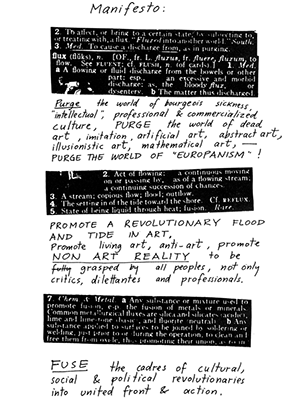
Fluxus—a name taken from a Latin word meaning ‘to flow’—is an international network of artists, composers and designers noted for blending different artistic media and disciplines in the 1960s. They have been active in Neo-Dada noise music and visual art as well as literature, urban planning, architecture, and design. Fluxus is sometimes described as intermedia.
The origins of Fluxus lie in many of the concepts explored by composer John Cage in his experimental music of the 1950s. Cage explored notions of indeterminacy in art, through works such as ‘4’ 33″,’ which influenced Lithuanian-born artist George Maciunas. Maciunas (1931–1978) organized the first Fluxus event in 1961 at the AG Gallery in New York City and the first Fluxus festivals in Europe in 1962.
read more »
Posted in Art, Language, Money |
Leave a Comment »
July 8, 2011

A perverse incentive is an incentive that has an unintended and undesirable result which is contrary to the interests of the incentive makers. Perverse incentives are a type of unintended consequences. For example, 19th century palaeontologists traveling to China used to pay peasants for each fragment of dinosaur bone (dinosaur fossils) that they produced. They later discovered that the peasants dug up the bones and then smashed them into many pieces, greatly reducing their scientific value, to maximise their payments. In Hanoi, under French colonial rule, a program paying people a bounty for each rat pelt handed in was intended to exterminate rats. Instead, it led to the farming of rats. Funding fire departments by the number of fire calls made is intended to reward the fire departments that do the most work. However, it may discourage them from fire-prevention activities, which reduce the number of fires.
In 1696, the English Parliament adopted a tax under which dwellings were to be assessed according their number of windows. Although the tax was intended to be progressive in that it exempted houses with fewer than ten windows from the bulk of the assessment, in operation it exacerbated the gap in living conditions between rich and poor as landlords were incentivized to brick up tenement windows to reduce their tax liability, leaving working-class tenants with insufficient light and ventilation. In 2007, the Bangkok, Thailand police switched to punitive pink armbands adorned with the cute Hello Kitty cartoon character when the tartan armbands that had been intended to be worn as a badge of shame for minor infractions were instead treated as collectibles by offending officers forced to wear them.
Posted in Language, Money, Politics |
Leave a Comment »
July 8, 2011


The cobra effect occurs when the solution to a problem, makes the problem worse. The term is used to illustrate the causes of wrong stimulation in economy and politics. The term stems from an anecdote set at the time of British rule of colonial India. The British government was concerned about the number of venomous cobra snakes. The Government therefore offered a reward for every dead snake. Initially this was a successful strategy as large numbers of snakes were killed for the reward. Eventually however the Indians began to breed cobras for the income.
When this was realized the reward was canceled, but the cobra breeders set the snakes free and the wild cobras consequently multiplied. The apparent solution for the problem made the situation even worse. A similar incident occurred in Hanoi, under French colonial rule, where a program paying people a bounty for each rat pelt handed in was intended to exterminate rats. Instead, it led to the farming of rats.
Posted in Humor, Money, Politics |
1 Comment »
July 8, 2011
Beatnik [beet-nik] was a media stereotype of the 1950s and early 1960s that displayed the more superficial aspects of the Beat Generation literary movement of the 1950s and violent film images, along with a cartoonish misrepresentation of the real-life people and the spirituality found in Jack Kerouac’s autobiographical fiction. Kerouac spoke out against this detour from his original concept.
Kerouac introduced the phrase ‘Beat Generation’ in 1948, generalizing from his social circle to characterize the underground, anti-conformist youth gathering in New York at that time. The name came up in conversation with the novelist John Clellon Holmes who published an early Beat Generation novel, ‘Go’ (1952), along with a manifesto in The New York Times Magazine: ‘This Is the Beat Generation.’
read more »
Posted in Language, Money, Politics |
Leave a Comment »
July 7, 2011
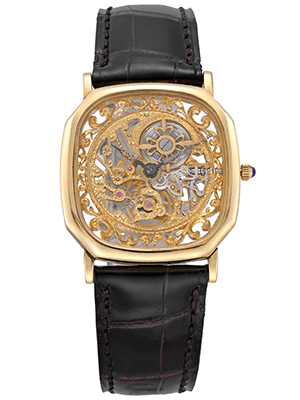
A skeleton watch is a mechanical watch (although occasionally quartz), in which all of the moving parts are visible through either the front of the watch, the back of the watch or a small cut outlining the dial.
Many watchmakers have skeleton watches, but Rolex has rarely made them (apart from the 1930s and early 1940s) and never made tourbillon skeletons. For this reason, one should exercise caution when buying a skeleton watch marked as a Rolex as it is likely a counterfeit.
Posted in Money, Technology |
Leave a Comment »
July 7, 2011

Audemars [awe-de-marr] Piguet [pee-gay] (AP) is a manufacturer of prestige Swiss watches which compete with Patek Philippe and Vacheron Constantin. The roots of the company date back to 1874, when the 23-year-old Jules-Louis Audemars met Edward-Auguste Piguet, then only 21, at Vallée de Joux, in western Switzerland, which is considered to be the cradle of prestige watch-making. Thus Audemars started producing component parts for movements and Piguet got the job of a repasseur, whose job it was to make the final regulation of the timepiece.
In 1875 they founded a firm later known as Audemars, Piguet et Cie, and since 1882, members of the Audemars and Piguet families have always been on the board of directors. Between 1894 and 1899 the company produced about 1,200 timepieces, including some very complex watches. When Audemars and Piguet died, in 1918 and 1919 respectively, the company was already quite famous. As the success of the company’s business was rising its customers became Tiffany & Co, Cartier and Bulgari, who rebranded and sold Audemars Piguet watches under their own house names. Today these watches are only identifiable as Audemars Piguet products by their serial numbers.
read more »
Posted in Money, Technology |
Leave a Comment »
July 7, 2011

Club 33 is a private club located in the heart of the New Orleans Square section of Disneyland. Officially maintained as a secret feature of the theme park, the entrance of the club is located next to the Blue Bayou Restaurant at ’33 Royal Street’ with the entrance recognizable by an ornate address plate with the number 33 engraved on it. Club 33 members and their guests have exclusive access to the club’s restaurant, and the premises are not open to the public at large. It is the only location within Disneyland to offer alcoholic beverages.
Members get free access to both Disney parks whenever they are open, plus early park admission several days each week. In addition, members are provided with valet parking to the overall Disney resort and access to Lilly Belle, the presidential caboose car on the Disneyland Railroad.
read more »
Posted in Food, Money |
Leave a Comment »
July 5, 2011

Granny Takes a Trip was a boutique opened in 1966 in Chelsea, London. The shop remained open until the mid-70s and has been called the ‘first psychedelic boutique in the ‘Swinging London’ in the 1960s.” It was also the name of a Purple Gang song of the 1960s named after the store and banned by the BBC.
The boutique was the brainchild of two young Londoners, Nigel Waymouth and Sheila Cohen, who were looking for an outlet for Cohen’s ever-increasing collection of antique clothes. By the spring of 1966 the shop had achieved worldwide renown. They paved the way for many of the designer boutiques that followed, such as Mr. Freedom, Alkasura, Let It Rock, and later the more ambitious enterprises of Malcolm McLaren and Vivienne Westwood and Paul Smith.
read more »
Posted in Art, Money, World |
Leave a Comment »