July 20, 2011

Dippin’ Dots is an ice cream snack, invented by Curt Jones in 1987. The confection is created by flash freezing ice cream mix in liquid nitrogen; consequently, Dippin’ Dots contain less air than conventional ice cream. The resulting small spheres of ice cream are stored at temperatures ranging from -70 to -20 °F (from -57 °C to -29 °C). The marketing slogan is ‘Ice Cream of the Future.’ The company, headquartered in Paducah, Kentucky, United recently began selling its product in supermarkets in the United States. Dippin’ Dots are sold in individual servings at franchised outlets, many in theme parks, stadiums, shopping malls, and in vending machines.
Several competing beaded ice-cream lines have been introduced in recent years. Some of these competing brands are similar to Dippin’ Dots in shape or size, yet differ in that they use dairy stabilizers and artificial sweeteners, in an effort to keep the beads from adhering to one another. Dippin’ Dots, made from conventional ice cream ingredients, are held at sub-zero temperatures to keep the beads separate and free-flowing.
Posted in Food, Money, Technology |
1 Comment »
July 20, 2011

El Bulli is a molecular gastronomy restaurant near the town of Roses, Spain (near the French border), run by chef Ferran Adrià. In early 2011, management announced that the restaurant would close that summer to reopen as a creativity center in 2014. Its main objective is to be a think-tank for creative cuisine and gastronomy and will managed by a private foundation. The former restaurant accommodated only 8,000 diners a season, but received more than two million requests. The average cost of a meal was €250. The restaurant itself operated at a loss since 2000, with operating profit coming from El Bulli-related books and lectures by Adrià. The location was selected in 1961 by Dr Hans Schilling, a German, and his Czech wife Marketta, who wanted a restaurant for a piece of land he had purchased. The name ‘El Bulli’ came from the French bulldogs the Schillings owned.
The first restaurant was opened in 1964. Ferran Adrià joined the staff in 1984, and was put in sole charge of the kitchen in 1987. In 1990 the restaurant gained its second Michelin star, and in 1997 its third. Menu items have included melon with ham, pine nut marshmallows, steamed brioche with rose-scented mozzarella, rock mussels with seaweed and fresh herbs, and passion fruit trees. Texturas is a range of products by Adrià and his brother Albert. Texturas include products such as Xanthan and Algin. Xanthan gum allows the user to use a very small amount to thicken soups, sauces and creams without changing the flavor. Algin is a key component of the ‘Spherification Kit’ and is essential for every spherical preparation: caviar, raviolis, balloons, gnocchi, pellets, and mini-spheres.
Posted in Food, Money, Technology |
Leave a Comment »
July 20, 2011

The Cessna 172 Skyhawk is a four-seat, single-engine, high-wing, fixed-wing aircraft. First flown in 1955 and still in production, more Cessna 172s have been built than any other aircraft.
Measured by its longevity and popularity, the Cessna 172 is the most successful mass produced light aircraft in history. The first production models were delivered in 1956 and they are still in production. As of 2008, more than 43,000 had been built.
Posted in Money, Technology |
Leave a Comment »
July 19, 2011


The Bristol underground scene is a term used to describe the culture surrounding trip hop, drum and bass and graffiti art that has existed in Bristol from the early 1990s to the present. The city of Bristol in the UK has spawned various musicians and artists, and is typified by its urban culture. While the city is most associated with a group of artists who emerged during the 1990s, especially the ‘Bristol Sound’, the city maintains an active and diverse underground urban scene.
The city has been particularly associated with trip hop. Trip hop was spawned in ‘the bohemian, multi-ethnic city of Bristol, where restlessly inventive DJs had spent years assembling samples of various sounds that were floating around: groove-heavy acid jazz, dub reggae, neo-psychedelia, techno disco music, and the brainy art rap.’
read more »
Posted in Art, Money, World |
Leave a Comment »
July 19, 2011
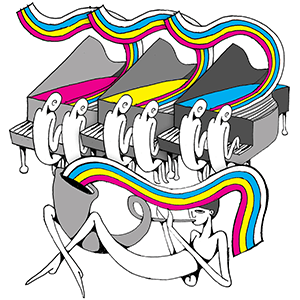
Teknivals (a portmanteau of ‘tekno’ and ‘festival’) are large free parties which take place worldwide. They take place most often in Europe and are often illegal under various national or regional laws. They vary in size from dozens to thousands of people, depending on factors such as accessibility, reputation, weather, and law enforcement.
The parties often take place in venues far away from residential areas such as squatted warehouses, empty military bases, forests or fields. The teknival phenomenon is a grassroots movement which has grown out of the rave, New Age Traveller and Burning Man scenes and spawned an entire subculture. Summer is the usual season for teknivals.
read more »
Posted in Art, Money, World |
Leave a Comment »
July 18, 2011
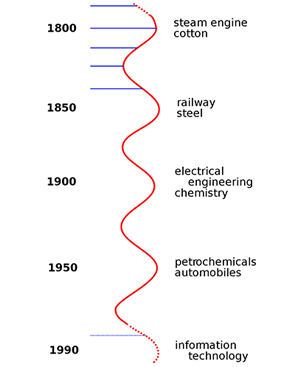
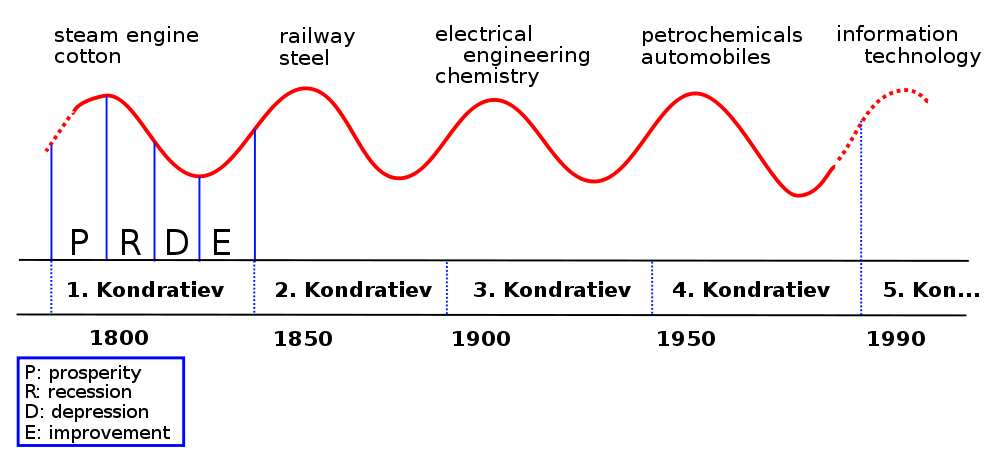
Kondratiev waves (also called supercycles, great surges, or long waves) are described as sinusoidal-like cycles in the modern capitalist world economy. Averaging fifty and ranging from approximately forty to sixty years in length, the cycles consist of alternating periods between high sectoral growth and periods of relatively slow growth. Unlike the short-term business cycle, the long wave of this theory is not accepted by current mainstream economics.
Russian economist Nikolai Kondratiev (1892 – 1938) was the first to bring these observations to international attention in his book ‘The Major Economic Cycles’ (1925). Kondratiev was a Russian economist, but his economic conclusions were disliked by the Soviet leadership and upon their release he was quickly dismissed from his post as director of the Institute for the Study of Business Activity in the Soviet Union in 1928. His conclusions were seen as a criticism of Joseph Stalin’s intentions for the Soviet economy. As a result he was sentenced to the Soviet Gulag and later received the death penalty in 1938.
read more »
Posted in Money, Technology, World |
Leave a Comment »
July 14, 2011

Ray Kurzweil (b. 1948) is an American author, inventor and futurist. He is involved in fields such as optical character recognition (OCR), text-to-speech synthesis, speech recognition technology, and electronic keyboard instruments. He is the author of several books on health, artificial intelligence (AI), transhumanism, the technological singularity, and futurism.
Ray Kurzweil grew up in Queens, NY. He was born to secular Jewish parents who had escaped Austria just before the onset of World War II, and he was exposed via Unitarian Universalism to a diversity of religious faiths during his upbringing. His father was a musician and composer and his mother was a visual artist. His uncle, an engineer at Bell Labs, taught young Ray the basics of computer science.
read more »
Posted in Language, Money, Technology |
1 Comment »
July 14, 2011
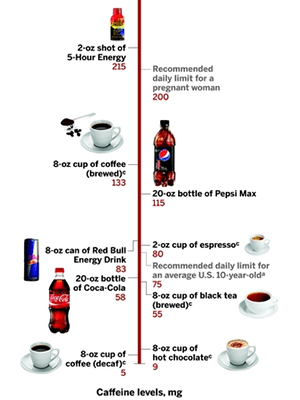
Energy shots are a specialized kind of energy drink. Sold in 59ml (2 fluid oz.) bottles, energy shots normally contain the same amount of caffeine, vitamins or other functional ingredients as their larger siblings, and therefore they may be considered concentrated forms of energy drinks. Also similar to energy drinks, energy shots contain caffeine, vitamins, and herbs such as guarana, ginseng or ginkgo biloba, taurine, maltodextrin, inositol, carnitine, creatine or glucuronolactone. Most energy shots contain sugar; however, many brands also offer artificially-sweetened ‘diet’ versions. The central ingredient in most energy shots is caffeine, the same stimulant found in coffee or tea. The average 50ml energy shot has about 80 mg of caffeine. This is approximately equivalent to a cup of coffee.
The idea of energy shots started decades ago in the Far East, notably in Japan, where small ‘tonics’ became very popular among consumers; they were highly concentrated and without carbonation. In 2004 the first suppliers, like 5-Hour Energy, Nitro2Go, and ZipFizz, took up the idea and launched these energy shots in the US, opening up a sub-segment in the energy drink market. Although originally marketed in the US, energy shots are becoming more popular in other parts of the world, like Europe, Asia and Australia.
Posted in Drugs, Health, Money |
Leave a Comment »
July 14, 2011

Hologram therapy is the pseudoscientific practice of adorning oneself with hologram jewelry for enhancement of athletic performance. Merchants claim it to be a method in alternative holistic medicine that can improve general physical fitness and athletic prowess. It centers around wearing plastic holograms purported to resonate with frequencies that react positively with the putative energy field of the human body.
Promoters borrow from concepts in crystal healing, vibrational medicine, energy medicine, and physics, but provide a sparse and disjointed scientific explanation. The holograms are printed on stickers, plastic wristbands, and pendants. Promoters rely heavily on the ritualistic superstition that often characterizes athletes.
Posted in Health, Money |
Leave a Comment »
July 14, 2011

The Big Green Egg is the brand name of a kamado-style ceramic charcoal cooker. Kamado barbecue originates in southern Japan. The kamado first came to the attention of Americans after World War II when US Air Force servicemen brought them back from Japan in empty transport planes. The Big Green Egg Company was founded in 1974 by Ed Fisher and is based in Georgia. The shape of the Egg is designed to contain the heat with only a small draft door at the bottom, and a daisy wheel damper unit on the top to give air flow control and therefore temperature regulation. Between the base and the lid is a felt gasket designed to maximize moisture retention during long cookouts.
Prices vary by model and start at approximately $700. Big Green Egg barbecues have quite an enthusiastic following of amateur chefs and the collective name given these enthusiasts is ‘Eggheads.’ Every October there is a global gathering called ‘Eggtoberfest’ held at the company’s headquarters in Tucker, GA. In addition, numerous other Big Green Egg Festivals occur throughout the US and the world, called ‘EggFests.’
Posted in Food, Money, Technology |
Leave a Comment »
July 13, 2011

Jordan Roseman aka DJ Earworm is a San Francisco/London-based mashup artist who has achieved recognition for his technically sophisticated, songwriting oriented music and video mashups. His annual ‘United State of Pop’ mashups, short mixes featuring the top 25 songs of the year according to Billboard magazine, have reached the Top 100 for national radio play. He began making mashups recreationally in 2003 using ACID (he announced in 2008 that he had switched to Abelton Live). After encouragement from DJ Adrian at Club Bootie, Roseman created the moniker DJ Earworm (‘earworm’ referencing a song that repeats uncontrollably in one’s mind) and began releasing mashups.
DJ Earworm has a unique mashup style that consists of a compositional, songwriting approach. He gradually layers samples on top of one another, matching keys and subtly altering melodies. His mashups often convey an entirely new meaning than the original material, such as a political message in ‘No More Gas.’ He has been contrasted with mashup artist Girl Talk, who has a more DJ-oriented style. He is the author of Audio Mashup Construction Kit (2006), a how-to manual for creating mashups.
Posted in Art, Money, Technology |
Leave a Comment »
July 13, 2011

Hustling is the deceptive act of disguising one’s skill in a sport or game with the intent of luring someone of lesser skill into gambling (or gambling for higher than current stakes) with the hustler, as a form of confidence trick. It is most commonly associated with pool, but also can be performed with regard to other sports and gambling activities. Hustlers may also engage in ‘sharking’ – distracting, disheartening, enraging or even threatening their opponents, to throw them off. Hustlers are thus often called ‘pool sharks.’
Professional and semi-pro hustlers sometimes work with a ‘stakehorse’ — a person who provides the money for the hustler to bet with (and who may assist in the hustling) — in exchange for a substantial portion of all winnings. Another form of hustling (often engaged in by the same hustlers who use the skill-disguising technique) is challenging ‘marks’ (swindle targets) to bet on trick shots that seem near-impossible but at which the hustler is exceptionally skilled.
read more »
Posted in Games, Language, Money |
Leave a Comment »