February 3, 2011

The I Ching [ee jing], also known as the Book of Changes and Zhouyi, is one of the oldest of the Chinese classic texts. The book contains a divination system comparable to Western geomancy or the West African Ifá system; in Western cultures and modern East Asia, it is still widely used for this purpose. The earliest extant version of the text, written on bamboo slips, albeit incomplete, is the Chujian Zhouyi, and dates to the mid 4th to early 3rd century BC. It centers on the ideas of the dynamic balance of opposites, the evolution of events as a process, and acceptance of the inevitability of change.
Posted in Philosophy, World |
Leave a Comment »
February 3, 2011

Divination [div-uh-ney-shuhn] (from Latin divinare ‘to foresee,’ or ‘to be inspired by a god’) is an attempt to get information through rituals, omens or supernatural things. Divining the outcome of things has been done by many different methods, such as astrology, which attempts to predict the future based on the movement of celestial bodies. Divination is not supported by empirical evidence and is dismissed by the scientific community, as mere superstition.
In ancient Rome augers divined the future by the flight patterns of birds. Tarot and other forms of cartomancy divine cards. Palmistry is palm reading. Extispicy is a particularly old tradition where the future is divined from the entrails of scarified animals. Graphology makes predictions based on handwriting analysis, and numerology analyses number systems. Phrenology is a bygone system of ‘reading’ the shape of a person’s head.
Posted in Language, Philosophy |
Leave a Comment »
January 29, 2011

The multiverse is the hypothetical set of multiple possible universes (including the historical universe we consistently experience) that together comprise everything that exists: the entirety of space, time, matter, and energy as well as the physical laws and constants that describe them. The term was coined in 1895 by the American philosopher and psychologist William James. The various universes within the multiverse are sometimes called parallel universes.
The structure of the multiverse, the nature of each universe within it and the relationship between the various constituent universes, depend on the specific multiverse hypothesis considered. Multiverses have been hypothesized in cosmology, physics, astronomy, religion, and philosophy. In these contexts, parallel universes are also called ‘alternative universes,’ ‘quantum universes,’ and ‘alternative realities,’ among others.
read more »
Posted in Language, Philosophy, Science |
Leave a Comment »
January 29, 2011

The universe is commonly defined as the totality of everything that exists, including all physical matter and energy, the planets, stars, galaxies, and the contents of intergalactic space. The term universe may be used in slightly different contextual senses, denoting such concepts as the cosmos, the world, or nature. Observations of earlier stages in the development of the universe, which can be seen at great distances, suggest that the universe has been governed by the same physical laws and constants throughout most of its extent and history.
The word universe derives from the Old French word Univers, which in turn derives from the Latin word universum. The Latin word was used by Cicero and later Latin authors in many of the same senses as the modern English word is used. The Latin word derives from the poetic contraction Unvorsum — first used by Roman poet, Lucretius, to describe ‘everything rolled into one,’ or ‘everything combined into one.’
Posted in Language, Philosophy, Science |
Leave a Comment »
January 29, 2011

In Norse mythology, Sleipnir [sleyp-nir] (Old Norse for ‘the slipper’) is a gray colored, eight-legged horse that serves as Odin’s steed.
He is the child of the Trickster God Loki and a famed stallion named Svaðilfari, is described as the best of all horses, and is sometimes ridden to the location of Hel (the Norse underworld).
Posted in Philosophy |
Leave a Comment »
January 29, 2011

The Valknut (Old Norse for ‘slain warriors knot’) is a symbol consisting of three interlocked triangles, and appears on various Germanic objects. A number of theories have been proposed for its significance. The name is an unattested modern invention used to describe the symbol, and was not used contemporaneously when the symbol was used. The Valknut has been compared to the three-horned symbol found on the 9th century Snoldelev runestone and may be related to it.
The symbol plays a role in modern Germanic Neopagan faiths, where numerous explanations and interpretations of the symbol are given. The Swedish paper manufacturer Svenska Cellulosa Aktiebolaget uses a triquetra Valknut as their logo. The symbol has also been used by a number of neo-Nazi groups. It is also represented in the Deutscher Fußball-Bund logo for the Germany national football team.
Posted in Art, Language, Philosophy |
Leave a Comment »
January 29, 2011

Islamism is a set of ideologies holding that Islam is not only a religion but also a political system; that modern Muslims must return to the roots of their religion, and unite politically. It is a controversial term and definitions sometimes vary. Leading Islamist thinkers emphasized the enforcement of sharia (Islamic law) on Muslims; of pan-Islamic political unity; and of the elimination of non-Muslim, particularly western military, economic, political, social, or cultural influences in the Muslim world, which they believe to be incompatible with Islam.
Some observers suggest Islamism’s tenets are less strict and can be defined as a form of identity politics or support for Muslim authenticity, broader regionalism, and revivalism. Still others define it as an Islamic militant, anti-democratic movement, bearing a holistic vision of Islam whose final aim is the restoration of the ‘caliphate.’ Many described as ‘Islamists’ disfavor the term, and claim their political beliefs and goals are simply an expression of Islamic religious belief. Similarly, some scholars favor the term activist ‘Political Islam’ instead.
Posted in Language, Philosophy, Politics |
Leave a Comment »
January 28, 2011

To grok is to share the same reality or line of thinking with another physical or conceptual entity. Author Robert A. Heinlein coined the term in his best-selling 1961 book ‘Stranger in a Strange Land.’ Grokking is the intermingling of intelligence that necessarily affects both the observer and the observed. According to the novel: ‘Grok means to understand so thoroughly that the observer becomes a part of the observed—to merge, blend, intermarry, lose identity in group experience. It means almost everything that we mean by religion, philosophy, and science—and it means as little to us (because of our Earthly assumptions) as color means to a blind man.’
To grok something is both to comprehend (relate intellectually) and to apprehend (relate emotionally and spiritually) its quiddity, its essence, its being. In an ideological context, a grokked concept becomes part of the person who contributes to its evolution by improving the doctrine, perpetuating the myth, espousing the belief, adding detail to the social plan, refining the idea or proving the theory.
Posted in Education, Language, Philosophy |
Leave a Comment »
January 26, 2011
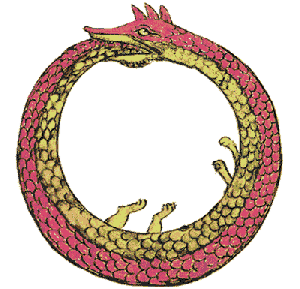
The Ouroboros [or-oh-bohr-ohs] is an ancient symbol depicting a serpent or dragon eating its own tail, which often represents self-reflexivity or cyclicality, especially in the sense of something constantly re-creating itself, the eternal return, and other things perceived as cycles that begin anew as soon as they end (compare with phoenix). It can also represent the idea of primordial unity related to something existing in or persisting before any beginning with such force or qualities it cannot be extinguished.
The ouroboros has been important in religious and mythological symbolism, but has also been frequently used in alchemical illustrations, where it symbolizes the circular nature of the alchemist’s opus. It is also often associated with Gnosticism, and Hermeticism. The earliest known representation of the Ouroboros is contained in the Egyptian Book of the Netherworld. The self-begetting sun god Atum is said to have ascended from chaos-waters with the appearance of a snake, the animal renewing itself every morning, and the deceased wishes to turn into the shape of the snake Sato (‘son of the earth’), the embodiment of Atum.
Posted in Art, Language, Philosophy |
1 Comment »
January 24, 2011

The term Large Group Awareness Training (LGAT) refers to self-help ‘training’ offered by certain groups sometimes linked with the human potential movement (a ‘new age’ philosophy founded in the 1960s) . The programs may involve several hundred people at a time for hours or days. It is common for the programs to feature an authoritarian demeanor by the trainer, and to cause physical strains on the participants from a long schedule followed by periods of release and encouragement.
By spending approximately half the time making a person feel bad and then suddenly reversing the feeling through effusive praise, the programs cause participants to experience a stress-reaction and an endorphin high. Over many hours and days the participants are physically exhausted, and made more susceptible to the trainer’s message, whether in the participants’ best interests or not. Examples of LGATs include: Lifespring, Erhard Seminars Training, The Forum, Newfield Consulting, Seres Naturales and Landmark Education.
Posted in Health, Money, Philosophy |
Leave a Comment »
January 21, 2011

The Book of Mormon is a musical written by South Park creators, Trey Parker and Matt Stone, and Avenue Q writer, Robert Lopez. The show tells the story of two young Mormon missionaries sent off to spread their faith in a dangerous part of Uganda. Scott Rudin and Anne Garafino are listed as the producers. The show debuted on Broadway at the Eugene O’Neill Theatre in 2011.
Posted in Art, Humor, Philosophy |
Leave a Comment »
January 19, 2011

The prosperity gospel is a religious belief found among Christians, primarily in the United States, centered on the notion that God provides material prosperity for those he favors. It has been defined by the belief that ‘Jesus blesses believers with riches’ or more specifically as the teaching that ‘believers have a right to the blessings of health and wealth and that they can obtain these blessings through positive confessions of faith and the ‘sowing of seeds’ through the faithful payments of tithes and offerings.’
It is not a clearly defined denomination, but a strain of belief that runs through the Pentecostal Church and a number of mainstream evangelical churches, with varying degrees of intensity. It arose in the United States after World War II championed by Oral Roberts and became particularly popular in the decade of the 1990s.
Posted in Money, Philosophy |
Leave a Comment »


 The Daily Omnivore