December 3, 2010

The Masters of Beef Advocacy (MBA) is an industry-funded program that trains college students to promote agribusiness. Since its launch in March 2009, the MBA has trained nearly 3,000 students and farmers to spread the ‘positive beef message.’ Daren Williams, the communications director for the National Cattlemen’s Beef Association, helped start the MBA with $240,000 from the Beef Checkoff program.
The MBA program is a self-directed online training program designed to equip beef producers and industry allies with the information they need to be everyday advocates for the beef industry. MBA candidates will be required to complete six courses in beef advocacy, including: Modern Beef Production, Animal Care, Beef Safety, Beef Nutrition, and Environmental Stewardship.
Posted in Food, Money, Politics |
Leave a Comment »
December 3, 2010

Checkoff organizations collect funds, sometimes called checkoff dollars, from producers of a particular agricultural commodity and uses these funds to promote and do research on the commodity. The organizations must promote their commodity in a generic way, without reference to a particular producer. These organizations are responsible for familiar American advertising campaigns, including ‘Milk Does a Body Good,’ ‘Got Milk?’, ‘Pork. The Other White Meat,’ ‘The Incredible, Edible Egg,’ and ‘Beef: It’s What’s for Dinner.’
read more »
Posted in Food, Money, Politics |
Leave a Comment »
December 1, 2010

Jury nullification occurs when a jury reaches a verdict contrary to the weight of evidence. Widely, it is any rendering of a verdict by a trial jury contrary to the letter of the law—that is, of an official rule, and especially a legislative enactment. Jury nullification need not disagree with the instructions by the judge—which concern what the law (common or otherwise) is—but it may rule contrary to an instruction requiring the jury to apply the law to the defendant in light of the facts in evidence.
A jury verdict contrary to the letter of the law pertains only to the particular case before it; however, if a pattern of identical verdicts develops in response to repeated attempts to prosecute a statutory offense, it can have the de facto effect of invalidating the statute. A pattern of jury nullification may indicate public opposition to an unwanted legislative enactment.
Posted in Politics |
Leave a Comment »
December 1, 2010


Teetotalism [tee-toht-l-iz-uhm] refers to either the practice of or the promotion of complete abstinence from alcoholic beverages. A person who practices or advocates teetotalism is called a teetotaler (plural teetotalers or teetotalli). The teetotalism movement was first started in Preston, England in the early 19th century. Some common reasons for choosing teetotalism are religious, health, family, philosophical, or social reasons, and, sometimes, as simply a matter of taste or preference.
Contemporary and colloquial usage has somewhat expanded teetotalism to include strict abstinence from most recreational intoxicants (legal and illegal). Most teetotaler organizations also demand from their members that they do not promote or produce alcoholic intoxicants.
read more »
Posted in Drugs, Language, Politics |
Leave a Comment »
November 30, 2010

Bacha Bazi (literally ‘playing with children’), also known as bacchá, is a practice recognized as sexual slavery and child prostitution in which prepubescent and adolescent boys are dressed as girls and sold to wealthy or powerful men for entertainment and sexual activities.
This business thrives in southern Afghanistan, where many men keep them as status symbols. The bacchá tradition, historically more common, waned after World War I, was forced out by Victorian era prudery and colonial powers. The reverse of bacha bazi is bacha posh, where girls are dressed up as boys.
Posted in Politics, Sex, World |
Leave a Comment »
November 30, 2010

Bacha posh is a cultural practice in areas of Afghanistan where a family in which there are no sons may have a girl dress in characteristic male clothing and have her hair cut short, occupying an intermediate status in which she is treated as neither a daughter nor fully as a son. In Afghan culture, pressure exists to have a son to carry on the family name and to inherit his father’s property. In the absence of a son, families may dress one of their daughters as a male, with some holding the superstition that having a bacha posh will make it more likely for a woman to give birth to a son in a subsequent pregnancy.
As a bacha posh, a girl is more readily able to attend school, escort her sisters in public places and find work, in addition to helping overcome the shame that a family experiences at not having any male children. The girl’s status as a bacha posh usually ends when she enters puberty. Women raised as a bacha posh often have difficulty making the transition from life as a boy and adapting to the traditional constraints placed on women in Afghan society. The reverse of bacha posh is bacha bazi, where boys are dressed up as girls.
Posted in Politics, Sex, World |
Leave a Comment »
November 23, 2010

Mother Hero was an honorary title in the Soviet Union awarded to all mothers bearing and raising 10 or more children. It was awarded upon the first birthday of the last child, provided that nine other children (natural or adopted) remained alive. Children who had perished under heroic, military or other respectful circumstances, including occupational diseases, were also counted.
Mother Heroes were entitled to wear a badge, which was a gold star with silver straight rays between the arms; it was suspended on a metal, red-enameled ‘ribbon’ bearing the words ‘Мать-героиня.’ They were also entitled to a number of privileges in terms of retirement pension, the payment of public utility charges, and the supply of food and other goods. Around 430,000 women were awarded this title during its existence. The only man to be awarded the title was Veniamin Petrovich Makarov from Orenburg, who raised 12 adopted boys.
Posted in Politics, Sex, World |
Leave a Comment »
November 23, 2010

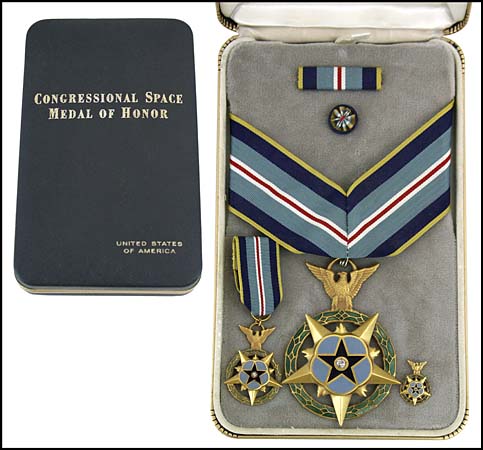
The Congressional Space Medal of Honor was authorized by the United States Congress in 1969 to recognize ‘any astronaut who in the performance of his duties has distinguished himself by exceptionally meritorious efforts and contributions to the welfare of the Nation and mankind.’ The highest award given in NASA, it is awarded by the President of the United States in Congress’s name on recommendations from the NASA Administrator. The award is a separate decoration from the Medal of Honor, which is a military award for extreme bravery and gallantry in combat.
Although the Congressional Space Medal of Honor is a civilian award of the United States government, it is authorized as a military decoration for display on U.S. military uniforms due to the prestige of the decoration. In such cases, the Congressional Space Medal of Honor is worn as a ribbon following all United States Armed Forces decorations. The Congressional Space Medal of Honor may also be presented posthumously to those astronauts who die while performing a United States space mission, and as of 2008 all 17 astronauts killed on U.S. missions have been awarded the medal.
Posted in Politics, Technology |
Leave a Comment »
November 19, 2010

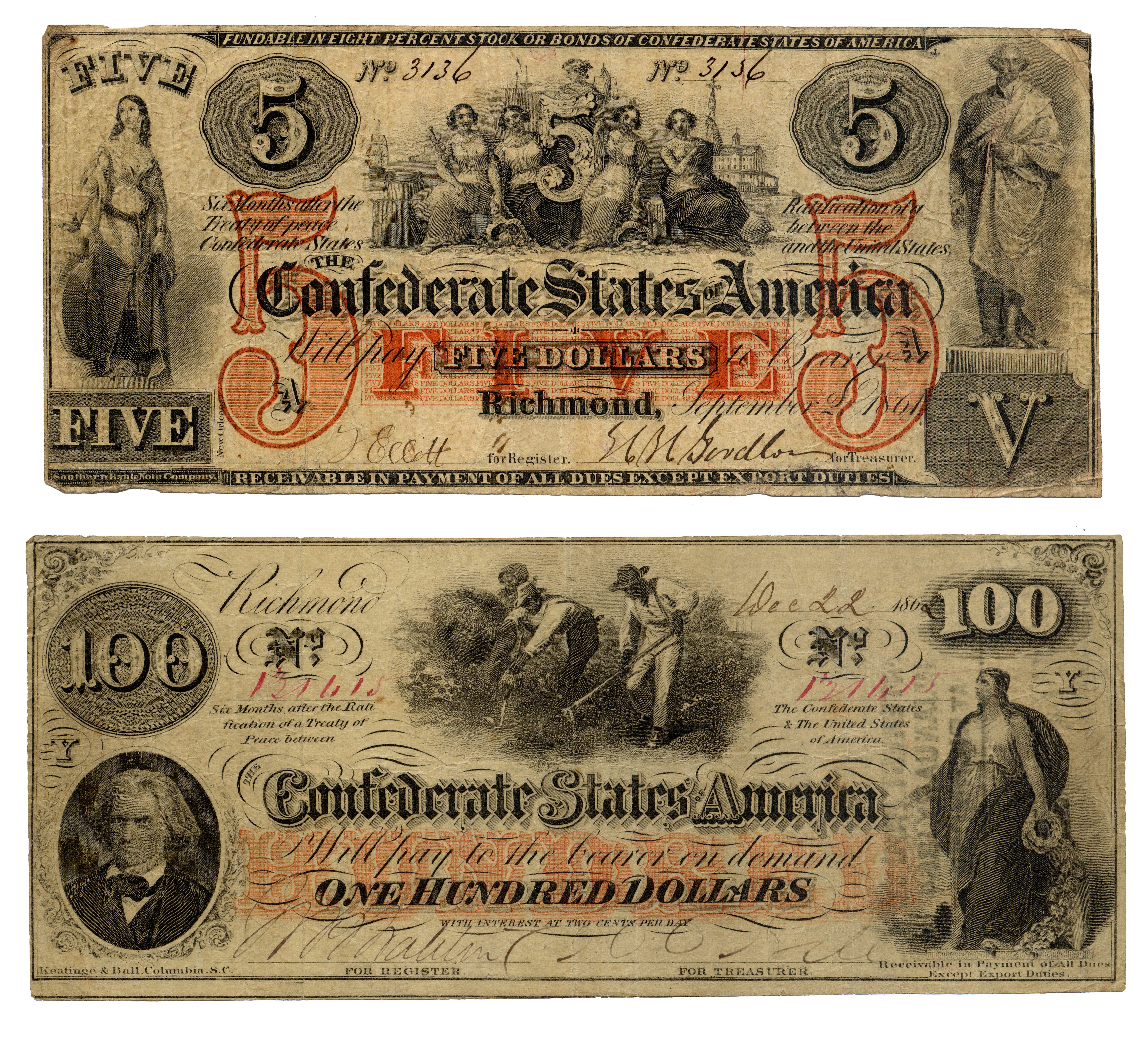
The Confederate States of America dollar was first issued into circulation in April 1861, when the Confederacy was only two months old, and on the eve of the outbreak of the Civil War. At first, Confederate currency was accepted throughout the South as a medium of exchange with high purchasing power. As the war progressed, however, confidence in the ultimate success waned, the amount of paper money increased, and their dates of redemption were extended further into the future.
The inevitable result was depreciation of the currency, and soaring prices characteristic of inflation. For example, by the end of the war, a cake of soap could sell for as much as $50 and an ordinary suit of clothes was $2,700. Near the end of the war, the currency became practically worthless as a medium of exchange. When the Confederacy ceased to exist as a political entity at the end of the war, the money lost all value as fiat currency.
Posted in Money, Politics, War |
3 Comments »
November 18, 2010

Cisgender [sis-jen-der] is a neologism that refers to individuals who are comfortable in the gender they were assigned at birth. It contrasts ‘transgender’ on the gender spectrum. A more popular term is ‘gender normative.’ The word has its origin in the Latin-derived prefix cis, meaning ‘on the same side’. In this case, ‘cis’ refers to the alignment of gender identity with assigned gender.
The word was coined in 1995 by Carl Buijs, a transsexual man from the Netherlands. Buijs said in a usenet posting, ‘As for the origin, I just made it up. I just kept running into the problem of what to call non-trans people in various discussions, and one day it just hit me: non-trans equals cis. Therefore, cisgendered.’
Posted in Language, Politics, Sex |
Leave a Comment »
November 18, 2010

The Goddess movement is a loose grouping of social and religious phenomena growing out of second-wave feminism, predominantly in North America, Western Europe, Australia and New Zealand in the 1970s, which spread to the metaphysical community as well.
Spurred by the perception that women were not treated equitably by mainstream religions, many women turned to a female deity, as more in tune with their beliefs and spiritual needs. Masculine gender and male imagery were, at the time, attached to deity to the exclusion of female gender and female imagery. A unifying theme of this diverse movement is the female-ness of the deity (as opposed and contrasted to a patriarchal, male God).
Posted in Philosophy, Politics, Sex |
Leave a Comment »
November 17, 2010

Numbers stations are shortwave radio stations of uncertain origin. They generally broadcast artificially generated voices reading streams of numbers, words, letters (sometimes using a spelling alphabet), tunes or Morse code. They are in a wide variety of languages and the voices are usually female, though sometimes male or children’s voices are used. Numbers stations appear and disappear over time (although some follow regular schedules), and their overall activity has increased slightly since the early 1990s.
Evidence supports popular assumptions that the broadcasts are used to send messages to spies. This usage has not been publicly acknowledged by any government that may operate a numbers station, but in 1892, the United States tried the Cuban Five for spying for Cuba. The group had received and decoded messages that had been broadcast from a Cuban numbers station. In 2009, the United States charged Walter Kendall Myers with conspiracy to spy for Cuba and receiving and decoding messages broadcast from a numbers station operated by the Cuban Intelligence Service.
Posted in Politics, Technology, War |
Leave a Comment »