November 2, 2010

Copyleft is a play on the word copyright to describe the practice of using copyright law to offer the right to distribute copies and modified versions of a work and requiring that the same rights be preserved in modified versions of the work.
In other words, copyleft is a general method for making a program (or other work) free, and requiring all modified and extended versions of the program to be free as well. It is a a form of licensing and can be used to maintain copyright conditions for works such as computer software, documents, music and art.
Posted in Money, Politics |
Leave a Comment »
November 2, 2010

Works are in the public domain if they are not covered by intellectual property rights at all, if the intellectual property rights have expired, and/or if the intellectual property rights are forfeited. Examples include the English language, the formulae of Newtonian physics, as well as the works of Shakespeare and the patents over powered flight.
Public domain is a concept of intellectual property law, which includes copyright, patents and trademarks, and refers to works, ideas, and information which are intangible to private ownership and/or which are available for use by members of the public.
Posted in Money, Politics |
Leave a Comment »
October 25, 2010


Astroturfing denotes political, advertising, or public relations campaigns that are formally planned by an organization, but are disguised as spontaneous, popular ‘grassroots’ behavior. The term refers to AstroTurf, a brand of synthetic carpeting designed to look like natural grass. The goal of such campaigns is to disguise the efforts of a political or commercial entity as an independent public reaction to some political entity—a politician, political group, product, service or event. The term is said to have been used first in this context by former US Senator Lloyd Bentsen of Texas in 1985.
Astroturfers attempt to orchestrate the actions of apparently diverse and geographically distributed individuals, by both overt (outreach, awareness, etc.) and covert (disinformation) means. Astroturfing may be undertaken by an individual promoting a personal agenda, or highly organized professional groups with money from large corporations, unions, non-profits, or activist organizations. Very often, the efforts are conducted by political consultants who also specialize in opposition research.
Posted in Language, Politics |
Leave a Comment »
October 20, 2010

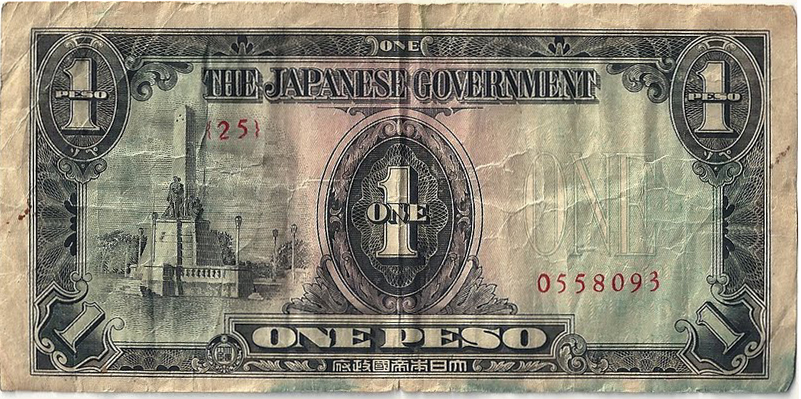
During World War II in the Philippines, the occupying Japanese government issued fiat currency in several denominations; this is known as the Japanese government-issued Philippine fiat peso, or simply the Japanese peso. The Japanese-sponsored Second Philippine Republic under Jose P. Laurel outlawed possession of guerilla currency, and declared a monopoly on the issuance of money, so that anyone found to possess guerrilla notes could be arrested.
The Filipinos called the fiat peso ‘Mickey Mouse money,’ because it was similar to play money and next to worthless. Many survivors of the war tell stories of going to the market laden with suitcases or ‘bayong’ (native bags made of woven coconut or buri leaf strips) overflowing with the Japanese-issued bills. In 1944, a box of matches cost more than 100 Mickey Mouse pesos.
Posted in Money, Politics, War |
Leave a Comment »
October 19, 2010

Seed bombing or aerial reforestation is a technique of introducing vegetation to land by throwing or dropping compressed clods of soil containing live vegetation. Often, seed bombing projects are done with arid or off-limits (for example, privately-owned) land. The term ‘seed grenade’ was first used by NY artist, Liz Christy in 1973 when she started the ‘Green Guerrillas.’ The first seed grenades were made from condoms filled with local wildflower seeds, water and fertilizer. They were tossed over fences onto empty lots in New York City in order to make the neighborhoods look better. It was the start of the guerrilla gardening movement.
The earliest records of aerial reforestation date back from 1930. In this period, planes were used to distribute seeds over certain inaccessible mountains in Honolulu after forest fires. Seed bombing is also widely used in Africa in barren or simply grassy areas. Newer seed bombs use biodegradable shells which feed the sprout as it grows. Barren land can be turned into a garden in a little over a month. A variant of seed bombing, called tree bombing, involves dropping saplings from military aircraft, but has yet to be attempted.
Posted in Politics, Science |
Leave a Comment »
October 18, 2010

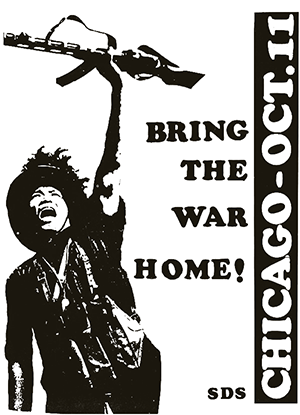
Weatherman, known colloquially as the Weathermen and later the Weather Underground Organization (WUO), was an American radical left organization. It originated in 1969 as a faction of Students for a Democratic Society (SDS). Their goal was to create a clandestine revolutionary party for the violent overthrow of the US government and the establishment of a dictatorship of the proletariat. With leadership whose revolutionary positions were characterized by Black separatist rhetoric, the group conducted a campaign of bombings through the mid-1970s, including aiding the jailbreak and escape of Timothy Leary.
read more »
Posted in Politics, War |
Leave a Comment »
October 14, 2010
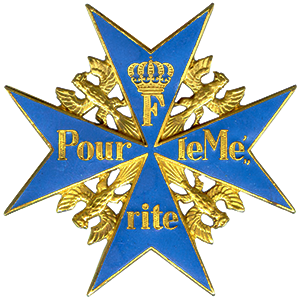
The Pour le Mérite, known informally during World War I as the Blue Max, was the Kingdom of Prussia’s highest military order for German soldiers until the end of World War I. The award was a blue-enameled Maltese Cross with eagles between the arms based on the symbol of the Johanniter Order, the Prussian royal cypher, and the French legend Pour le Mérite (‘for Merit’) arranged on the arms of the cross. A civil version of the order, for accomplishments in the arts and sciences, still exists in the Federal Republic of Germany.
Posted in Politics, War, World |
Leave a Comment »
October 11, 2010

Jailbreaking is a process that allows iPad, iPhone and iPod Touch users to install homebrew applications on their devices by unlocking the operating system and allowing the user root access. Once jailbroken, iPhone users are able to download many extensions and themes previously unavailable through the App Store via unofficial installers such as Cydia.
A jailbroken iPad, iPhone or iPod Touch is still able to use the App Store and iTunes. Jailbreaking is different from SIM unlocking, which, once completed, means that the mobile phone will accept any SIM without restriction on, for example, the country or network operator of origin.
Posted in Politics, Technology |
Leave a Comment »
October 9, 2010

In Ireland, the Great Famine was a period of mass starvation, disease and emigration between 1845 and 1852. It is also known, mostly outside of Ireland, as the Irish Potato Famine. In the Irish language it is called ‘An Gorta Mór‘ (The Great Hunger) or ‘An Drochshaol’ (The Bad Times). During the Famine, Ireland’s population fell by between 20 and 25 percent. Approximately one million people died and a million more emigrated from Ireland. The proximate cause of famine was a plant disease commonly known as potato blight. The blight ravanged much of Europe but hit Ireland particularly hard due to a number of political, social and economic factors which remain the subject of historical debate.
For example, views of the Irish as racially inferior, and for this reason significantly responsible for their circumstances, gained purchase in Great Britain during and immediately after the famine. Discussion of the British government’s response to the failure of the potato crop in Ireland and the subsequent large-scale starvation, and whether or not this constituted genocide, remains a politically-charged issue in Ireland.
Posted in Death, Politics, World |
Leave a Comment »
October 1, 2010
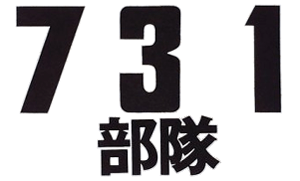

Unit 731 was a covert biological and chemical warfare research and development unit of the Imperial Japanese Army that undertook lethal human experimentation during the Second Sino-Japanese War (1937–1945) and World War II. It was responsible for some of the most notorious war crimes carried out by Japanese personnel. Unit 731 was the code name of an Imperial Japanese Army unit officially known as the Epidemic Prevention and Water Purification Department of the Kwantung Army. It was initially set up under the Kempeitai military police of the Empire of Japan to develop weapons of mass destruction for potential use against Chinese, and possibly Soviet forces.
read more »
Posted in Death, Politics, War |
Leave a Comment »
September 30, 2010
Unit 8200 is an Israeli Defence Force (IDF) Intelligence Corps unit, responsible for collecting signal intelligence and code decryption. It is the largest unit in the IDF, with several thousand soldiers. It is comparable in its function to the United States’ National Security Agency, except that it is not a separate civilian body.
In March 2004, The Commission to investigate the intelligence network following the War in Iraq recommended turning the unit into a civilian National SIGINT Agency, as is largely the case in other Western countries, but this proposal has yet to be implemented. Urim SIGINT Base is the most important signal intelligence-gathering installation operated by Israel’s military and is part of Unit 8200. The Urim base is located in the Negev desert approximately 30km from Beersheba.
Posted in Politics, War |
Leave a Comment »
September 24, 2010

The Reagan Doctrine was a strategy orchestrated and implemented by the United States under the Reagan Administration to oppose the global influence of the Soviet Union during the final years of the Cold War. While the doctrine lasted less than a decade, it was the centerpiece of United States foreign policy from the early 1980s until the end of the Cold War in 1991. Under the Reagan Doctrine, the U.S. provided overt and covert aid to anti-communist guerrillas and resistance movements in an effort to ‘rollback’ Soviet-backed communist governments in Africa, Asia and Latin America. Most notably, the mujahideen in Afghanistan and the contras in Nicaragua.
The doctrine was designed to serve the dual purposes of diminishing Soviet influence in these regions, while also potentially opening the door for capitalism (and sometimes liberal democracy) in nations that were largely being governed by Soviet-supported socialist governments. However, since the September 11 attacks, some critics have argued that, by facilitating the transfer of large amounts of weapons to various areas of the world and by training military leaders in these regions, the Reagan Doctrine actually contributed to ‘blowback’ by strengthening some political and military movements that ultimately developed hostility toward the United States, such as al-Qaeda in Afghanistan.
Posted in Politics, War |
Leave a Comment »