February 26, 2017

A contrarian is a person that takes up a contrary position, especially a position that is opposed to that of the majority, regardless of how unpopular it may be. A contrarian investing style is one that is based on identifying, and speculating against, movements in stock prices that reflect changes in the sentiments of the majority of investors.
Contrarian journalism is characterised by articles and books making counterintuitive claims, or attacking what is said to be the conventional wisdom (a phrase attributed to Canadian economist and diplomat John Kenneth Galbraith) on a given topic. A typical contrarian trope takes the form, ‘everything you know about topic X is wrong.’
read more »
Posted in Philosophy, Politics, Science |
Leave a Comment »
February 21, 2017

Vatnik (Russian: ‘cotton-padded jacket’), a derivative of and often shortened to ‘vata’ (Russian: ‘batting’), is a derogatory social slang neologisms in Russian and Ukrainian languages, and an internet meme used in reference to individuals with pro-Russian jingoist and chauvinist views. In the original meaning, ‘vatnik’ (also ‘telogreika’) is a cheap cotton-padded jacket.
The meme was created by Anton Chadskiy under the pseudonym ‘Jedem das Seine.’ His associated picture of an anthropomorphic square-shaped quilted jacket similar to the cartoon character ‘Spongebob Squarepants’ was first posted on Russian social network ‘VK’ September 9, 2011. The meme went viral in 2012, but became much more widespread in society after the Russian military intervention in Ukraine started in 2014. Chadskiy, claiming he feared political persecution, left Russia in late 2014.
read more »
Posted in Language, Politics, World |
Leave a Comment »
February 14, 2017
Buck passing, or passing the buck, is the act of attributing to another person or group one’s own responsibility. It is often used to refer to a strategy in power politics whereby a state tries to get another state to deter or possibly fight an aggressor state while it remains on the sidelines.
The expression is said to have originated from poker, in which a marker or counter (such as a knife with a buckhorn handle during the American Frontier era) was used to indicate the person whose turn it was to deal. If the player did not wish to deal he could pass the responsibility by passing the ‘buck,’ as the counter came to be called, to the next player.
read more »
Posted in Philosophy, Politics |
2 Comments »
February 7, 2017


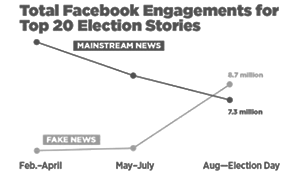
Fake news is a type of hoax or deliberate spread of misinformation, be it via the traditional news media or via social media, with the intent to mislead in order to gain financially or politically. It often employs eye-catching headlines or entirely fabricated news-stories in order to increase readership and online sharing. Profit is made in a similar fashion to ‘clickbait’ (content that is aimed at generating online advertising revenue at the expense of quality or accuracy) and relies on ad-revenue generated regardless of the veracity of the published stories.
Easy access to ad-revenue, increased political polarization and the ubiquity of social media, primarily the Facebook newsfeed have been implicated in the spread of fake news. Anonymously hosted websites lacking known publishers have also been implicated, because they make it difficult to prosecute sources of fake news for slander. With a large portion of Americans using Facebook or Twitter to receive news, in combination with increased political polarization, filter bubbles, the tendency for readers to mainly read headlines – fake news was implicated in influencing the 2016 American presidential election.
read more »
Posted in Politics |
1 Comment »
February 3, 2017
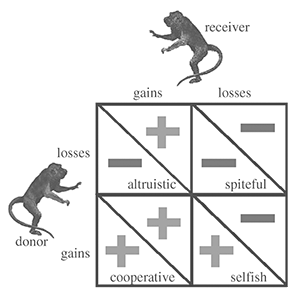
The prisoner’s dilemma (PD) is a paradox about co-operation. It shows why two ‘rational’ individuals might not co-operate, even if it seems in their best interests. It is studied in game theory.
In the classic example two people are arrested for a crime, and the police are uncertain which person committed the crime, and which person abetted the crime. If each remains silent, they are both soon released. If one betrays the other, the betrayer goes free, and the other is imprisoned for a long time. If each betrays the other, they both are held for a short time. No matter what happens, they will never see each other again.
read more »
Posted in Games, Politics, Science |
1 Comment »
January 30, 2017

The Idaho stop is the common name for a law that allows cyclists to treat a stop sign as a yield sign, and a red light as a stop sign. It first became law in Idaho in 1982, but has not been adopted elsewhere.
A limited form of the law called ‘Stop as Yield,’ that deals only with stop signs, has expanded to parts of Colorado and been considered in several other states. Advocates argue that current law criminalizes normal cycling behavior, and that the Idaho stop makes cycling easier and safer and places the focus where it should be: on yielding the right-of-way. Lawmakers in many states and cities have attempted to pass similar laws.
read more »
Posted in Games, Politics |
2 Comments »
January 23, 2017
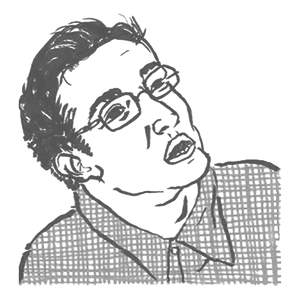
George Miller, commonly known by his internet pseudonym ‘Filthy Frank,’ is a musician and YouTube personality. He was born to Australian and Japanese parents, and attended Canadian Academy, where he graduated from in 2012. Aside from the comedic and often rap based music he creates under his ‘Pink Guy’ alias, Miller also creates more serious and traditional music under the stage name ‘Joji.’ He first became known for his absurdist YouTube channel, ‘TVFilthyFrank,’ which features music, rants and a bizarre ‘show’ featured in an alternate universe, with all of the main characters played by him.
Miller’s video titled ‘Do the Harlem Shake (Original)’ has been viewed 57.2 million times and spawned the ‘Harlem Shake’ meme. The earliest known video of Miller is a YouTube video titled ‘2cool4u92,’ uploaded to a channel sharing the same name in 2006 and features a young Miller performing a break dance move in front of the camera. Miller created the ‘Filthy Frank’ character during his time on his ‘Dizasta Music’ channel, where he created other content but started gaining popularity once he conceptualized Frank, who is described as the anti-vlogger of YouTube. The first known video on this particular channel was uploaded in 2011, and was titled ‘Filthy Shit.’
Posted in Art, Humor, Politics |
Leave a Comment »
January 19, 2017
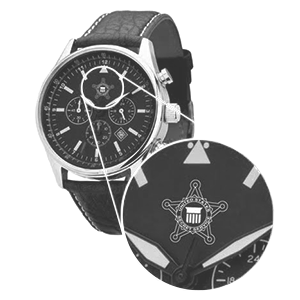
Jorg Gray is a California-based brand of men’s and women’s watches. They are best known as the favored watch of U.S. President Barack Obama and the U.S. Secret Service. Jorg Gray was established as a watch line in 1998 by Logomark, Inc. based in Tustin, California. Originally Jorg Gray timepieces were manufactured as a high end promotional item for corporations and federal agencies. Jorg Gray became a retail only brand in 2009. The company has since expanded their line and launched a women’s collection in late 2013. There are currently over 250 authorized dealers the U.S. and the brand can be found in retail stores in Asia, Europe, the Caribbean, and South America.
President Obama received his original JG6500, the ‘official’ model of the Secret Service in 2007 as a birthday gift from his security team and has been documented wearing it. Shortly thereafter Jorg Gray created a commemorative edition of the timepiece. Each watch comes with an individualized serial number and an inscription, laser engraved on the case back. Other government agencies around the world, including the London Metropolitan Police, now also wear watches made by Jorg Gray.
Posted in Money, Politics, Technology |
Leave a Comment »
January 10, 2017

In legal history, an animal trial was the criminal trial of a non-human animal. Such trials are recorded as having taken place in Europe from the thirteenth century until the eighteenth. In modern times, it is considered in most criminal justice systems that non-human creatures lack moral agency and so cannot be held culpable for an act.
Animals, including insects, faced the possibility of criminal charges for several centuries across many parts of Europe. According to a 1624 treatise by Johannis Gross, in 1474 a rooster was put on trial for ‘the heinous and unnatural crime of laying an egg,’ which the townspeople were concerned was spawned by Satan and contained a cockatrice (a mythical beast).
read more »
Posted in Humor, Politics |
Leave a Comment »
December 29, 2016
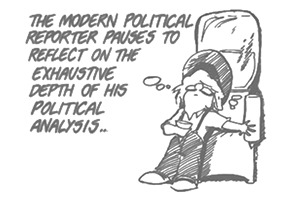

Bloom County is an American comic strip by Berkeley Breathed which ran from 1980 until 1989. It examined events in politics and culture through the viewpoint of a fanciful small town in Middle America, where children often have adult personalities and vocabularies and where animals can talk.
The fictional setting of ‘Bloom County’ served as a recurring backdrop for the comic and its sequels, although the nature of the setting was frequently altered. In the comics, the county is presented as a stereotypical American midwestern small town. The small town setting was frequently contrasted with the increasing globalization taking place in the rest of the world; though Bloom County contained the likes of farmers and wilderness creatures by default, it was frequented by Hare Krishnas, feminists, and rock stars.
read more »
Posted in Art, Language, Politics |
Leave a Comment »
December 20, 2016

Post-truth politics (also called post-factual politics) is a political culture in which debate is framed largely by appeals to emotion disconnected from the details of policy, and by the repeated assertion of talking points to which factual rebuttals are ignored. Post-truth differs from traditional contesting and falsifying of truth by rendering it of ‘secondary’ importance.
While this has been described as a contemporary problem, there is a possibility that it has long been a part of political life, but was less notable before the advent of the Internet. In the novel ‘Nineteen Eighty-Four,’ George Orwell cast a world in which the state is daily changing historic records to fit its propaganda goals of the day. Orwell is said to have based much of his criticism of this on Soviet Russian practices.
read more »
Posted in Language, Politics, World |
Leave a Comment »
December 15, 2016


Kompromat is the Russian term for compromising materials about a politician or other public figure. Such materials can be used to create negative publicity, for blackmail, or for ensuring loyalty. Kompromat can be acquired from various security services, or outright forged, and then publicized by paying off a journalist. Widespread use of kompromat has been one of the characteristic features of politics in Russia and other post-Soviet states.
One recent development has been the creation of specialized kompromat websites, most famously compromat.ru, which will, for a fee of several hundred dollars, publish any piece of kompromat on anyone. Such websites are occasionally temporarily blocked by Russian ISPs and their owners harassed by government agencies. The possibility that the email accounts of senior Republican Party leaders have been hacked by Russian intelligence services worries some observers that President Donald Trump and members of his administration will be vulnerable to manipulation by the Russian government.
Posted in Politics, World |
Leave a Comment »


 The Daily Omnivore