October 16, 2012


Anti-nationalism denotes the sentiments associated with the opposition to nationalism, arguing that it is undesirable or dangerous. Some anti-nationalists are humanitarians or humanists who pursue an idealist form of world community, and self-identify as world citizens.
They reject chauvinism, jingoism, and militarism, and want humans to live in peace rather than perpetual conflict. They do not necessarily oppose the concepts of countries, nation states, national boundaries, cultural preservation or identity politics.
read more »
Posted in Money, Politics, World |
Leave a Comment »
October 16, 2012
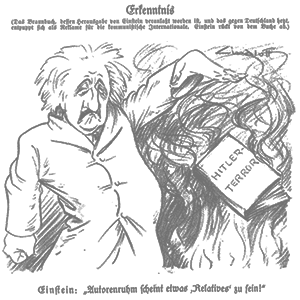
Deutsche Physik (literally: ‘German Physics’) or ‘Aryan Physics’ was a nationalist movement in the German physics community in the early 1930s against the work of Albert Einstein and other modern theoretically based physics, labeled ‘Jewish Physics’ (German: ‘Jüdische Physik’). The term was taken from the title of a 4-volume physics textbook by Philipp Lenard in the 1930s.
This movement began as an extension of a German nationalistic movement in the physics community which went back as far as World War I. In 1915, during fighting between the German army and Belgian resistance fighters after the German invasion in Belgium, the library of the Katholieke Universiteit in Leuven caught fire when German troops looted and set fire to the town. The loss of the library led to a protest note by British scientists, which was signed also by eight distinguished British scientists, namely William Bragg, William Crookes, Alexander Fleming, Horace Lamb, Oliver Lodge, William Ramsay, Baron Rayleigh, and J.J. Thomson, and in which it was assumed that the war propaganda mentioned corresponded to real behavior of German soldiers.
read more »
Posted in Education, Politics, Science |
Leave a Comment »
October 11, 2012

In Marxist theory, human society consists of two parts: the base and superstructure; the base comprehends the forces and relations of production — employer-employee work conditions, the technical division of labor and property relations — into which people enter to produce the necessities and amenities of life.
These relations determine society’s other relationships and ideas, which are described as its superstructure: its culture, institutions, political power structures, roles, rituals, and state. The base determines (conditions) the superstructure, yet their relation is not strictly causal, because the superstructure often influences the base; the influence of the base, however, predominates. In Orthodox Marxism, the base determines the superstructure in a one-way relationship. However, in more advanced forms and variations of Marxist thought their relationship is not strictly one-way, as some theories claim that just as the base influences the superstructure, the superstructure also influences the base.
read more »
Posted in Money, Politics |
Leave a Comment »
October 11, 2012
In sociology, articulation labels the process by which particular classes appropriate cultural forms and practices for their own use. The term appears to have originated from the work of Italian political theorist Antonio Gramsci, specifically from his conception of ‘superstructure’ (culture, institutions, political power structures, roles, rituals, and state, which are supported by the ‘base,’ the forces and relations of production). In this theory, cultural forms and practices have relative autonomy; socio-economic structures of power do not determine them, but rather they relate to them.
‘The theory of articulation recognizes the complexity of cultural fields. It preserves a relative autonomy for cultural and ideological elements (…) but also insists that those combinatory patterns that are actually constructed do mediate deep, objective patterns in the socio-economic formation, and that the mediation takes place in struggle: the classes fight to articulate together constituents of the cultural repe[r]toire in particular ways so that they are organized in terms of principles or sets of values determined by the position and interests of the class in the prevailing mode of production.’
read more »
Posted in Politics, Science, World |
1 Comment »
October 10, 2012

The Adventures of Tintin: Breaking Free is an anarchist parody of the popular Tintin series of comics. An exercise in detournement (turning expressions of the capitalist system and its media culture against itself), the book was written under the pseudonym J. Daniels and published by Attack International in 1988. It has recently been re-printed by anarchist publishers Freedom Press which includes for the first time Tintin’s earlier adventures during the Wapping dispute as told in ‘The Scum,’ a 1986 pamphlet which was produced in solidarity with the printworkers.
The story features a number of characters based on those from the original series by Hergé, notably Tintin himself and Captain Haddock (referred to only as ‘the Captain’ and depicted here as being Tintin’s uncle), but not the original themes or plot. Snowy is featured on the cover – being especially visible on the first edition’s cover – but not in the narrative. The story tracks Tintin’s development from a disaffected, shoplifting youth to a revolutionary leader.
read more »
Posted in Humor, Money, Politics |
Leave a Comment »
October 10, 2012

In music, sampling is the act of taking a portion, or sample, of one sound recording and reusing it as an instrument or a sound recording in a different song or piece. Sampling was originally developed by experimental musicians working with musique concrète and electroacoustic music, who physically manipulated tape loops or vinyl records on a phonograph.
In the late 1960s, the use of tape loop sampling influenced the development of minimalist music and the production of psychedelic rock and jazz fusion. In the 1970s, DJs manipulating vinyl on turntables gave birth to hip hop music, the first popular music genre based originally around the art of sampling.
read more »
Posted in Money, Politics, Technology |
Leave a Comment »
October 9, 2012
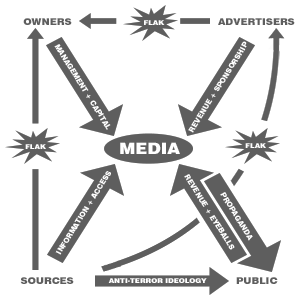
The propaganda model is a conceptual model in political economy advanced by Edward S. Herman and Noam Chomsky that states how propaganda, including systemic biases, function in mass media. The model seeks to explain how populations are manipulated and how consent for economic, social and political policies is ‘manufactured’ in the public mind due to this propaganda. The theory posits that the way in which news is structured (through advertising, media ownership, government sourcing and others) creates an inherent conflict of interest which acts as propaganda for undemocratic forces.
First presented in their 1988 book ‘Manufacturing Consent: The Political Economy of the Mass Media,’ the ‘propaganda model’ views the private media as businesses interested in the sale of a product—readers and audiences—to other businesses (advertisers) rather than that of quality news to the public. Describing the media’s ‘societal purpose,’ Chomsky writes, ‘… the study of institutions and how they function must be scrupulously ignored, apart from fringe elements or a relatively obscure scholarly literature.’
read more »
Posted in Language, Money, Politics |
3 Comments »
October 9, 2012
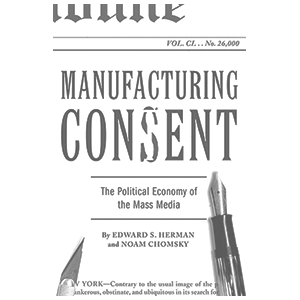
‘Manufacturing Consent: The Political Economy of the Mass Media’ (1988), by Edward S. Herman and Noam Chomsky, is an analysis of the news media, arguing that the mass media of the United States ‘are effective and powerful ideological institutions that carry out a system-supportive propaganda function by reliance on market forces, internalized assumptions, and self-censorship, and without overt coercion.’
The title derives from the phrase ‘the manufacture of consent’ that essayist–editor Walter Lippmann employed in the book ‘Public Opinion’ (1922). Chomsky has said that Australian social psychologist Alex Carey, to whom the book was dedicated, was in large part the impetus of his and Herman’s work. The book introduced the propaganda model of the media. A film, ‘Manufacturing Consent: Noam Chomsky and the Media,’ was later released based on the book.
read more »
Posted in Language, Money, Politics |
1 Comment »
October 9, 2012

Repressive desublimation [dih-suhb-luh-mey-shuhn] is a term first coined by philosopher and sociologist Herbert Marcuse in his 1964 work ‘One-Dimensional Man, ‘that refers to the way in which, in advanced capitalism, ‘sexuality is liberated (or rather liberalized) in socially constructive forms’ so as to serve, rather than to challenge, forms of social control.
Instead of acting against the social order (as the repressive hypothesis would suggest), sexual liberation was thus co-opted to support the status quo, through the undoing of sublimations (the conversion of negative impulses into positive behavior) and the release of pleasure in socially approved forms.
read more »
Posted in Politics |
Leave a Comment »
October 9, 2012

Edupunk is an approach to teaching and learning practices that result from a do it yourself (DIY) attitude. ‘The New York Times’ called it ‘an approach to teaching that avoids mainstream tools like PowerPoint and Blackboard, and instead aims to bring the rebellious attitude and D.I.Y. ethos of ’70s bands like The Clash to the classroom.’
The term was first used in 2008 by Jim Groom in his blog, and covered less than a week later in the ‘Chronicle of Higher Education.’ Edupunk arose in objection to the efforts of government and corporate interests in reframing and bundling emerging technologies into cookie-cutter products with pre-defined application—somewhat similar to traditional punk ideologies.
Posted in Education, Money, Politics |
Leave a Comment »
October 8, 2012

The free culture movement is a social movement that promotes the freedom to distribute and modify creative works in the form of free content by using the Internet and other forms of media. The movement objects to overly-restrictive copyright laws. Many members of the movement argue that such laws hinder creativity. They call this system ‘permission culture.’ ‘Creative Commons’ is a well-known website which was started by legal activist Lawrence Lessig. It lists licenses that permit sharing under various conditions, and also offers an online search of various creative-commons-licensed productions.
The free culture movement, with its ethos of free exchange of ideas, is of a whole with the free software movement. Richard Stallman, the founder of the GNU project (a free UNIX competitor, and free software activist, advocates free sharing of information. He famously stated that free software means free as in ‘free speech,’ not ‘free beer.’ Today, the term stands for many other movements, including hacker computing, the access to knowledge movement, and the copyleft movement. The term ‘free culture’ was originally the title of a 2004 book by Lawrence Lessig, a founding father of the free culture movement.
read more »
Posted in Money, Politics, Technology |
2 Comments »
October 8, 2012

Information wants to be free is a slogan of technology activists invoked against limiting access to information. According to criticism of intellectual property rights, the system of governmental control of exclusivity is in conflict with the development of a public domain of information. The iconic phrase is attributed to American writer Stewart Brand who, in the late 1960s, founded the ‘Whole Earth Catalog’ and argued that technology could be liberating rather than oppressing.
The earliest recorded occurrence of the expression was at the first ‘Hackers’ Conference’ in 1984. Brand told Steve Wozniak: ‘On the one hand information wants to be expensive, because it’s so valuable. The right information in the right place just changes your life. On the other hand, information wants to be free, because the cost of getting it out is getting lower and lower all the time. So you have these two fighting against each other.’
read more »
Posted in Money, Politics, Technology |
Leave a Comment »



