May 13, 2012

Gauche [gohsh] caviar [kav-ee-ahr] (‘Caviar left’) is a pejorative French term to describe someone who claims to be a socialist while living in a way that contradicts socialist values. The expression is a political neologism dating from the 1980s and implies a degree of hypocrisy. It is broadly similar to the English ‘champagne socialist,’ the American ‘Limousine liberal,’ the German ‘Salonkommunist,’ the Italian ‘Radical Chic,’ and the Danish ‘Kystbanesocialist’ (referring to well-off coastal neighborhoods north of Copenhagen). French encyclopedia ‘Petit Larousse’ defines ‘left caviar’ as a pejorative expression for a, ‘Progressivism combined with a taste for society life and its accoutrements.’
The term was once prevalent in Parisian circles, applied deprecatingly to those who professed allegiance to the Socialist Party, but who maintained a far from proletariat lifestyle that distinguished them from the working-class base of the French Socialist Party. It was often employed by detractors of former French President François Mitterrand. In early 2007, French politician Ségolène Royal was identified with the ‘gauche caviar’ when it was revealed that she had been avoiding paying taxes. The description damaged her campaign for the French presidency. The weekly French news magazine, ‘Le Nouvel Observateur,’ has been described as the ‘quasi-official organ of France’s ‘gauche caviar.”
Posted in Food, Money, Politics |
Leave a Comment »
May 11, 2012

Jennifer Government is a 2003 novel written by Max Barry, set in a dystopian alternate reality in which most nations (now controlled by the United States) are dominated by for-profit corporate entities while the government’s political power is extremely limited. Some readers consider it similar in satiric intent to Orwell’s ‘1984,’ but of a world with too little political power as opposed to too much.
Consequently, some readers see the novel as a criticism of libertarianism. Many readers also see it as a criticism of globalization, although Barry claims he is not an anti-globalizationist.
read more »
Posted in Language, Money, Politics |
Leave a Comment »
May 10, 2012

Mireille Suzanne Francette Porte (b. 1947), better known as ORLAN, is a French artist. She lives and works in Los Angeles, New York, and Paris. She was invited to be a scholar in residence at the Getty Research Institute in Los Angeles, for the 2006-2007 academic year. She sits on the board of administrators for the Palais de Tokyo in Paris, and is a professor at the École Nationale Supérieure des Beaux-Arts in Cergy (a suburb of Paris).
Although ORLAN is best known for her work with plastic surgery in the early-to-mid 1990s, she has not limited her work to a particular medium.
read more »
Posted in Art, Politics, Sex |
Leave a Comment »
May 10, 2012
A canary trap is a method for exposing an information leak, which involves giving different versions of a sensitive document to each of several suspects and seeing which version gets leaked. The term was coined by Tom Clancy in his novel ‘Patriot Games,’ though Clancy did not invent the technique. The actual method (usually referred to as a ‘Barium meal test’ in espionage circles) has been used by intelligence agencies for many years. The fictional character Jack Ryan describes the technique he devised for identifying the sources of leaked classified documents:
‘Each summary paragraph has six different versions, and the mixture of those paragraphs is unique to each numbered copy of the paper. There are over a thousand possible permutations, but only ninety-six numbered copies of the actual document. The reason the summary paragraphs are so lurid is to entice a reporter to quote them verbatim in the public media. If he quotes something from two or three of those paragraphs, we know which copy he saw and, therefore, who leaked it.’ A refinement of this technique uses a thesaurus program to shuffle through synonyms, thus making every copy of the document unique.
Posted in Politics, War, World |
Leave a Comment »
May 9, 2012

‘The Better Angels of Our Nature: Why Violence Has Declined’ is a 2011 book by American cognitive scientist Steven Pinker arguing that violence in the world, especially the western part, has declined both in the long run and in the short. He also suggests explanations of why this has happened. The phrase ‘the better angels of our nature’ stems from the last words of Lincoln’s first inaugural address. Due to the highly interdisciplinary nature of the book Pinker uses the works of political scientist John Mueller and sociologist Norbert Elias, among others.
The extent of Elias’ influence on Pinker can be adduced from the title of Chapter 3: ‘The Civilizing Process,’ which is taken from the title of Elias’ seminal sociology text. Pinker also draws upon the work of international relations scholar Joshua Goldstein, and both have co-written a New York Times op-ed article titled ‘War Really Is Going Out of Style’ that summarizes many of their shared views. Both authors also appeared together at Harvard’s Institute of Politics to answer questions from academics and students concerning their similar thesis.’
Posted in Politics, War, World |
Leave a Comment »
May 8, 2012

The exorbitant privilege is a term coined in the 1960s by Valéry Giscard d’Estaing, then the French Minister of Finance. This quote is generally misattributed to Charles de Gaulle, who is said to have had somewhat similar views. The term refers to the benefit the United States had in its Dollar being the international reserve currency: the US would not face a balance of payments crisis, because it purchased imports in its own currency.
‘Exorbitant privilege’ as a concept cannot refer to currencies that have a regional reserve currency role, only global reserve currencies. Recent McKinsey Global Institute research questions whether the benefit that the US enjoys is really that exorbitant, highlighting the countervailing loss of trade competitiveness from the high dollar (that typically results from its reserve status, all else equal). The phrase became the title of a 2010 book by economist Barry Eichengreen, examining the future prospects for the US Dollar’s dominance in international trade.
Posted in Money, Politics, World |
Leave a Comment »
May 8, 2012
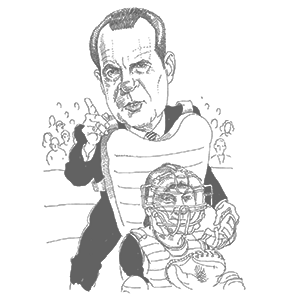
The Nixon Shock was a series of economic measures taken by U.S. President Richard Nixon in 1971 including unilaterally cancelling the direct convertibility of the United States dollar to gold that essentially ended the existing Bretton Woods system of international financial exchange.
The return to a gold standard is supported by followers of the Austrian School, largely because they object to the role of the government in issuing fiat currency through central banks. A number of gold standard advocates also call for a mandated end to fractional reserve banking.
read more »
Posted in Money, Politics, World |
1 Comment »
May 7, 2012

Korean reunification refers to the hypothetical future reunification of North Korea and South Korea under a single government. The process towards this was started by the ‘June 15th North–South Joint Declaration’ in 2000, where the two countries agreed to work towards a peaceful reunification in the future. However, there are a number of difficulties in this process due to the large political and economic differences between the two countries and other state actors such as China, Russia, Japan, and the United States.
Short-term problems, such as potentially large numbers of refugees migrating from North Korea and initial economic and political instability, and long-term problems, such as cultural differences and possible discrimination, would need to be resolved. North Korea’s policy is to seek reunification without what it sees as outside interference, through a federal structure retaining each side’s leadership and systems.
read more »
Posted in Politics, War, World |
Leave a Comment »
May 7, 2012

The Atrocity Exhibition is an experimental collection of ‘condensed novels’ by British writer J. G. Ballard. The book was originally published in the UK in 1970 by Jonathan Cape.
After a 1970 edition by Doubleday & Company had already been printed, Nelson Doubleday, Jr. personally cancelled the publication and had the copies destroyed, fearing legal action from some of the celebrities depicted in the book. Thus, the first U.S. edition was published in 1972 by Grove Press under the title ‘Love and Napalm: Export U.S.A.’
read more »
Posted in Language, Politics, Sex |
1 Comment »
May 7, 2012

Why I Want to Fuck Ronald Reagan is a short work by dystopian English author J.G. Ballard, first published in 1968 as a pamphlet by the Unicorn Bookshop in Brighton, England. It was later collected in ‘The Atrocity Exhibition’ (an experimental collection of Ballard’s ‘condensed novels’).
It is written in the style of a scientific paper and catalogs an apocryphal series of bizarre experiments intended to measure the psychosexual appeal of Ronald Reagan, who was then the Governor of California and candidate for the 1968 Republican presidential nomination.
read more »
Posted in Humor, Politics, Sex |
Leave a Comment »
May 5, 2012


A non-apology apology is a statement in the form of an apology but that is not in fact an apology at all. It is common in both politics and public relations. It most commonly entails the speaker saying that he or she is sorry not for a behavior, statement or misdeed, but rather is sorry only because a person who has been aggrieved is requesting the apology, expressing a grievance, or is threatening some form of retribution or retaliation.
An example of a non-apology apology would be saying ‘I’m sorry that you felt insulted’ to someone who has been offended by a statement. This apology does not admit that there was anything wrong with the remarks made, and additionally, it may be taken as insinuating that the person taking offense was excessively thin-skinned or irrational in taking offense at the remarks in the first place.
read more »
Posted in Language, Money, Politics |
Leave a Comment »
May 5, 2012

Neighbours is a 1952 anti-war film by Scottish-Canadian filmmaker Norman McLaren. Produced at the National Film Board of Canada in Montreal, the film uses the technique known as pixilation, an animation technique using live actors as stop-motion objects. McLaren created the soundtrack by scratching the edge of the film, leaving various blobs, lines, and triangles which the projector read as sound.
In the short, two men live peacefully in adjacent cardboard houses. When a flower blooms between their houses, they fight each other to the death over the ownership of the single small flower. According to McLaren: ‘I was inspired to make ‘Neighbours’ by a stay of almost a year in the People’s Republic of China. Although I only saw the beginnings of Mao’s revolution, my faith in human nature was reinvigorated by it. Then I came back to Quebec and the Korean War began. (…) I decided to make a really strong film about anti-militarism and against war.’
read more »
Posted in Art, Politics, War |
Leave a Comment »



