April 26, 2012

Lee Shelton(1865 – 1912) was a black carriage driver and pimp convicted of murdering William ‘Billy’ Lyons on Christmas night, 1895 in St. Louis. The crime was immortalized in a popular song that has been recorded by numerous artists. Stagger Lee (also ‘Stackalee,’ ‘Stackolee,’ and ‘Stagolee’) ultimately becomes a folk figure of the trickster type as numerous legends accumulated around him.
Lee Shelton was not a common pimp, he belonged to a group of pimps known in St. Louis as the ‘Macks.’ The Macks were not just ‘urban strollers’; they presented themselves as objects to be observed. Shelton died in prison in 1912, of tuberculosis. Stagger Lee has become an archetype, the embodiment of a tough black man;one who is sly, streetwise, cool, lawless, amoral, potentially violent, and who defies white authority.
read more »
Posted in Art, Politics |
2 Comments »
April 26, 2012

Clay Shirky (b. 1964) is an American writer, consultant, and teacher on the social and economic effects of Internet technologies. He has a joint appointment at NYU as a Distinguished Writer in Residence at the Arthur L. Carter Journalism Institute and Assistant Arts Professor in the New Media focused graduate Interactive Telecommunications Program (ITP). His courses address, among other things, the interrelated effects of the topology of social networks and technological networks, how our networks shape culture and vice-versa.
Shirky divides his time between consulting, teaching, and writing on the social and economic effects of Internet technologies. His consulting practice is focused on the rise of decentralized technologies such as peer-to-peer, web services, and wireless networks that provide alternatives to the wired client–server infrastructure that characterizes the World Wide Web. He is a member of the Wikimedia Foundation’s Advisory Board. In 2010, Kevin Kelly (founding executive editor of ‘Wired’ magazine) cited the phrase ‘Institutions will try to preserve the problem to which they are the solution,’ and called it the ‘Shirky Principle,’ as the phrasing reminded him of the clarity of the Peter Principle.
read more »
Posted in Language, Politics, Technology |
Leave a Comment »
April 23, 2012

Élan vital [ey-lahn vee-tal] was coined by French philosopher Henri Bergson in his 1907 book ‘Creative Evolution,’ in which he addresses the question of self-organization and spontaneous morphogenesis of things in an increasingly complex manner. Elan vital was translated in the English edition as ‘vital impetus,’ but is usually translated by his detractors as ‘vital force.’ It is a hypothetical explanation for evolution and development of organisms, which Bergson linked closely with consciousness.
It was believed by others that this essence (élan vital) could be harvested and embedded into an inanimate substance and activated with electricity, perhaps taking literally another of Bergson’s metaphorical descriptions, the ‘current of life.’ British biologist Julian Huxley remarked that Bergson’s élan vital is no better an explanation of life than is explaining the operation of a railway engine by its ‘élan locomotif’ (‘locomotive driving force’). The same epistemological fallacy is parodied in Molière’s ‘Le Malade imaginaire,’ where a quack ‘answers’ the question of ‘Why does opium cause sleep?’ with ‘Because of its soporific [sleep-inducing] power.’
read more »
Posted in Language, Politics |
Leave a Comment »
April 23, 2012

BosWash is a name coined by futurist Herman Kahn in a 1967 essay describing a theoretical United States megalopolis extending from the metropolitan area of Boston to that of Washington, D.C. The publication also coined ‘SanSan’ for the areas on the Pacific coast of California.
The general concept for the area described by BosWash was first identified in French geographer Jean Gottmann’s 1961 book ‘Megalopolis: The Urbanized Northeastern Seaboard of the United States.’ Kahn’s essay was the product of a study commissioned in 1965 by the American Academy of Arts and Sciences. Kahn discussing urbanization, began by writing: ‘The United States in the year 2000 will probably see at least three gargantuan megalopolises. We have labeled these—only half frivolously—’Boswash,’ ‘Chipitts,’ and ‘SanSan.”
read more »
Posted in Politics, Science, World |
Leave a Comment »
April 23, 2012

The Blue Banana (also known as the Hot Banana, European Megalopolis or European Backbone) is a discontinuous corridor of urbanization in Western Europe, with a population of around 110 million. It stretches approximately from North West England to Milan.
The curvature of this corridor (hence the ‘banana’ in the name) takes in cities such as Leeds, Liverpool, Manchester, Birmingham, London, Amsterdam, The Hague, Rotterdam, Brussels, Antwerp, Eindhoven, the Ruhr, Düsseldorf, Cologne, Frankfurt am Main, Luxembourg, Strasbourg, Stuttgart, Munich, Zürich, Turin, Milan, Venice, and Genoa and covers one of the world’s highest concentrations of people, money and industry.
read more »
Posted in Money, Politics, World |
Leave a Comment »
April 23, 2012

Ecumenopolis [ek-yoo-meh-nop-oh-lys] (Greek: ‘world city’) is a word invented in 1967 by the Greek city planner Constantinos Doxiadis to represent the idea that in the future urban areas and megalopolises would eventually fuse and there would be a single continuous worldwide city as a progression from the current urbanization and population growth trends.
Before the word was coined, the American religious leader Thomas Lake Harris (1823–1906) mentioned city-planets in his verses, and science fiction author Isaac Asimov uses the city-planet Trantor as the setting of some of his novels.
read more »
Posted in Politics, Technology, World |
Leave a Comment »
April 23, 2012
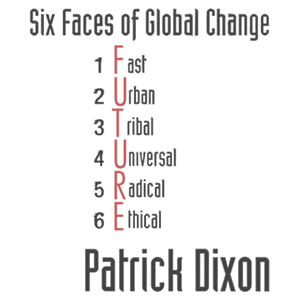
Futurewise is a book on global trends written by the futurist Patrick Dixon in 1998, with new editions in 2001, 2003, and 2007. ‘Futurewise’ contains over 500 expectations about what future life will be like, and divides future trends into six dimensions, which spell the word FUTURE: Fast (combinations of events bring new opportunities for agile leaders—and risks); Urban (demographics and lifestyle issues including megacities); Tribal (the most powerful force in the world today is tribalism—basis of culture, belonging, teams, brands); Universal (globalization at cost of local identity, risking international tensions, and the impact of the digital age); Radical (the rise of single issue activism and the death of left-right politics); and Ethical (the passions people have and personal values, including spirituality– the glue holding our future together)
A key thesis of ‘Futurewise’ is that the future is about emotion, and that emotional reactions to events are usually more important than the events themselves. Therefore a deep understanding is needed of how people are likely to feel in the future. The book also focuses on managing uncertainty. Risk management is a major challenge for all large corporations, including responding to wild cards – low probability but potentially high impact events.
Posted in Language, Politics, World |
Leave a Comment »
April 22, 2012
Rational ignorance occurs when the cost of educating oneself on an issue exceeds the potential benefit that the knowledge would provide. Ignorance about an issue is said to be ‘rational’ when the cost of educating oneself about the issue sufficiently to make an informed decision can outweigh any potential benefit one could reasonably expect to gain from that decision, and so it would be irrational to waste time doing so.
This has consequences for the quality of decisions made by large numbers of people, such as general elections, where the probability of any one vote changing the outcome is very small. The term is most often found in economics, particularly public choice theory, but also used in other disciplines which study rationality and choice, including philosophy (epistemology) and game theory. The term was coined by Anthony Downs in ‘An Economic Theory of Democracy’ (1957).
read more »
Posted in Money, Philosophy, Politics |
1 Comment »
April 19, 2012

Rubyfruit Jungle is the first novel (1973) by Rita Mae Brown, remarkable, in its day, for its explicit lesbianism. The novel is a semi-autobiographical (some have suggested picaresque) account of Brown’s youth and emergence as a lesbian author. The term ‘ruby fruit jungle’ is slang for the female genitals. The novel focuses on Molly Bolt, the adopted daughter of a poor family, who possesses remarkable beauty and who is aware of her lesbianism from early childhood. The work is notable for being an early literary lesbian novel, as well as for Brown’s own activism in lesbian and feminist causes. Many lesbian readers have found in it a reflection of their own experiences and observations. While some now refer to it as ‘just another lesbian coming of age novel’ (Bildungsroman), its success is part of why the genre is now often considered a cliché.
In 1955, when Brown was 11 years old, her family moved to Fort Lauderdale where she attended high school and experimented sexually with boys and girls. When Brown was 16, her girlfriend’s father found her love letters, and Brown was dismissed from the student council. In the 1960s, Brown attended Broward Community College and the University of Florida, but she was expelled from UF for participating in a civil rights rally. She later moved to New York City, attended New York University, and received a degree in Classics and English. Later, she received another degree in Cinematography from the New York School of Visual Arts, and, in 1976, she received a doctorate in political science.
Posted in Language, Politics, Sex |
Leave a Comment »
April 19, 2012
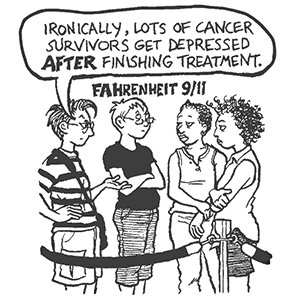
Dykes to Watch Out For (sometimes DTWOF) was a comic strip by Alison Bechdel, which ran from 1983 to 2008, and was one of the earliest ongoing representations of lesbians in popular culture and has been called ‘as important to new generations of lesbians as landmark novels like Rita Mae Brown’s ‘Rubyfruit Jungle’ (1973) and Lisa Alther’s ‘Kinflicks’ (1976) were to an earlier one.’
DTWOF chronicled the lives, loves, and politics of a fairly diverse group of characters (most of them lesbians) living in a medium-sized city in the United States, featuring both humorous soap opera storylines and biting topical commentary. The strip was carried in ‘Funny Times’ and a number of gay and lesbian newspapers. According to Bechdel, her strip was ‘half op-ed column and half endless, serialized Victorian novel.’ Characters reacted to contemporary events, including going to the Michigan Womyn’s Festival, Gay Pride parades, and protest marches and having heated discussions about day-to-day events, political issues and the way lesbian culture was changing.
Posted in Humor, Politics, Sex |
Leave a Comment »
April 18, 2012

Fighting in ice hockey is an established tradition of the sport in North America, with a long history involving many levels of amateur and professional play and including some notable individual fights. Although a source of criticism, it is a considerable draw for the sport. Fighting is usually performed by one or more enforcers, or ‘goons’—players whose role it is to fight and intimidate—on a given team and is governed by a complex system of unwritten rules that players, coaches, officials, and the media refer to as ‘the code.’
Some fights are spontaneous, while others are premeditated by the participants. While officials tolerate fighting during hockey games, they impose a variety of penalties on players who engage in fights. The NHL and most minor professional leagues in North America do not eject players outright for fighting, but major European and collegiate hockey leagues do, and multi-game suspensions may be added on top of the ejection.
read more »
Posted in Games, Health, Politics |
Leave a Comment »
April 18, 2012

Veganarchism is the political philosophy of veganism (more specifically animal liberation and earth liberation) and anarchism, creating a combined praxis that is designed to be a means for social revolution. This encompasses viewing the state as unnecessary and harmful to animals, both human and non-human, whilst practicing a vegan lifestyle. It is either perceived as a combined theory, or that both philosophies are essentially the same. It is further described as an anti-speciesist perspective on green anarchism, or an anarchist perspective on animal liberation. The philosophy was first popularized by Brian A. Dominick in ‘Animal Liberation and Social Revolution’ and later promoted by anarcho-punk band Virus using symbolism, ‘Roots of Compassion,’ a zine named ‘veganarchy,’ and political prisoner Jonny Albewhite.
Dominick describes veganarchists as either opposed to reformist measures for animals (considering them the task of liberals or progressives), such as granting non-humans suffrage, or include but do not limit their goals to changes within the law. He criticizes the need for the state to stand between humans and non-humans, detailing increased crime and violence due to alcohol prohibition and the war on drugs, believing a government orchestrated ‘War on Meat’ would only cause more problems rather than curb animal abuse and the reinforced desires for animal products; preferring instead a non-coercive approach to eliminating animal consumption.
Posted in Food, Politics |
Leave a Comment »


 The Daily Omnivore