December 31, 2011


‘The White Negro: Superficial Reflections on the Hipster’ is a 9,000 word essay by Norman Mailer that recorded a number of young white people in the 1920s, 1930s and 1940s who liked jazz and swing music so much that they adopted black culture as their own.
It was first published in the Summer 1957 issue of ‘Dissent,’ before being published separately by ‘City Lights.’ The so-called white negroes adopted black clothing styles, black jive language, and black music. They mainly associated with black people, distancing themselves from white society.
read more »
Posted in Language, Politics |
1 Comment »
December 30, 2011

Natalism [neyt-l-iz-uhm] is a belief that promotes human reproduction. The term is taken from the Latin adjective form for ‘birth,’ ‘natalis.’ Natalism promotes child-bearing and glorifies parenthood. It typically advocates policies such as limiting access to abortion and contraception, as well as creating financial and social incentives for the population to reproduce.
The degree of natalism is individual; the extreme end is ‘Natalism’ as a life stance (with the first letter capitalized), which holds natalism as of ultimate importance and everything else is only good to the extent it serves this purpose. The more moderate stance holds that there ought to be a higher rate of population growth than what is currently mainstream in industrialized countries. Philosophic motivations for natalism may include that of considering value in bringing potential future persons into existence.
read more »
Posted in Philosophy, Politics, Sex |
Leave a Comment »
December 30, 2011

‘Breeder‘ is a denigrating term for heterosexuals used in LGBT slang. It is often used pejoratively. The use in homosexual groups is drawn from the fact that their sexual activity cannot lead to reproduction, where as heterosexual sexual intercourse can, with implicit mocking by connotation of animal husbandry, the original usage of the word. Along these lines a particularly fecund woman may be referred to as a ‘brood sow,’ implying low ethical standards and an absence of due diligence in the reproductive process.
‘Breeder’ may also be used as a derogatory term by childfree people of any sexual orientation, to refer to parents who focus on their children and abandon their previous friends and lifestyle. The phrases ‘breeder, not parent’ (BNP) or ‘parent, not breeder’ (PNB) are used by some childfree communities to differentiate between what they regard as positive and negative parenting.
Posted in Politics, Sex |
1 Comment »
December 30, 2011

The Voluntary Human Extinction Movement, or VHEMT (pronounced ‘vehement’), is a movement which calls for the voluntary gradual self-extinction of the human species through abstaining from reproduction. VHEMT’s motto is ‘May we live long and die out.’ Proponents of VHEMT concepts are characterized either as supporters, or as volunteers (extinctionists).
Les U. Knight of Portland, Oregon is generally cited as founding VHEMT in 1991, although he does not take credit for it. Knight is the owner of vhemt.org and acts as a spokesman for the movement. In his mid-twenties, he underwent a vasectomy in support of his conviction that, ‘It’s obvious that the intentional creation of another [human being] by anyone anywhere can’t be justified today.’ During the 1970s, he joined the organization Zero Population Growth.
read more »
Posted in Death, Politics |
1 Comment »
December 30, 2011

Last Tango in Paris (Italian: ‘Ultimo Tango a Parigi’) is a 1972 Italian romantic drama film directed by Bernardo Bertolucci which portrays a recent American widower who takes up an anonymous sexual relationship with a young, soon-to-be-married Parisian woman. It stars Marlon Brando, Maria Schneider, and Jean-Pierre Léaud. The film’s raw portrayal of sexual violence and emotional turmoil led to international controversy and drew various levels of government censorship. The MPAA gave the film an X rating upon release in the United States. After revisions were made to the MPAA ratings code, it was classified as an NC-17 in 1997.
The idea grew from Bernardo Bertolucci’s sexual fantasies, stating ‘he once dreamed of seeing a beautiful nameless woman on the street and having sex with her without ever knowing who she was.’
read more »
Posted in Art, Politics, Sex |
Leave a Comment »
December 23, 2011

The Radium Girls were female factory workers who contracted radiation poisoning from painting watch dials with glow-in-the-dark paint at the United States Radium factory in Orange, New Jersey around 1917.
The women, who had been told the paint was harmless, ingested deadly amounts of radium by licking their paintbrushes to sharpen them. Some also painted their fingernails and teeth with the glowing substance. Five of the women challenged their employer in a court case that established the right of individual workers who contract occupational diseases to sue their employers.
read more »
Posted in Death, Money, Politics |
1 Comment »
December 23, 2011

Market failure occurs in economics when the allocation of goods and services by a free market is not efficient. In such cases the pursuit of pure self-interest leads to results that can be improved upon from the societal point-of-view. The first known use of the term by economists was in 1958, but the concept has been traced back to the Victorian philosopher Henry Sidgwick.
A market failure can occur for three main reasons: if the market is monopolized (a small group of businesses hold significant market power), if production of the good or service results in an externality (a cost or benefit that affects an unaffiliated third party), or if the good or service is a ‘public good’ (a non-excludable good like air).
read more »
Posted in Money, Politics |
Leave a Comment »
December 21, 2011
net.art refers to a group of artists who have worked in the medium of Internet art from 1994 on. The main members of this movement are Vuk Ćosić, Jodi.org, Alexei Shulgin, Olia Lialina, and Heath Bunting. Although this group was formed as a parody of avant garde movements by writers such as Tilman Baumgärtel, Josephine Bosma, Hans Dieter Huber and Pit Schultz, their individual works have little in common.
The term ‘net.art’ is also used as a synonym for net art or Internet art and covers a much wider range of artistic practices. In this wider definition, net.art means art that uses the Internet as its medium and that cannot be experienced in any other way. Often net.art has the Internet as (part of) its subject matter but it is not a requirement.
read more »
Posted in Art, Politics, Technology |
Leave a Comment »
December 20, 2011

Nettime is an internet mailing list that was founded in 1995 during the second meeting of the Medien Zentral Kommittee at the Venice Biennale. Founded by Geert Lovink and Pit Schultz, the list was meant to provide a space for a new form of critical discourse on and with the nets. Since 1995, Nettime has been recognized for building up the discourse of Netzkritik or Net Critique, providing a backdrop and context for the emergence of net.art and influencing critical net culture in general.
Often understood as a European ‘online salon,’ Nettime was initially a pre-publishing platform for international critical thinkers. Originally a mainly English language mailing list, other lists have been created for other languages. While the subscribers have changed over time, the list and lists have had the regular participation of such notable figures as: American poet John Perry Barlow, political writer Hakim Bey, art professor Ricardo Dominquez, Russian artist Alexei Shulgin, and DJ Spooky, among others. The lists has around 3500 subscribers.
Posted in Language, Politics, Technology |
Leave a Comment »
December 20, 2011

‘Series of tubes‘ is a phrase coined originally as an analogy by then Senator Ted Stevens (R-Alaska) to describe the Internet in the context of opposing network neutrality.
In 2006, he used this metaphor to criticize a proposed amendment to a committee bill that would have prohibited Internet service providers such as AT&T and Verizon Communications from charging fees to give some companies higher priority access to their networks or their customers. This metaphor has been widely ridiculed as demonstrating Stevens’s poor understanding of the Internet, despite the fact that he was in charge of regulating it.
read more »
Posted in Humor, Politics, Technology |
1 Comment »
December 20, 2011

In 2010, a new rule for the next NCAA football season, dubbed ‘The Tebow Rule‘ by media because it would have affected him, banned messages on eye paint. During his college football career, Tebow frequently wore references to biblical verses on his eye black. In the 2009 BCS Championship Game, he wore John 3:16 on his eye paint, and as a result, 92 million people searched ‘John 3:16’ on Google during or shortly after the game. Tebow stated of the searches ‘It just goes to show you the influence and the platform that you have as a student-athlete and as a quarterback at Florida.’
The NFL already has a rule prohibiting players from wearing messages on eye black; so, Tebow is not able to continue the practice in the NFL. Despite the media label, the NCAA denies the rule was influenced by Tebow particularly, since many other notable players (Reggie Bush and Terrelle Pryor for example) wear or have worn messages on eye black. An NCAA spokesman said ‘When this rule was proposed the committee did not focus on any one team or student athlete. That measure reinforces what the intended use of eye black is, which is to shade the eyes from the sun.’
Posted in Games, Philosophy, Politics |
Leave a Comment »
December 19, 2011
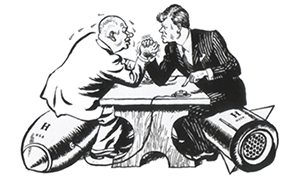

The game of chicken, also known as the hawk-dove or snowdrift game, is an influential model of conflict for two players in game theory. The principle of the game is that while each player prefers not to yield to the other, the worst possible outcome occurs when both players do not yield.
The name ‘chicken’ has its origins in a game in which two drivers drive towards each other on a collision course: one must swerve, or both may die in the crash, but if one driver swerves and the other does not, the one who swerved will be called a ‘chicken,’ meaning a coward; this terminology is most prevalent in political science and economics.
read more »
Posted in Games, Politics, Science |
Leave a Comment »



