December 14, 2011

Atari Democrat, a phrase first popularized during the early 1980s, references both the video game brand Atari and Democratic legislators who suggested that the support and development of high tech and related businesses would stimulate the economy and create jobs. A 1984 article for ‘The Philadelphia Inquirer,’ defined the term as ‘a young liberal trying to push the party toward more involvement with high-tech solutions.’ Other commentators discussed a generation gap which developed during the 1980s between older liberals who maintained an interest in traditional visions of social liberalism and Atari Democrats who attempted to find a middle ground:
‘When the Atari Democrats first emerged in the early Reagan years, their commitments to free markets and investment won them much criticism from older liberals, who considered their neo-liberalism as warmed-over Reaganism. Mr. Leahy, who combines his environmentalism with an old-fashioned commitment to social programs, argues that the cutbacks of the Reagan years suggested that it had been a mistake for members of his Congressional class to take the old programs for granted. But some of the Atari Democrats argue that their commitment to innovative uses of markets and to the environment are complementary. Mr. Wirth, for example, has sought to bring his two passions together by arguing that market forces can be harnessed to protect the environment and work better than ‘command-and-control regulations.’
Posted in Games, Money, Politics |
Leave a Comment »
December 13, 2011
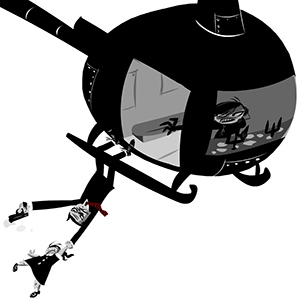
Black helicopters is a term which became popular in the US militia movement and its associated political circles in the 1990s as a symbol and warning sign of an alleged conspiratorial military takeover, though it has also been associated with men in black and similar conspiracies. Rumors circulated that, for instance, the UN patrolled the States with unmarked black helicopters, or that federal agents used black helicopters to enforce wildlife laws.
The concept springs from the basic truth that many government agencies and corporations do use helicopters, and that some of these helicopters are dark-colored or black. For instance, dark-colored military helicopters were deployed in the standoff at Ruby Ridge. Earlier tales from the 1970s linked them with UFO conspiracy theories.
read more »
Posted in Humor, Politics, War |
1 Comment »
December 13, 2011

In ethnolinguistics, an endonym [en-doe-nim] or autonym is a local name for a geographical feature, and an exonym [ex-o-nim] or xenonym is a foreign language name for it. Exonyms and endonyms can be names of places (toponym), ethnic groups (ethnonym), languages (glossonym), or individuals (personal name).
For example, China, India, Germany, Greece, Japan, and Korea are the English exonyms corresponding to the endonyms Zhongguo, Bharat, Deutschland, Hellas, Nippon, and Goryeo, respectively.
read more »
Posted in Language, Politics, World |
Leave a Comment »
December 13, 2011

Billboard Utilising Graffitists Against Unhealthy Promotions, or B.U.G.A. U.P. is an Australian subvertising artistic movement that detourns or modifies with graffiti billboard advertising that promotes something they deem unhealthy. The movement started in inner-city Sydney in 1979 and has been active ever since, although the late 70’s and early-mid 1980s is considered their most prolific period. The movement’s founder was Bill Snow, who continues to be active in anti-smoking and littering campaigns.
The movement aimed mainly at Cigarette and Alcohol advertising, often blanking out letters and adding others to promote their view that the product is unhealthy. Cola and soft drink ads were also targeted.
Posted in Money, Politics, World |
Leave a Comment »
December 13, 2011

The Billboard Liberation Front practices culture jamming (a tactic used by anti-consumerist social movements to disrupt or subvert mainstream cultural institutions, including corporate advertising) by altering billboards by changing key words to radically alter the message, often to an anti-corporate message.
It started in San Francisco in 1977 as an outgrowth of the Cacophony Society, a secret society responsible for a number of anarchic pranks.
Posted in Humor, Money, Politics |
Leave a Comment »
December 12, 2011

The Copyright Term Extension Act (CTEA) of 1998 extended copyright terms in the United States by 20 years. Since the Copyright Act of 1976, copyright would last for the life of the author plus 50 years, or 75 years for a work of corporate authorship. The Act extended these terms to life of the author plus 70 years and for works of corporate authorship to 120 years after creation or 95 years after publication, whichever endpoint is earlier. Copyright protection for works published prior to 1978, was increased by 20 years to a total of 95 years from their publication date.
This law, also known as the Sonny Bono Act, or as the Mickey Mouse Protection Act, effectively ‘froze’ the advancement date of the public domain in the United States for works covered by the older fixed term copyright rules. Under this Act, additional works made in 1923 or afterwards that were still protected by copyright in 1998 will not enter the public domain until 2019 or afterward (depending on the date of the product) unless the owner of the copyright releases them into the public domain prior to that or if the copyright gets extended again. Unlike copyright extension legislation in the European Union, the Sonny Bono Act did not revive copyrights that had already expired.
read more »
Posted in Money, Politics |
Leave a Comment »
December 12, 2011


Internet in a suitcase is a program reportedly developed or spearheaded by the U.S. Department of State to provide Internet and mobile phone service to dissidents that can bypass government censorship or shut down of telecommunications in countries such as the Islamic Republic of Iran, Syria and Libya. The plan reportedly involves utilizing common hardware components ‘into a package that could easily’ be smuggled ‘into a repressive country and quickly assembled to deliver wireless service across a wide area to maintain crucial communications between legitimately protesting citizens.’
Part of the operation includes a prototype ‘Internet in a suitcase’ being developed by a ‘group of young entrepreneurs’ led by Sascha Meinrath of the New America Foundation, a public policy think tank. Other projects employ tools ‘that have already been created by hackers in a so-called liberation-technology movement sweeping the globe,’ and stealth wireless networks.
Posted in Politics, Technology, World |
Leave a Comment »
December 12, 2011

The Stop Online Piracy Act (SOPA), also known as H.R.3261 was a proposed American law to stop copyright infringement on the Internet. The Internet community had major discussion over it, but the bill was not passed. The supporters claimed that current copyright laws are not effective in shutting down piracy websites. The opponents argued the law amounted to a broad censorship tool over the internet.
In protest, several major sites went dark on January 18, 2012. News aggregator site Reddit blocked access first and then others joined the movement. Wikipedia masked most of its pages with a banner to spotlight the value of open access to information on the Internet. Google put up a black censor board in front of its logo.
Posted in Money, Politics, Technology |
Leave a Comment »
December 12, 2011
The term First World Problems refers to issues perceived as difficult to those residing in the more developed nations in the global arena (i.e., the First World), but which are banal when compared to the difficulties encountered by those in the less developed Third World. First World Problems is often used in a derisive manner towards those who complain about the problems they experience in the ‘First World’ on a regular basis. However, it is also routinely used by scholars and economists in studying the relationship between the Third World and the First World.
The exact provenance of the term is uncertain, although some believe that it originated with comedic author David Rakoff, whose 2005 book ‘Don’t Get Too Comfortable’ is subtitled ‘The Indignities of Coach Class, the Torments of Low Thread Count, the Never-Ending Quest for Artisanal Olive Oil, and Other First World Problems.’ Many computer games, notably, provide a fascinating degree of First World escapism via a simulation of Third World Problems. For example, the infamous 1980s ASCII-based dungeon crawler ‘Rogue’ provided those First World denizens who had overcome the First World Problem of not owning a computer to experience such Third World Problems as starvation, existential ennui, and life-or-death hand-to-hand combat.
Posted in Money, Politics, World |
Leave a Comment »
December 11, 2011

Stieg Larsson (1954 – 2004) was a Swedish journalist and writer, best known for his ‘Millennium series’ of crime novels, which were published posthumously.
Larsson lived and worked much of his life in Stockholm, in the field of journalism and as an independent researcher of right-wing extremism.
read more »
Posted in Art, Language, Politics |
Leave a Comment »
December 8, 2011

The Double Cross System, or XX System, was a World War II anti-espionage and deception operation of the British military intelligence arm, MI5. Nazi agents in Britain – real and false – were captured, turned themselves in or simply announced themselves and were then used by the British to broadcast mainly disinformation to their Nazi controllers.
Its operations were overseen by the Twenty Committee under the chairmanship of John Cecil Masterman; the name of the committee comes from the number 20 in Roman numerals: ‘XX.’ The policy of MI5 during the war was initially to use the system for counter-espionage. It was only later that its potential for deception purposes was realized. Agents from both of the German intelligence services, the Abwehr and Sicherheitsdienst (SD), were apprehended.
read more »
Posted in Politics, War, World |
Leave a Comment »
December 7, 2011

Gerd Arntz (1900 – 1988) was a German Modernist artist – famous for his black and white woodcuts. A core member of the Cologne Progressives he was also a council communist. The Cologne Progressives participated in the revolutionary unions AAUD and its offshoot the AAUE in the 1920s, and in 1928 Arntz was contributing anti-parliamentary prints to its paper ‘Die Proletarische Revolution’ which called for workers to form and participate in worker’s councils. These political prints depicted the life of worker’s and the class struggle in abstracted figures in woodcuts.
In 1926 Otto Neurath sought his collaboration in designing pictograms for the ‘Vienna Method of Pictorial Statistics’ (‘Wiener Methode der Bildstatistik’; later renamed ‘Isotype’). From the beginning of 1929 Arntz worked at the Gesellschafts- und Wirtschaftsmuseum (Social and economic museum) directed by Neurath in Vienna. Eventually, Arntz designed around 4000 pictograms. After the brief civil war in Austria in 1934 he emigrated to the Netherlands, joining Neurath and Reidemeister in The Hague, where they continued their collaboration at the International Foundation for Visual Education.
Posted in Art, Language, Politics |
Leave a Comment »


 The Daily Omnivore