December 19, 2012
Epigenetics [ep-uh-juh-net-iks] refers to non-genetic, heritable characteristics: information other than that found in DNA that can be transmitted from parent to offspring, such as in the form of methylation of DNA (molecular markers attached at several points on a strand of DNA) or histone modification (histones are protein structures that tightly pack and unpack DNA, exposing and ‘expressing’ desired genes).
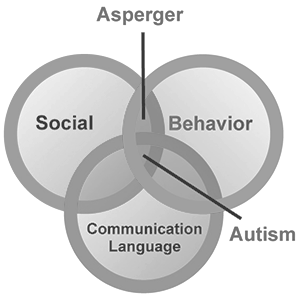
Autism spectrum disorder (ASD) includes autism, Asperger disorder (high-functioning autism), childhood disintegrative disorder, and pervasive developmental disorder-not otherwise specified.
read more »
Posted in Health, Science |
Leave a Comment »
December 19, 2012
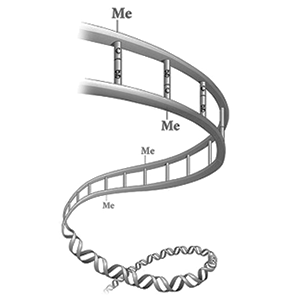
Epigenetics [ep-uh-juh-net-iks] is the study of changes in gene activity which are not caused by changes in the DNA sequence. More specifically, epigenetics is the study of gene expression, the way genes bring about their phenotypic effects (observable characteristics or traits).
Gene expression is the process by which the heritable information in a gene, the sequence of DNA base pairs, is made into a functional gene product, such as protein or RNA. The basic idea is that DNA is ‘transcribed’ into RNA, which is then ‘translated’ into proteins (which make many of the structures and all the enzymes in a cell or organism).
read more »
Posted in Health, Science |
Leave a Comment »
December 13, 2012

Psychohistory [sahy-koh-his-tuh-ree] is a fictional science in Isaac Asimov’s ‘Foundation’ universe which combines history, sociology, and mathematical statistics to make general predictions about the future behavior of very large groups of people. It was first introduced in the five short stories (1942–1944) which would later be collected as the 1951 novel ‘Foundation.’
Psychohistory depends on the idea that, while one cannot foresee the actions of a particular individual, the laws of statistics as applied to large groups of people could predict the general flow of future events. Asimov used the analogy of a gas: an observer has great difficulty in predicting the motion of a single molecule in a gas, but can predict the mass action of the gas to a high level of accuracy (physicists know this as the Kinetic theory). Asimov applied this concept to the population of his fictional Galactic Empire, which numbered a quintillion.
read more »
Posted in Art, Language, Science |
Leave a Comment »
December 12, 2012
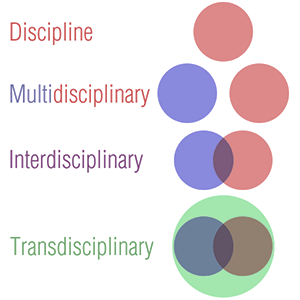
Transdisciplinarity connotes a research strategy that crosses many disciplinary boundaries to create a holistic approach.
It applies to research efforts focused on problems that cross the boundaries of two or more disciplines, such as research on effective information systems for biomedical research or bioinformatics, and can refer to concepts or methods that were originally developed by one discipline, but are now used by several others, such as ethnography, a field research method originally developed in anthropology but now widely used by other disciplines.
read more »
Posted in Education, Philosophy, Science |
Leave a Comment »
December 12, 2012

Interdisciplinarity involves the combining of two or more academic disciplines into one activity (e.g. a research project). It is about creating something new by crossing boundaries, and thinking across them. It is related to an interdiscipline (e.g. Sociolinguistics, Biosemiotics) which is an organizational unit that crosses traditional boundaries between academic disciplines or schools of thought, as new needs and professions have emerged.
Originally, the term interdisciplinary is applied within education and training pedagogies to describe studies that use methods and insights of several established disciplines or traditional fields of study. Interdisciplinarity involves researchers, students, and teachers in the goals of connecting and integrating several academic schools of thought, professions, or technologies – along with their specific perspectives – in the pursuit of a common task.
read more »
Posted in Education, Philosophy, Science |
Leave a Comment »
December 12, 2012
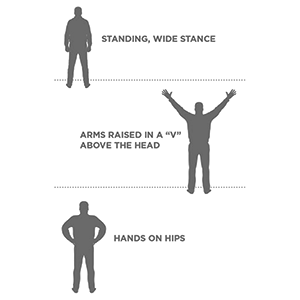
Amy Cuddy is an American social psychologist known for her studies of the relations between stereotyping and behavior. She is Associate Professor in the Negotiation, Organizations & Markets Unit at Harvard Business School. Cuddy studies the origins and outcomes of how people judge and influence each other.
She has conducted experimental and correlational research on stereotyping and discrimination against various groups (e.g., Asian Americans, elderly people, Latinos, working mothers), the causes and consequences of feeling ambivalent emotions (e.g., envy and pity), nonverbal behavior and communication, and hormonal responses to social stimuli. She is a sought-after speaker on the psychology of power, influence, nonverbal communication, and prejudice.
read more »
Posted in Education, Money, Science |
Leave a Comment »
December 12, 2012

The hormonal theory of sexuality holds that, just as exposure to certain hormones plays a role in fetal sex differentiation, such exposure also influences the sexual orientation that emerges later in the adult. Prenatal hormones may be seen as the primary determinant of adult sexual orientation, or a co-factor with genes, biological factors and/or environmental and social conditions. Differences in brain structure that come about from hormones and genes interacting on developing brain cells are believed to be the basis of sex differences in countless behaviors, including sexual orientation.
Prenatal factors that affect or interfere with the interaction of these hormones on the developing brain can influence later sex-typed behavior in children. This hypothesis is originated from countless experimental studies in non-human mammals, yet the argument that similar effects can be seen in human neurobehavioral development is a much debated topic among scholars. Recent studies, however, have provided evidence in support of prenatal androgen exposure influencing childhood sex-typed behavior.
read more »
Posted in Health, Science, Sex |
Leave a Comment »
December 12, 2012
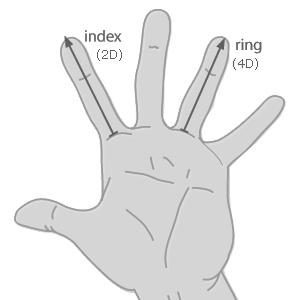
The digit ratio (the ratio of the lengths of different fingers) is possibly affected by exposure to androgen hormones (e.g. testosterone) while in the uterus. The index to ring finger ratio (2D:4D) in particular has been suggested as a crude measure for prenatal androgen exposure, with lower 2D:4D ratios pointing to higher androgen exposure.
A longer index finger will result in a ratio higher than 1, while a longer ring finger will result in a ratio of less than 1. The 2D:4D digit ratio is sexually dimorphic: while the second digit is typically shorter in both females and males, the difference between the lengths of the two digits is greater in males than females.
read more »
Posted in Health, Science, Sex |
Leave a Comment »
December 12, 2012

Allometry [uh-lom-i-tree] is the study of the relationship of body size to shape. In particular, it refers to the rate of growth of one part of the body compared to other parts. In most cases, the relative size of body parts changes as the body grows. Most allometric relationships are adaptive.
For example, organs which depend on their surface area (such as the intestine) grow faster as the body weight increases. Also, there are changes in allometry in the evolution of a clade (branches on the tree of life).
read more »
Posted in Science |
Leave a Comment »
December 12, 2012

Male pregnancy is the incubation of one or more embryos or fetuses by male members of any species. In nearly all sexually reproducing animal species, offspring are ordinarily carried by the female until birth, but in fish of the Syngnathidae family (pipefish and seahorses), males perform this function. They may possess a brood pouch on the trunk or tail (in other species, the eggs are merely attached to the male’s trunk or tail when the female lays them).
Fertilization may take place in the pouch or in the water before implantation, but in either case, syngnathids’ male pregnancy ensures them complete confidence of paternity. After implantation in or on the brood pouch or brood patch, the male incubates the eggs. Many species osmoregulate the brood pouch fluid to maintain proper pH for the developing embryos.
read more »
Posted in Health, Science, Sex |
1 Comment »
December 11, 2012
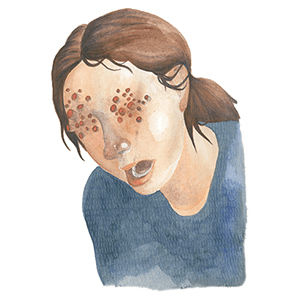
Trypophobia [try-poe-phobia] (sometimes called repetitive pattern phobia) is fear of or revulsion from clustered geometric shapes, especially small holes. It is not recognized in the Diagnostic and Statistical Manual of Mental Disorders, however thousands of people claim to be fearful of objects with small holes, such as beehives, ant holes, and lotus seed heads.
Research is limited and Arnold Wilkins and Geoff Cole, who claim to be the first to scientifically investigate, believe the reaction to be based on a biological revulsion, rather than a learned cultural fear. The term was coined in 2005, a combination of the Greek ‘trypo’ (punching, drilling or boring holes) and phobia.
Posted in Health, Science |
4 Comments »
December 6, 2012

Cannabinoids [kuh-nab-uh-noid] are a class of diverse chemical compounds that activate cannabinoid receptors (molecules on the surface of a cells in the brain and throughout the body, which receive chemical signals). After the receptor is engaged, multiple intracellular signal pathways are activated; researchers are still unraveling the precise mechanism at work.
Cannabinoid receptors are activated by endocannabinoids (produced naturally in the body), phytocannabinoids (found in plants), and synthetic cannabinoids (produced chemically in a lab). The most notable cannabinoid is the phytocannabinoid tetrahydrocannabinol (THC), the primary psychoactive compound of cannabis. However, there are known to exist dozens of other cannabinoids with varied effects. Before the 1980s, it was often speculated that cannabinoids produced their physiological and behavioral effects via nonspecific interaction with cell membranes, instead of interacting with specific membrane-bound receptors.
read more »
Posted in Drugs, Health, Science |
Leave a Comment »


 The Daily Omnivore