July 30, 2012
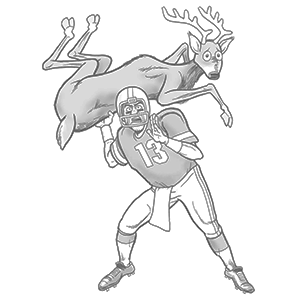
A self-serving bias is attributing successes to internal factors and failures to external factors. This bias is a mechanism for individuals to protect or enhance their own self-esteem.
A student who attributes a good grade on an exam to his or her own intelligence and hours of studying but a poor grade to the professor’s poor teaching ability and unfair test questions is exhibiting the self-serving bias. Studies have shown that similar attributions are made in various situations, such as the workplace, interpersonal relationships, sports, and consumer decisions.
read more »
Posted in Health, Science, World |
1 Comment »
July 30, 2012

Mistakes Were Made (But Not by Me) is a non-fiction book by social psychologists Carol Tavris and Elliot Aronson, first published in 2007. It deals with cognitive dissonance (discomfort caused by holding conflicting ideas simultaneously), self-serving bias (attributing successes to internal factors and failures to external factors), and other cognitive biases (deviations in judgment), using these psychological theories to illustrate how the perpetrators of hurtful acts justify and rationalize their behavior.
It describes a positive feedback loop of action and self-deception by which slight differences between people’s attitudes become polarized. Topics covered include: the doomsday cult described in ‘When Prophecy Fails’; the MMR vaccine controversy and Andrew Wakefield; marriage; day care sex abuse hysteria and false memory syndrome, confabulation of autobiographical memory; George W. Bush and the Iraq War; Criminal interrogations, trials, and capital punishment; Mel Gibson; and Oprah Winfrey and her involvement in the James Frey controversy.
Posted in Health, Language, Science |
Leave a Comment »
July 25, 2012

Common sense is ‘sound and prudent judgment based on a simple perception of the situation or facts.’ Thus, ‘common sense’ (in this view) equates to the knowledge and experience which most people already have, or which the person using the term believes that they do or should have. It is ‘the basic level of practical knowledge and judgment that we all need to help us live in a reasonable and safe way.’
However, identifying particular items of knowledge as ‘common sense’ is difficult. Philosophers may choose to avoid using the phrase when using precise language. Common sense remains a perennial topic in epistemology (the study of knowledge) and many philosophers make wide use of the concept or at least refer to it. Some related concepts include intuitions, pre-theoretic belief, ordinary language, the frame problem, foundational beliefs, good sense, endoxa, axioms, wisdom, folk wisdom, folklore, and public opinion.
read more »
Posted in Language, Philosophy, Science |
Leave a Comment »
July 25, 2012
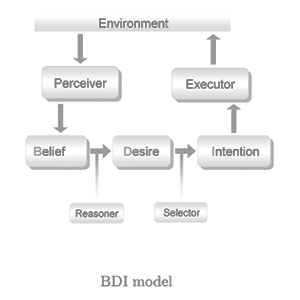
Folk psychology can be described as the common understanding of mental processes (e.g. pain, pleasure, excitement, anxiety, etc.), grounded in the use of common linguistic terms as opposed to technical or scientific jargon. Folk psychology and analogy are invariably linked, with both concepts having evolved as a result of the relationship they have with each other. Once technical terms are stripped, the easiest way to describe something is through references to familiar items. In this way, the union between analogy and folk psychology was inevitable.
Traditionally, the study of folk psychology has focused on how everyday people—those without formal training in the various academic fields of science—go about attributing mental states. This domain has primarily been centered on intentional states reflective of an individual’s beliefs and desires; each described in terms of everyday language and concepts such as ‘beliefs,’ ‘desires,’ ‘fear,’ and ‘hope.’ As a result of this among other intrinsic factors, the domain’s scope, method, and contributions are consistently subjects of dispute in many scientific quarters.
read more »
Posted in Health, Language, Science |
Leave a Comment »
July 25, 2012

Boundaries of the mind refers to a personality trait concerning the degree of separateness (‘thickness’) or connection (‘thinness’) between mental functions and processes. Thin boundaries are associated with open-mindedness, sensitivity, vulnerability, creativity, and artistic ability.
People with thin boundaries may tend to confuse fantasy and reality and tend to have a fluid sense of identity, so that they tend to merge or lose themselves in their relations with others. People with thick boundaries differentiate clearly between reality and fantasy and between self and other, and tend to prefer well-defined social structures. The concept was developed by psychoanalyst Ernest Hartmann from his observations of the personality characteristics of frequent nightmare sufferers. The construct has been particularly studied in relation to dream recall and lucid dreaming.
read more »
Posted in Health, Science |
Leave a Comment »
July 25, 2012
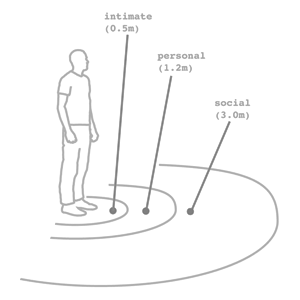
Proxemics [prok-see-miks] is a subcategory of the study of nonverbal communication along with haptics (touch), kinesics (body movement), vocalics (paralanguage), and chronemics (structure of time). Proxemics can be defined as ‘the interrelated observations and theories of man’s use of space as a specialized elaboration of culture.’
Edward T. Hall, the cultural anthropologist who coined the term in 1963, emphasized the impact of proxemic behavior (the use of space) on interpersonal communication. Hall believed that the value in studying proxemics comes from its applicability in evaluating not only the way man interacts with others in his daily life, but also ‘the organization of space in his houses and buildings, and ultimately the layout of his towns.’
read more »
Posted in Language, Science, World |
Leave a Comment »
July 18, 2012
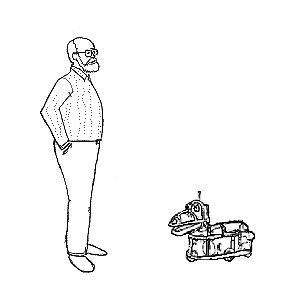
The intentional stance is a term coined by philosopher Daniel Dennett for the level of abstraction in which we view the behavior of a thing in terms of mental properties. It is part of a theory of mental content proposed by Dennett, which provides the underpinnings of his later works on free will, consciousness, folk psychology, and evolution.
‘Here is how it works: first you decide to treat the object whose behavior is to be predicted as a rational agent; then you figure out what beliefs that agent ought to have, given its place in the world and its purpose. Then you figure out what desires it ought to have, on the same considerations, and finally you predict that this rational agent will act to further its goals in the light of its beliefs. A little practical reasoning from the chosen set of beliefs and desires will in most instances yield a decision about what the agent ought to do; that is what you predict the agent will do.’
read more »
Posted in Health, Philosophy, Science |
Leave a Comment »
July 16, 2012
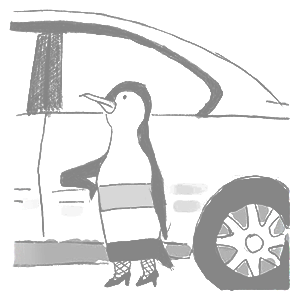
Different studies show animal prostitution exists among species such as Adélie Penguins, chimpanzees, and crab-eating macaque. Penguins use stones for building their nests. A shortage of stones led female Adélie Penguins to trade sex for stones. The female penguins, even when in a committed relationship, will exchange sexual favors with strange males for the pebbles they need to build their nests. Prostitution is also observed among chimpanzees, who trade food for sex.
The first documented case of prostitution in animals was reported in 1998 by Fiona Hunter and Lloyd Davis, who had spent five years observing the mating behavior of penguins. The study was conducted as part of an Antarctica New Zealand program on the Ross Island, approximately 800 miles from the South Pole. The female penguins observed under the study were coupled with males. The females will go outside alone to collect pebbles, but the males did not suspect their female partners. According to the observations and analysis made by Hunter, the prostitute penguins targeted single males, because if instead they picked a male penguin with a partner, the male penguin’s current partner will come in conflict with the prostitute female.
read more »
Posted in Money, Science, Sex |
1 Comment »
July 13, 2012
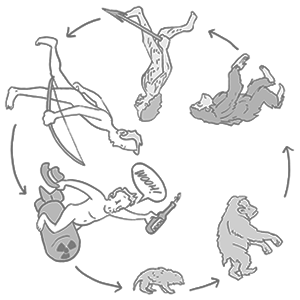
Fermi’s paradox asks why, given the age and size of the universe, we have not detected any other alien civilizations. Unless the Earth is very atypical, extraterrestrial life should be common. In an informal discussion in 1950, Italian American physicist Enrico Fermi questioned why, if a multitude of advanced extraterrestrial civilizations exists in the Milky Way galaxy, evidence such as spacecraft or probes is not seen.
Another common name for the phenomenon is silentium universi (‘the silence of the universe’). There have been attempts to resolve the paradox by locating evidence of extraterrestrial civilizations (e.g. SETI), along with proposals that such life could exist without human knowledge. Counterarguments suggest that intelligent extraterrestrial life does not exist or occurs so rarely or briefly that humans will never make contact with it.
read more »
Posted in Philosophy, Science, Technology |
3 Comments »
July 11, 2012

Mosquito control manages the population of mosquitoes to reduce their damage to human health, economies, and enjoyment. Mosquito control is a vital public-health practice throughout the world and especially in the tropics because mosquitoes spread many diseases, such as malaria. Mosquito-control operations are targeted against three different problems:
Nuisance mosquitoes (bother people around homes or in parks and recreational areas); Economically important mosquitoes (reduce real estate values, adversely affect tourism and related business interests, or negatively impact livestock or poultry production); and Public health (focusing on mosquitoes as vectors, or transmitters, of infectious disease).
read more »
Posted in Health, Money, Science |
Leave a Comment »
July 10, 2012

Time perception is a field of study within psychology and neuroscience; it refers to the sense of time, which differs from other senses since time cannot be directly perceived but must be reconstructed by the brain. Humans can perceive relatively short periods of time, in the order of milliseconds, and also durations that are a significant fraction of a lifetime. Human perception of duration is subjective and variable.
Some researchers attempt to categorize people by how they differ in their perception of time. Pioneering work, emphasizing species-specific differences, was done by Estonian naturalist Karl Ernst von Baer. Experimental work began under the influence of the psycho-physical notions of Gustav Theodor Fechner with studies of the relationship between perceived and measured time. Work with animals conducted by German biologist Jakob von Uexküll included measurement of length of momentum in snails.
read more »
Posted in Health, Science |
Leave a Comment »
July 3, 2012

A derecho [deh-rey-cho] is a widespread and damaging group of severe thunderstorms which often represent with rapid forward speeds. They have a distinct appearance on radars, known as bow echos (after an archer’s bow). The common definition of the word is: a thunderstorm complex that produces a damaging wind swath of at least 240 miles, featuring a concentrated area of convectively induced wind gusts exceeding 58 mph. Some studies add further criteria, such as a requirement that no more than two or three hours separate any two successive wind reports.
Unlike other thunderstorms, which typically can be heard in the distance when approaching, a derecho seems to strike suddenly. Within minutes, extremely high winds can arise, strong enough to knock over highway signs and topple large trees. These winds are accompanied by spraying rain and frequent lightning from all directions. It is dangerous to drive under these conditions, especially at night, because of blowing debris and obstructed roadways. A derecho moves through quickly, but can do much damage in a short period of time.
read more »
Posted in Death, Science, World |
Leave a Comment »



 The Daily Omnivore