June 21, 2012

‘Simulacra and Simulation‘ [sim-yuh-ley-kruh / sim-yuh-ley-shuhn] is a philosophical treatise by French sociologist Jean Baudrillard seeking to interrogate the relationship among reality, symbols, and society. A simulacrum (singular form of simulacra) in an imperfect simulation (a recreation of something). Baudrillard claims that our current society has replaced all reality and meaning with symbols and signs, and that human experience is of a simulation of reality.
Moreover, these simulacra are not merely mediations of reality, nor even deceptive mediations of reality; they are not based in a reality nor do they hide a reality, they simply hide that anything like reality is irrelevant to our current understanding of our lives. The simulacra that Baudrillard refers to are the significations and symbolism of culture and media that construct perceived reality, the acquired understanding by which our lives and shared existence is and are rendered legible; Baudrillard believed that society has become so saturated with these simulacra and our lives so saturated with the constructs of society that all meaning was being rendered meaningless by being infinitely mutable. Baudrillard called this phenomenon the ‘precession of simulacra.’
read more »
Posted in Language, Philosophy, Science |
Leave a Comment »
June 7, 2012
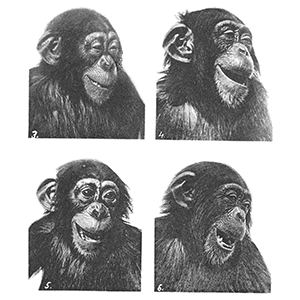
Laughter in animals other than humans describes animal behavior which resembles human laughter. Self awareness is conscious concomitant of the physiological processes involving laughter or smiling reflex (response) and its grades, degrees, or spectrum varies according to phylogenetic development, with no clear cut demarcation. The emotional ingredients (such as contempt, hatred, ridicule, sarcasm, love, amusement etc.) are variable and involve different neurophysiological and physiological processes.
Chimpanzees, gorillas, bonobos and orangutans show laughter-like vocalizations in response to physical contact, such as wrestling, play chasing, or tickling. This is documented in wild and captive chimpanzees. Chimpanzee laughter is not readily recognizable to humans as such, because it is generated by alternating inhalations and exhalations that sound more like panting or screeching. The differences between chimpanzee and human laughter may be the result of adaptations that have evolved to enable human speech. It is hard to tell, though, whether or not the chimpanzee is expressing joy.
read more »
Posted in Humor, Science |
1 Comment »
June 7, 2012

A smile is a facial expression formed by flexing the muscles near both ends of the mouth. The smile can also be found around the eyes (‘Duchenne Smiling’). Among humans, it is an expression denoting pleasure, joy, happiness, or amusement, but can also be an involuntary expression of anxiety, in which case it is known as a grimace. Smiling is something that is understood by everyone despite culture, race, or religion; it is internationally known.
Cross-cultural studies have shown that smiling is a means of communicating emotions throughout the world. But there are large differences between different cultures. A smile can also be spontaneous or artificial. Many biologists think the smile originated as a sign of fear. Primalogist Signe Preuschoft traces the smile back over 30 million years of evolution to a ‘fear grin’ stemming from monkeys and apes who often used barely clenched teeth to portray to predators that they were harmless. Biologists believe the smile has evolved differently among species and especially among humans.
read more »
Posted in Science, World |
Leave a Comment »
June 7, 2012

A cultural universal is an element, pattern, trait, or institution that is common to all human cultures worldwide. Taken together, the whole body of cultural universals is known as the human condition. Evolutionary psychologists hold that behaviors or traits that occur universally in all cultures are good candidates for evolutionary adaptations. Some anthropological and sociological theorists that take a cultural relativist perspective may deny the existence of cultural universals: the extent to which these universals are ‘cultural’ in the narrow sense, or in fact biologically inherited behavior is an issue of ‘nature versus nurture.’
Anthropological universals include: Language and Cognition (e.g. language employed to manipulate others, language employed to misinform or mislead, binary cognitive distinctions, color terms for black and white, figurative speech and metaphors, taboo utterances, and units of time); Society (e.g. personal names, families, laws, moral sentiments, promises, prestige inequalities, statuses and roles, leaders, property, gender roles, male dominated public/political realm, males more aggressive and more prone to violence and theft, marriage, incest avoidance, rape prohibitions, etiquette, inheritance rules, gift giving, redress of wrongs, sexual jealousy, shame, territoriality, visiting, and trade); Myth and Ritual (e.g. magical thinking, dream interpretation, proverbs, poetry, medicine, rites of passage, music, dance, play, toys, mourning, feasting, body adornment, and hairstyles); and Technology (e.g. shelter, control of fire, tools, weapons, containers, cooking, levers, tying and weaving).
Posted in Language, Science, World |
Leave a Comment »
June 7, 2012


The evolutionary psychology of religion is the study of religious belief using evolutionary psychology principles. As with all other organs and organ functions, the brain and cognition’s functional structure have been argued to have a genetic basis, and are therefore subject to the effects of natural selection and evolution. Like other organs and tissues, this functional structure should be universally shared amongst humans and should solve important problems of survival and reproduction. Evolutionary psychologists seek to understand cognitive processes, religion in this case, by understanding the survival and reproductive functions they might serve.
There is general agreement among scientists that a propensity to engage in religious behavior evolved early in human history. However, there is disagreement on the exact mechanisms that drove the evolution of the religious mind. There are two schools of thought. One is that religion itself evolved due to natural selection and is an adaptation, in which case religion conferred some sort of evolutionary advantage. Alternatively, religious beliefs and behaviors may have emerged as by-products of other adaptive traits without initially being selected for because of their own benefits (called spandrels).
read more »
Posted in Health, Philosophy, Science |
Leave a Comment »
June 7, 2012
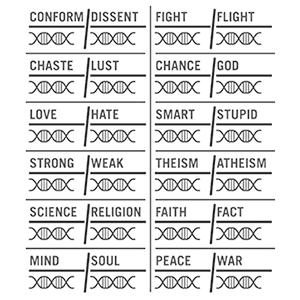
The evolutionary origin of religions theorizes about the emergence of religious behavior during the course of human evolution. Humanity’s closest living relatives are common chimpanzees and bonobos. These primates share a common ancestor with humans who lived between four and six million years ago. It is for this reason that chimpanzees and bonobos are viewed as the best available surrogate for this common ancestor.
Anthropologist Barbara King argues that while non-human primates are not religious, they do exhibit some traits that would have been necessary for the evolution of religion. These traits include high intelligence, a capacity for symbolic communication, a sense of social norms, realization of ‘self’ and a concept of continuity. There is inconclusive evidence that Homo neanderthalensis may have buried their dead. Elephants are the only other species known to have any recognizable ritual surrounding death. Ecologist Marc Bekoff, however, argues that many species grieve death and loss.
read more »
Posted in Philosophy, Science |
1 Comment »
June 1, 2012
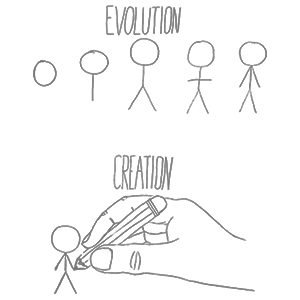
Irreducible complexity is an argument by proponents of intelligent design that certain biological systems are too complex to have evolved from simpler, or ‘less complete’ predecessors, through natural selection acting upon a series of advantageous naturally occurring, chance mutations.
The argument is central to intelligent design, and is rejected by the scientific community at large, which overwhelmingly regards intelligent design as pseudoscience. Irreducible complexity is one of two main arguments (both discredited) used by intelligent design proponents, the other being specified complexity (which singles out patterns that are both specified and complex as markers of design by an intelligent agent).
read more »
Posted in Philosophy, Science |
1 Comment »
May 31, 2012

‘Teach the Controversy‘ is the name of a campaign by the Discovery Institute (a conservative Christian think tank based in Seattle) to promote a variant of traditional creationism, intelligent design, while attempting to discredit evolution in US public high school science courses.
The central claim is that fairness and equal time requires educating students with a ‘critical analysis of evolution’ where ‘the full range of scientific views,’ evolution’s ‘unresolved issues,’ and the ‘scientific weaknesses of evolutionary theory’ will be presented and evaluated alongside intelligent design concepts like irreducible complexity. The overall goal of the movement is to ‘defeat [the] materialist world view’ represented by the theory of evolution and replace it with ‘a science consonant with Christian and theistic convictions.’
read more »
Posted in Education, Philosophy, Science |
Leave a Comment »
May 25, 2012

The memory-prediction framework is a theory of brain function that was created by Jeff Hawkins and described in his 2004 book, ‘On Intelligence.’ This theory concerns the role of the mammalian neocortex and its associations with the hippocampus and the thalamus in matching sensory inputs to stored memory patterns and how this process leads to predictions of what will happen in the future.
The theory is motivated by the observed similarities between the brain structures (especially neocortical tissue) that are used for a wide range of behaviours available to mammals. It posits that the remarkably uniform physical arrangement of cortical tissue reflects a single principle or algorithm which underlies all cortical information processing.
read more »
Posted in Health, Science |
Leave a Comment »
May 25, 2012

Encephalization Quotient [en-sefa-lie-zay-shun] (EQ) is a measure of relative brain size defined as the ratio between actual brain mass and predicted brain mass for an animal of a given size, which is hypothesized to be a rough estimate of the intelligence of the animal. This is a more refined measurement than the raw brain-to-body mass ratio, as it takes into account allometric effects (changes in proportion of various parts of an organism as a consequence of growth).
The relationship, expressed as a formula, has been developed for mammals, and may not yield relevant results when applied outside this group. Brain size usually increases with body size in animals. The relationship is not linear, however. Generally, small mammals have relatively larger brains than big ones. Mice have a direct brain/body size ratio similar to humans (1/40), while elephants have a comparatively small brain/body size (1/560), despite elephants being quite intelligent animals.
read more »
Posted in Science |
Leave a Comment »
May 21, 2012

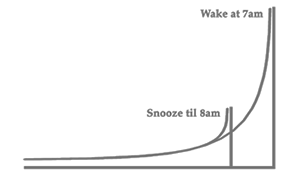
In economics, hyperbolic discounting is a time-inconsistent model of discounting. Given two similar rewards, humans show a preference for one that arrives sooner rather than later. Humans are said to discount the value of the later reward, by a factor that increases with the length of the delay. This process is traditionally modeled in form of exponential discounting, a time-consistent model of discounting.
A large number of studies have since demonstrated that the constant discount rate assumed in exponential discounting is systematically being violated. Hyperbolic discounting is a particular mathematical model devised as an improvement over exponential discounting. Hyperbolic discounting has been observed in humans and animals.
read more »
Posted in Money, Science |
1 Comment »
May 21, 2012
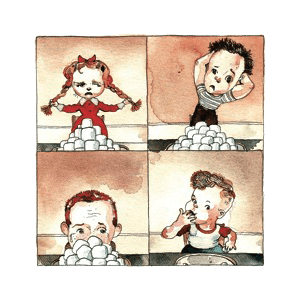
Delayed gratification denotes a person’s ability to wait in order to obtain something that he or she wants. This intellectual attribute is also called impulse control, will power, self control, and ‘low’ time preference, in economics. Delay discounting is defined as ‘the preference for smaller immediate rewards over larger but delayed rewards and to the well established fact that the subjective value of reward decreases with increasing delay to its receipt.’ Sociologically, good impulse control is considered a positive personality trait.
Moreover, people who lack the psychological trait of being able to delay gratification are said to require instant gratification and might suffer poor impulse control. The Stanford Marshmallow Experiment indicates that good impulse control might be psychologically important for academic achievement and for success in adult life.
read more »
Posted in Health, Science |
1 Comment »


 The Daily Omnivore