July 15, 2011


Antiscience is a position that rejects science and the scientific method. People holding antiscientific views are generally skeptical that science is an objective method, as it purports to be, or that it generates universal knowledge.
They also contend that scientific reductionism (reducing complex things to the interactions of their parts, or to simpler or more fundamental things) is a limited means of reaching understanding of the complex world we live in. Antiscience proponents also criticize what they perceive as the unquestioned privilege, power and influence science seems to wield in society, industry and politics; they object to what they regard as an arrogant or closed-minded attitude amongst scientists.
read more »
Posted in Philosophy, Politics, Science |
Leave a Comment »
July 14, 2011


Pseudoscience refers to concepts that are presented as scientific, but which do not adhere to a valid scientific method, or cannot be reliably tested. Pseudoscience is often characterized by the use of vague, exaggerated or unprovable claims, an over-reliance on confirmation rather than rigorous attempts at refutation, a lack of openness to evaluation by other experts, and a general absence of systematic processes to rationally develop theories. So-called ‘Pop science’ blurs the divide between science and pseudoscience among the general public, and may also involve science fiction (it is disseminated to, and can also easily emanate from, persons not accountable to scientific methodology and expert peer review).
Pseudoscientific beliefs are widespread, even among public school science teachers and newspaper reporters. The demarcation problem between science and pseudoscience has ethical political implications (as well as philosophical and scientific). Differentiating science from pseudoscience has practical implications in the case of health care, expert testimony, environmental policies, and science education. Distinguishing scientific facts and theories from pseudoscientific beliefs such as those found in astrology, medical quackery, and occult beliefs combined with scientific concepts, is part of science education and scientific literacy.
read more »
Posted in Language, Science |
Leave a Comment »
July 13, 2011

The Tetris effect occurs when people devote sufficient time and attention to an activity that it begins to overshadow their thoughts, mental images, and dreams. People who play the video game Tetris for a prolonged amount of time may then find themselves thinking about ways different shapes in the real world can fit together, such as the boxes on a supermarket shelf or the buildings on a street. In this sense, the Tetris effect is a form of habit. They might also dream about falling Tetris shapes when drifting off to sleep or see images of falling Tetris shapes at the edges of their visual fields or when they close their eyes. In this sense, the Tetris effect is a form of hallucination or hypnagogic imagery.
The Tetris effect can occur with other video games, with any prolonged visual task (such as classifying cells on microscope slides, weeding, picking or sorting fruit, flipping burgers, driving long distances, or playing board games such as chess or go), and in other sensory modalities. For example, there is the tendency for a catchy tune to play out unbidden in one’s mind (an earworm). In kinesthesis, a person newly on land after spending long periods at sea may move with an unbidden rocking motion, having become accustomed to the ship making such movements (known as sea legs or mal de debarquement). Computer programmers and developers sometimes have similar experiences, and report dreaming about code when they sleep at night.
read more »
Posted in Games, Language, Science |
1 Comment »
July 13, 2011

Earworm, a loan translation of the German ‘ohrwurm,’ is a portion of a song or other music that repeats compulsively within one’s mind, put colloquially as ‘music being stuck in one’s head.’ Use of the English translation was popularized by James Kellaris, a marketing researcher at the University of Cincinnati, and American cognitive psychologist Daniel Levitin. Kellaris’ studies demonstrated that different people have varying susceptibilities to earworms, but that almost everybody has been afflicted with one at some time or another. The psychoanalyst Theodor Reik used the term ‘haunting melody’ to describe the psychodynamic features of the phenomenon. The term Musical Imagery Repetition (MIR) was suggested by neuroscientist and pianist Sean Bennett in 2003 in a scientifically researched profile of the phenomenon. Another scientific term for the phenomenon, ‘involuntary musical imagery,’ or INMI, was suggested by the neurologist Oliver Sacks in 2007.
People with obsessive-compulsive disorder (OCD) are more likely to report being troubled by ear worms – in some cases, medications for OCD can minimize the effects. The best way to eliminate an unwanted earworm is to simply play a different song. Supposedly, some songs are better for this purpose than others, such as the theme song to ‘Gilligan’s Island’ or ‘The Lion Sleeps Tonight.’ Arthur C. Clarke’s 1956 short story ‘The Ultimate Melody’ offers up a science fictional explanation for the phenomenon. The story is about a scientist who develops the ultimate melody—one that so compels the brain that its listener becomes completely and forever enraptured by it. He succeeds, and is found in a catatonia from which he never awakens.
Posted in Art, Language, Science |
Leave a Comment »
July 11, 2011

Cats feed on small prey, primarily birds and rodents. Feral cats and house cats that are free-fed tend to consume many small meals in a single day, although the frequency and size of meals varies between individuals. Cats use two hunting strategies, either stalking prey actively, or waiting in ambush until an animal comes close enough to be captured.
They often ambush outside burrows, but tend to actively stalk birds. Most breeds of cat have a noted fondness for settling in high places, or perching. In the wild, a higher place may serve as a concealed site from which to hunt; domestic cats may strike prey by pouncing from such a perch as a tree branch, as does a leopard.
read more »
Posted in Food, Science |
Leave a Comment »
July 11, 2011
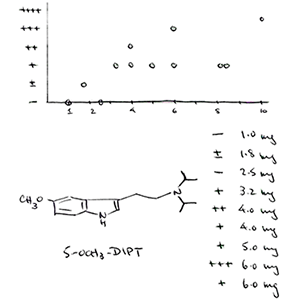
The Shulgin Rating Scale is a simple scale for reporting the subjective effect of psychoactive substances at a given dosage, and at a given time.
The system was developed for research purposes by the American biochemist Alexander Shulgin and detailed in his book ‘PiHKAL’ (‘Phenethylamines I Have Known And Loved: A Chemical Love Story’).
read more »
Posted in Drugs, Health, Science |
Leave a Comment »
July 6, 2011

The EcoSphere is sealed blown-glass miniature aquarium produced by Ecosphere Associates, Inc., of Tucson, Arizona, United States. Spherical or ovoid, the aquaria range from roughly baseball-size to soccer-ball-size. They are sold worldwide as scientific novelties and decorative objects. The spheres are populated by tiny red-pink shrimp, which swim energetically around the aquarium, eat the brown bacterial and algal scum on the glass, consume the filamentous green algae which sometimes forms a globular pillow in the water, and perch on a fragment of coral.
Each EcoSphere is a materially closed ecological systems which is self-sustaining over a period of years. At room temperature, and with only low inputs of light, the algae produce oxygen which supports the shrimp and bacteria. Bacteria break down the shrimps’ wastes. The breakdown products provide nutrients to the algae and bacteria upon which the shrimp feed. The manufacturer states that shrimp live in the EcoSphere for an average of 2 to 3 years, and are known to live over 10 years.
read more »
Posted in Art, Science |
Leave a Comment »
July 4, 2011

Cultural cringe, in cultural studies and social anthropology, is an internalized inferiority complex which causes people in a country to dismiss their own culture as inferior to the cultures of other countries.
It is closely related, although not identical, to the concept of colonial mentality, and is often linked with the display of anti-intellectual attitudes towards thinkers, scientists and artists who originate from a colonial or post-colonial nation. It can also be manifested in individuals in the form of ‘cultural alienation.’ In many cases, cultural cringe, or an equivalent term, is an accusation made by a fellow-national, who decries the inferiority complex and asserts the merits of the national culture.
read more »
Posted in Politics, Science, World |
Leave a Comment »
June 29, 2011
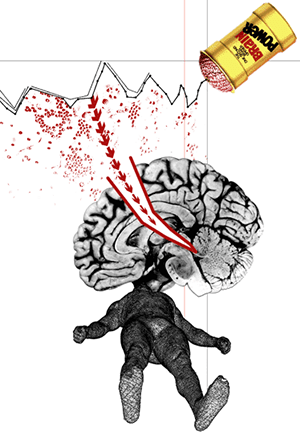
Latent inhibition (LI) is a technical term used in Classical conditioning (Pavlovian reinforcement) that refers to the natural tendency to tune out familiar stimuli. Individuals take longer to become aware of common stimuli than novel ones. It is ‘a measure of reduced learning about a stimulus to which there has been prior exposure without any consequence.’ Latent inhibition occurs when voluntarily trying to ignore an ongoing sound (like an air conditioner) or not hear the conversation of others.
This tendency to disregard or even inhibit formation of memory (by preventing associative learning of observed stimuli) is an unconscious response, and is assumed to prevent sensory and cognitive overload. Latent inhibition is observed in many species, and is believed to be an integral part of learning, enabling an organism to interact successfully in an environment.
read more »
Posted in Drugs, Health, Science |
Leave a Comment »
June 28, 2011

String theory is the name for a number of mathematical models that want to find a common explanation for the four main forces that have so far been observed in nature. These forces are gravity, the electromagnetic force, the strong nuclear force and the weak nuclear force, respectively. Classical physics says that the universe is made of small particles (points) which are basically static and unchanging. String theory says that the particle is a string/line (not a particle/point) that forms these four different forces by vibrating in different ways.
String Theory suggests that the universe is similar to a very big guitar. The strings upon the guitar are one dimensional and vibrate to take the form of all matter. String theory suggests that when these tiny loops move really, really fast back and forth in different and diverse ways, each of which is a different type of matter. These changes in oscillation can be hard to detect, as the strings are oscillating in at least 10 different dimensions.
read more »
Posted in Science |
Leave a Comment »
June 28, 2011

The Theory of Everything (TOE) refers to the attempted unification of several major theories of physics.
The four basic forces of nature are gravity, the strong nuclear force, the nuclear weak force, and the electromagnetic force. The theory of general relativity explains gravity, and quantum mechanics explains the other three forces. Right now, no one theory that everyone accepts can explain all four forces. String theory is a theory that could become the ‘theory of everything.’
read more »
Posted in Science |
Leave a Comment »
June 28, 2011

Technogaianism [tek-noh-guy-uh-niz-uhm] is a ‘bright green’ environmentalist stance of active support for the research, development and use of emerging and future technologies to help restore Earth’s environment. Technogaians argue that developing safe, clean, alternative technology should be an important goal of environmentalists.
This point of view is different from the default position of radical environmentalists and a common opinion that all technology necessarily degrades the environment, and that environmental restoration can therefore occur only with reduced reliance on technology. Technogaians argue that technology gets cleaner and more efficient with time.
read more »
Posted in Science, Technology, World |
Leave a Comment »




 The Daily Omnivore