March 3, 2011


An optical illusion is characterized by visually perceived images that differ from objective reality. An illusion is different from a hallucination; a hallucination is sensing something which is not real, but an illusion is interpreting what we sense wrongly.
The information gathered by the eye is processed in the brain to give a percept that does not tally with a physical measurement of the stimulus source. There are three main types: literal optical illusions that create images that are different from the objects that make them, physiological ones that are the effects on the eyes and brain of excessive stimulation of a specific type (brightness, tilt, color, movement), and cognitive illusions where the eye and brain make unconscious inferences.
Posted in Art, Science |
Leave a Comment »
March 3, 2011
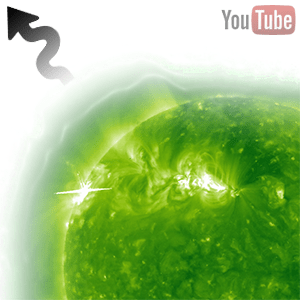
A coronal mass ejection (CME) is a massive burst of solar wind, plasma, and magnetic fields rising above the solar corona or being released into space. CMEs are often associated with other forms of solar activity, most notably solar flares, but a causal relationship has not been established. Most ejections originate from active regions on Sun’s surface, such as groupings of sunspots associated with frequent flares.
Posted in Science |
Leave a Comment »
March 3, 2011
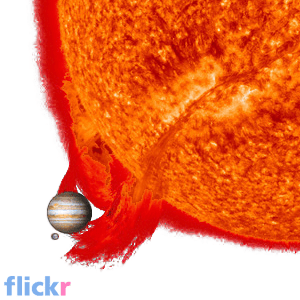
A prominence is a large, bright feature extending outward from the Sun’s surface, often in a loop shape. Prominences are anchored to the Sun’s surface and extend outwards into the Sun’s corona. While the corona consists of extremely hot ionized gases, known as plasma, which do not emit much visible light, prominences contain much cooler plasma. A prominence forms over timescales of about a day, and stable prominences may persist in the corona for several months. Some prominences break apart and give rise to coronal mass ejections.
A typical prominence extends over many thousands of kilometers; the largest on record was observed by the Solar and Heliospheric Observatory (SOHO) in 2010 and is estimated at over 700,000 kilometres (430,000 mi) long – roughly the radius of the Sun.
Posted in Science |
Leave a Comment »
March 3, 2011
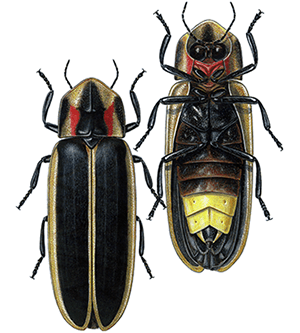
Crepuscular [kri-puhs-kyuh-ler] refers to animals that are primarily active during dawn and dusk. The term is derived from the Latin word ‘crepusculum,’ meaning ‘twilight.’ Crepuscular animals may also be active on a bright moonlit night. Some species are active only in the dawn (matutinal) or only in the dusk (vespertine). Many animals that are casually described as nocturnal are in fact crepuscular, including most cats. Others crepuscular species include include dogs, rabbits, pigs, rats, deer, skunks, and wombats. Many moths, beetles, flies, and other insects are crepuscular as well.
The patterns of activity are thought to be an antipredator adaptation. Many predators forage most intensely at night, while others are active at mid-day and see best in full sun. Thus the crepuscular habit may reduce predation. Some species have different habits in the absence of predators. For example, the Short-eared Owl is crepuscular on those of the Galápagos Islands that have buzzard species, but diurnal on those without. Additionally, in hot areas, it may be a way of avoiding thermal stress while capitalizing on available light.
Posted in Language, Science |
Leave a Comment »
March 3, 2011
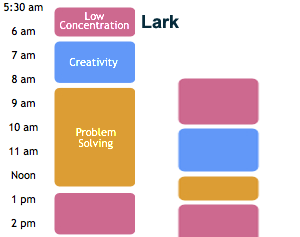

Chronotype is an attribute of animals, including human beings, reflecting at what time of the day their physical functions (hormone level, body temperature, cognitive faculties, eating and sleeping) are active. This phenomenon is commonly reduced to sleeping habits only, referring to people as ‘larks’ and ‘owls’ where morning people wake up early and are most alert in the first part of the day, and evening people are most alert in the late evening hours and prefer to go to bed late.
read more »
Posted in Health, Science |
Leave a Comment »
March 3, 2011
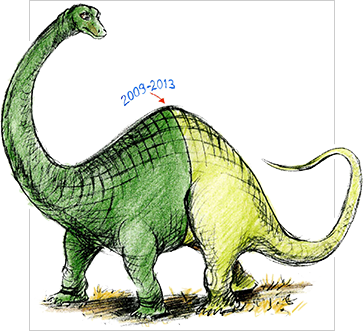
Peak oil is the idea that at some point a country, or the world, will be producing the most oil it can ever produce at one time. After this point, less oil will be produced and therefore people will have to use less oil because it will cost more money. The first person to come up with this idea was M.K. Hubbert, a U.S. geoscientist who worked at Shell, who said that a graph of oil production looks like a curve (which we now call Hubbert’s Curve).
Hubbert drew a graph in 1956 that predicted that the United States would reach its peak oil in the early 1970s, and the United States did indeed reach its peak oil in the early 1970s. It is unclear as to when the world’s peak oil will happen, though most scientists agree that it was reached in the early 2000s or will be reached before 2020. For example, the International Energy Agency (IEA) has said that peak oil may have happened in 2006.
Posted in Money, Politics, Science |
Leave a Comment »
March 2, 2011
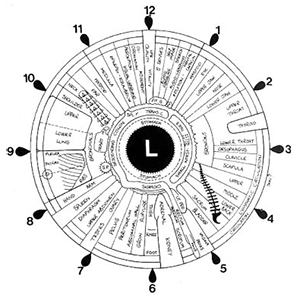
Iridology is a pseudoscience whose proponents believe that patterns, colors, and other characteristics of the iris can be examined to determine information about a patient’s systemic health. Practitioners match their observations to iris charts, which divide the iris into zones that correspond to specific parts of the human body.
Posted in Philosophy, Science |
Leave a Comment »
March 1, 2011

Hallucigenia [huh-loo-suh-jane-ee-uh] is an extinct genus of animal found in British Columbia, Canada. The genus name was coined by English paleontologist, Simon Conway Morris in 1979. He named the genus Hallucigenia, because of its ‘bizarre and dream-like quality’ (like a hallucination).
Hallucigenia was initially considered by Stephen Jay Gould to be unrelated to any living species, but most palaeontologists now believe that the species was a relative of modern arthropods.
Posted in Science |
Leave a Comment »
March 1, 2011
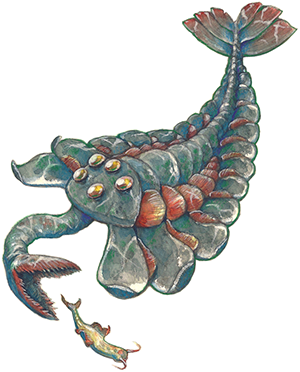
Opabinia [oh-puh-bin-ee-uh] is an extinct animal found in Cambrian fossil deposits. Its sole species, Opabinia regalis, is known from the Middle Cambrian Burgess Shale of British Columbia. The discoverer of Opabinia, American paleontologist, Charles Doolittle Walcott, named it after a local mountain, Opabin Peak in the Canadian Rockies.
Thirty specimens of Opabinia are known and each ranges in size from 40-70 mm. The most intriguing feature of Opabinia are its five eyes found on the dorsal surface of the head.
Posted in Science |
Leave a Comment »
March 1, 2011

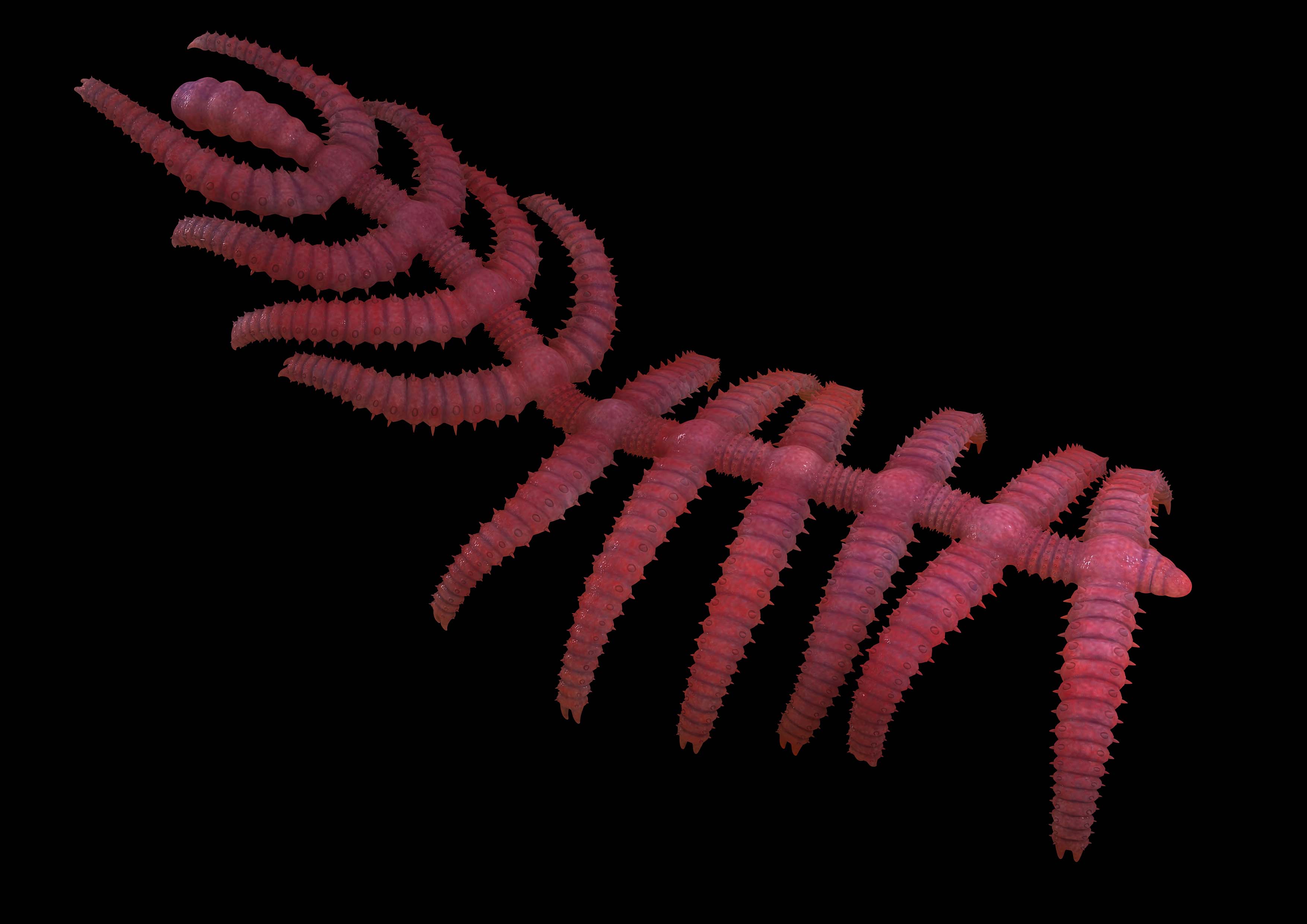
Diania is an extinct genus of animal found in China, represented by a single species: cactiformis. Known during its investigation by the nickname ‘walking cactus,’ this remarkable organism belongs to a group known as the armored lobopodians and has a simple worm-like body with robust, spiny, and apparently jointed legs.
Its significance is that jointed legs are the defining character of the arthropods and Diania may thus be very close to the origins of the most diverse group of animals on the planet. Diania also suggests that that arthropodization (i.e. the appearance of hard ring-like, joints around the legs), evolved before arthrodization (i.e. hard, ring-like segments, around the body).
Posted in Science |
Leave a Comment »
March 1, 2011

The anterior fornix erogenous zone (AFE or A-Spot) is a female erogenous zone that when stimulated can lead to rapid vaginal lubrication and arousal, sometimes without any other form of stimulation, with continued stimulation resulting in an intense orgasm. It is located at or near the deepest point on the anterior wall of the vagina, above the cervix, where the anterior wall of the vagina starts to curve upward. The posterior fornix is also believed to be an erogenous zone, called the ‘deep spot.’
Some believe that the AFE is the anterior fornix itself, but some sex experts believe it to be a degenerated female prostate (a theory that many have already applied to the G-spot and the Skene’s gland) or the area where the vaginal nerves connect, which is thought to be near it. One other theory is that it is the vesicouterine pouch, due to its proximity to the supposed location of the AFE zone and the supposed erogenous qualities of the rectouterine pouch. The AFE redirects female ejaculatory fluid, which is expelled from the Skene’s gland during G-spot orgasms, and turns it into vaginal lubrication. Because stimulating the AFE zone causes this mechanism and creates an erotic sensation simultaneously, full arousal occurs very quickly.
Posted in Health, Science, Sex |
1 Comment »
February 28, 2011

The Giant’s Causeway is an area of about 40,000 interlocking basalt columns, the result of an ancient volcanic eruption. It is located on the northeast coast of Northern Ireland. The tops of the columns form stepping stones that lead from the cliff foot and disappear under the sea. Most of the columns are hexagonal, although there are also some with four, five, seven and eight sides. The tallest are about 12 metres (36 ft) high, and the solidified lava in the cliffs is 28 metres thick in places.
Posted in Science, World |
Leave a Comment »





 The Daily Omnivore