February 14, 2011

Copernicus named his treatise on the movements of planets around the sun ‘On the Revolutions of Celestial Bodies’ in 1583 The word ‘Revolution‘ then passed from astronomy into vernacular speech; coming to represent abrupt change in the social order. Political usage of the word first appeared in 1688 in the young United Kingdom as a description of the replacement of James II with William III. The process was termed ‘The Glorious Revolution.’
Posted in Language, Politics, Science |
Leave a Comment »
February 14, 2011
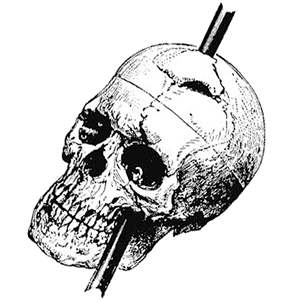
Phineas P. Gage (1823 – 1860) was an American railroad construction foreman now remembered for his improbable survival of an accident in which a large iron rod was driven completely through his head, destroying much of his brain’s left frontal lobe, and for that injury’s reported effects on his personality and behavior—effects so profound that friends saw him as ‘no longer Gage.’
Long called ‘the American Crowbar Case, Phineas Gage influenced 19th-century discussion about the brain, particularly debate on cerebral localization (determination of areas of the cortex involved in performance of certain functions) and was perhaps the first case suggesting that damage to specific regions of the brain might affect personality and behavior.
Posted in Health, Science |
Leave a Comment »
February 13, 2011
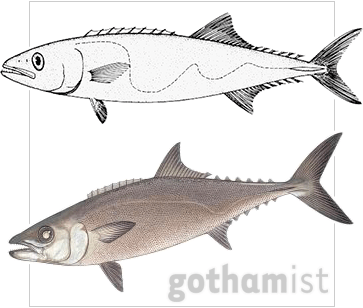
The escolar [es-kuh-lahr] is a species of fish found in deep tropical and temperate waters around the world. It is also known as Snake Mackerel, and sometimes marketed as ‘butterfish,’ ‘oilfish,’ ‘white tuna,’ ‘walu,’ or ‘codfish,’ a controversial practice due to potential health problems related with consumption of the fish. Like its relative the oilfish, escolar cannot metabolize the wax esters naturally found in its diet. This gives the escolar an oil content of 14–25% in its flesh. These wax esters may cause gastrointestinal distress in humans called ‘steatorrhea,’ the onset of which may occur between 30 minutes and 36 hours following consumption.
Symptoms may include stomach cramps, bright orange oil in stool, diarrhea, headaches, nausea, vomiting, and anal leakage. Because of the possible effects of consumption, escolar has been banned from consumption in Japan since 1977, as the Japanese government considers it toxic. It has also been banned in Italy. In 1999, the Swedish and Danish National Food Administrations informed fish trade associations and fish importing companies about the problems escolar and related fish could cause if not prepared properly and issued recommendations.
Posted in Food, Health, Science |
Leave a Comment »
February 13, 2011

Algebraic geometry is a branch of mathematics which combines techniques of abstract algebra, especially commutative algebra, with the language and the problems of geometry. Initially a study of systems of polynomial equations in several variables, the subject of algebraic geometry starts where equation solving leaves off, and it becomes even more important to understand the intrinsic properties of the totality of solutions of a system of equations, than to find some solution; this leads into some of the deepest waters in the whole of mathematics, both conceptually and in terms of technique.
Posted in Education, Science |
Leave a Comment »
February 12, 2011
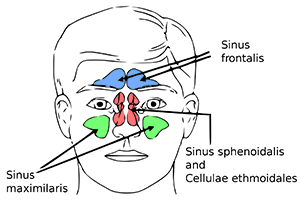

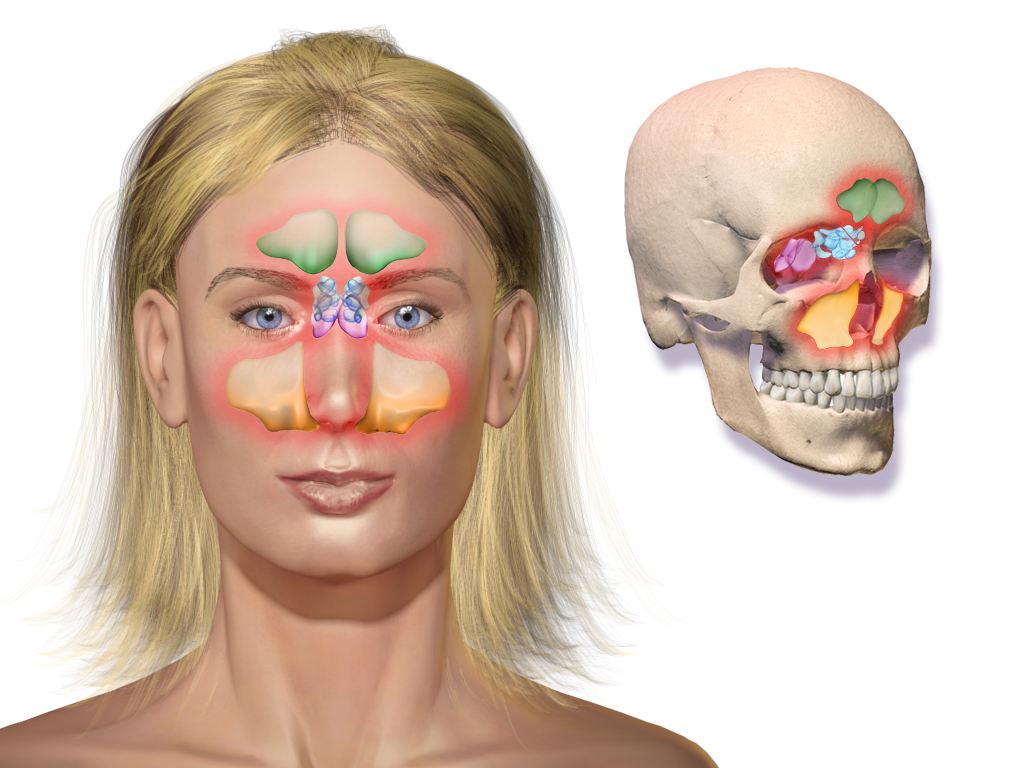
Paranasal sinuses are air-filled spaces, communicating with the nasal cavity, within the bones of the skull and face. Humans possess a number of paranasal sinuses, divided into subgroups that are named according to the bones within which the sinuses lie. Paranasal sinuses occur in a variety of animals (including most mammals, birds, non-avian dinosaurs, and crocodilians). The biological role of the sinuses is debated, but a number of possible functions have been proposed such as decreasing the relative weight of the front of the skull, and especially the bones of the face; increasing resonance of the voice; and providing a buffer against blows to the face.
It has also been suggested they insulate sensitive structures like dental roots and eyes from rapid temperature fluctuations in the nasal cavity, and also serve to humidify and heat inhaled air. The paranasal sinuses are joined to the nasal cavity via small orifices called ostia. These become blocked easily by allergic inflammation, or by swelling in the nasal lining which occurs with a cold. If this happens, normal drainage of mucus within the sinuses is disrupted, and sinusitis may occur. These conditions may be treated with drugs such as pseudoephedrine, which causes vasoconstriction in the sinuses, reducing inflammation, by traditional techniques of nasal irrigation, or by corticosteroid.
Posted in Health, Science |
Leave a Comment »
February 11, 2011
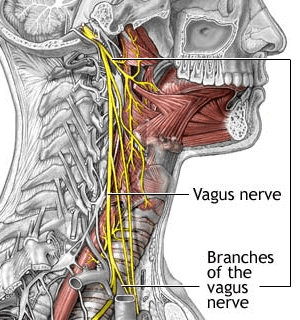
The vagus nerve [vey-guhs] is the tenth of twelve cranial nerves. Besides output to the various organs in the body, the vagus nerve conveys sensory information about the state of the body’s organs to the central nervous system. 80-90% of the nerve fibers in the vagus nerve are afferent (sensory) nerves communicating the state of the viscera to the brain. The medieval Latin word ‘vagus’ means literally ‘Wandering’ (the words vagrant, vagabond, and vague come from the same root). Sometimes the branches are spoken of in the plural and are thus called vagi.
read more »
Posted in Health, Science |
1 Comment »
February 11, 2011
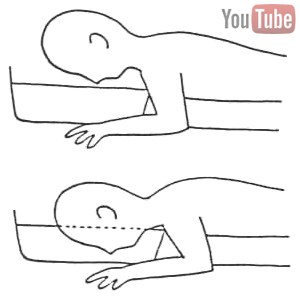
The mammalian diving reflex optimizes respiration to allow mammals to stay underwater for a long time. It is exhibited strongly in aquatic mammals (seals, otters, dolphins, etc.), but exists in a weaker version in other mammals, including humans. Diving birds, such as penguins, have a similar reflex. Every animal’s diving reflex is triggered specifically by cold water contacting the face – water that is warmer than 21 °C (70 °F) does not cause the reflex, and neither does submersion of body parts other than the face.
Also, the reflex is always exhibited more dramatically, and thus can grant longer survival, in young individuals. Beyond the effect of the reflex when submerged in water, the reflex is used consciously in ‘splashing cold water on one’s face,’ either to relax when upset or wake up when drowsy. Additionally, the reflex is also elicited through water boarding torture, in order to create the sense of drowning upon the individual.
Posted in Science |
1 Comment »
February 11, 2011
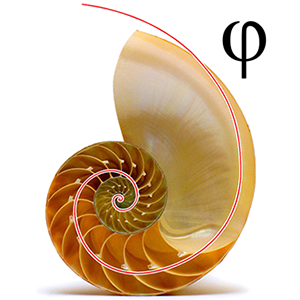
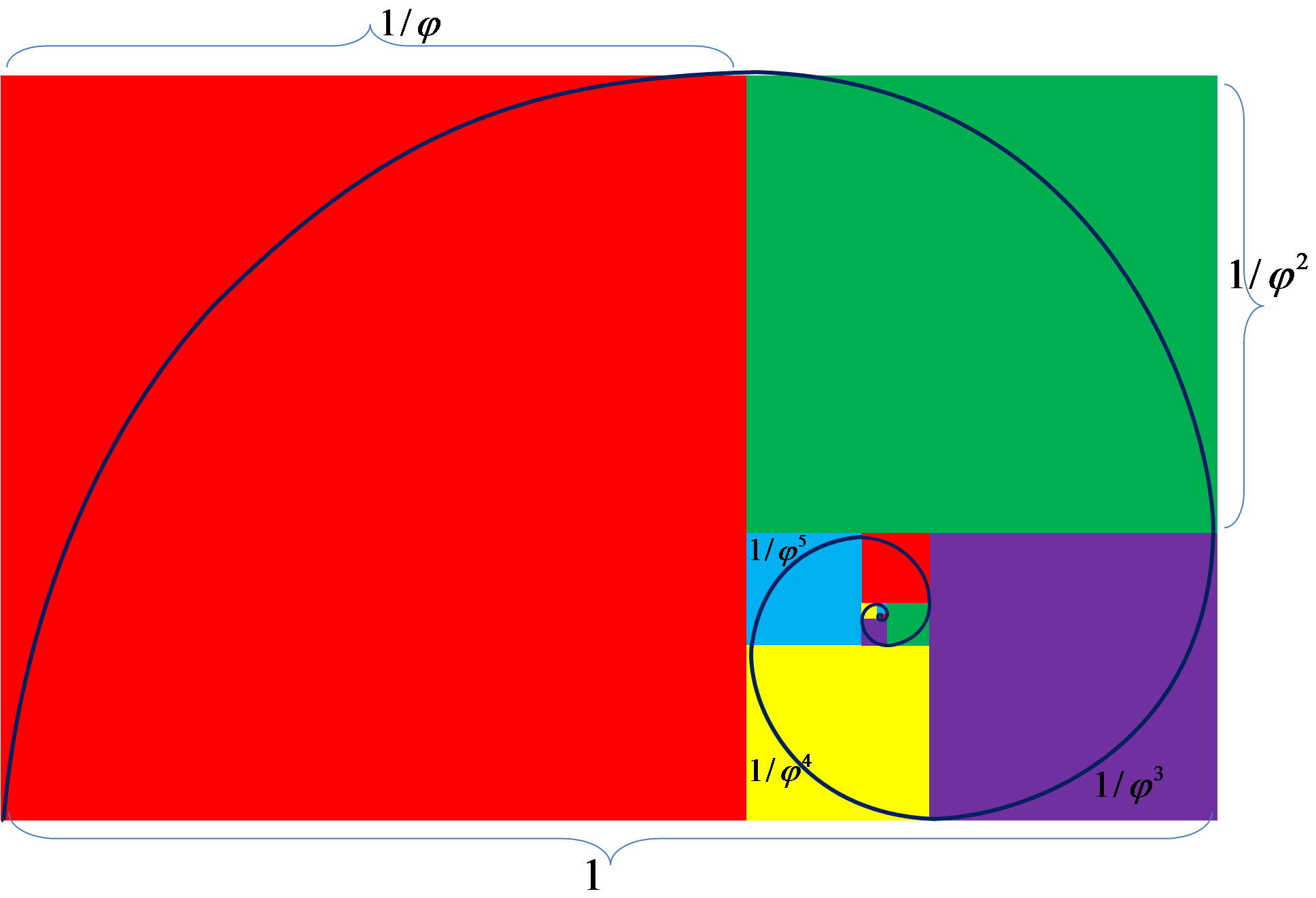
If a person has one number a and another smaller number b, he can make the ratio of the two numbers by dividing them. Their ratio is a/b. He can make another ratio by adding the two numbers together a+b and dividing this by the larger number a. The new ratio is (a+b)/a. If these two ratios are equal to the same number, then that number is called the golden ratio. The Greek letter  (phi) is usually used to represent the golden ratio. Like Pi, the golden ratio is an irrational number. If a person tries to write it, it will never stop and never be the same again and again, but it will start this way: 1.6180339887…
Italian mathematician, Fibonacci (1170 – 1250), discovered a sequence of numbers that relates to the golden ratio called the Fibonacci numbers. A person can find the next number in the list by adding the last two numbers together. If a person divides a number in the list by the number that came before it, this ratio comes closer and closer to the golden ratio. At least since the Renaissance, many artists and architects have proportioned their works to approximate the golden ratio—especially in the form of the golden rectangle, in which the ratio of the longer side to the shorter is the golden ratio—believing this proportion to be aesthetically pleasing. Mathematicians have studied the golden ratio because of its unique and interesting properties.
Posted in Art, Science |
Leave a Comment »
February 10, 2011

Lina Medina (b. 1933) is the youngest confirmed mother in medical history, giving birth at the age of five years, seven months and 21 days. She now lives in Lima, Peru. Medina’s son weighed 2.7 kg (6.0 lb; 0.43 st) at birth and was named Gerardo after her doctor. Gerardo was raised believing that Medina was his sister, but found out at the age of 10 that she was his mother. He grew up healthy but died in 1979 at the age of 40 of a bone marrow disease. Medina never revealed the father of the child nor the circumstances of her impregnation. Her father was arrested on suspicion of rape and incest, but was later released due to lack of evidence.
Although the case was called a hoax by some, a number of doctors over the years have verified it based on biopsies, X rays of the fetal skeleton in utero, and photographs taken by the doctors caring for her. Extreme precocious puberty in children 5 or under is very uncommon; pregnancy and delivery by a child this young remains extremely rare. Extreme precocious puberty is treated to suppress fertility, preserve growth potential, and reduce the social consequences of full sexual development in childhood.
Posted in Science, Sex |
Leave a Comment »
February 9, 2011
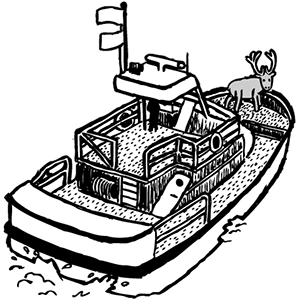
St. Matthew Island is a remote island in the Bering Sea in Alaska. The island has a land area of 138 sq mi, making it the 43rd largest island in the United States. In 1944, 29 reindeer were introduced to the island by the United States Coast Guard to provide an emergency food source. The coast guard abandoned the island a few years later, leaving the reindeer. Subsequently, the reindeer population rose to about 6,000 by 1963 and then died off in the next two years to 43 animals.
A scientific study attributed the population crash to the limited food supply in interaction with climatic factors (the winter of 1963-64 was exceptionally severe in the region). By the 1980s, the reindeer population had completely died out. American ecologist, Garrett Hardin cited the ‘natural experiment’ of St. Matthew Island of the reindeer population explosion and collapse as a paradigmatic example of the consequences of overpopulation.
Posted in Politics, Science, World |
Leave a Comment »
February 8, 2011
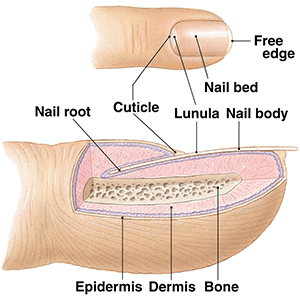
The lunula [loo-nyuh-luh] (‘little moon’ in Latin) is the crescent-shaped whitish area of the bed of a fingernail or toenail. The lunula is the visible part of the nail matrix (i.e. the root of the nail). In humans, it appears by week 14 of gestation, and has a primary structural role in defining the free edge of the distal nail plate (the part of the nail that grows outward). The lunula is most noticeable on the thumb, however, not everyone’s lunula is visible. In some cases, the eponychium may partially or completely cover the lunula.
It is located at the end of the nail (that is closest to the skin of the finger), but it still lies under the nail. It is not actually white, but it only appears so, when it is seen through the nail. Outlining the nail matrix, the lunula is a very delicate part of the nail structure. If one damages the lunula, the nail will permanently be deformed. Even when the totality of the nail is removed, the lunula remains in place and is similar in appearance to another smaller fingernail embedded in the nail bed.
Posted in Health, Language, Science |
Leave a Comment »
February 3, 2011

Prince Rupert’s Drops (also known as Rupert’s Balls or Dutch tears) are a glass curiosity created by dripping hot molten glass into cold water. The glass cools into a tadpole-shaped droplet with a long, thin, tail. The water rapidly cools the molten glass on the outside of the drop, while the inner portion of the drop remains hot. When the glass on the inside eventually cools, it contracts inside the already-solid outer part. This contraction sets up very large compressive stresses on the exterior, while the core of the drop is in a state of tensile stress. It can be said to be a kind of tempered glass.
The very high residual stress within the drop gives rise to unusual qualities, such as the ability to withstand a blow from a hammer on the bulbous end without breaking, while the drops will disintegrate explosively if the tail end is even slightly damaged. When the tail end is damaged, the large amount of potential energy stored in the drop’s crystalline or amorphous atomic structure is released, causing fractures to propagate through the material at very high speeds. Due to glass’s inherent transparency, the internal stress within these objects can be demonstrated by viewing them through polarizing filters.
Posted in Science |
Leave a Comment »




 The Daily Omnivore