February 10, 2011

Lina Medina (b. 1933) is the youngest confirmed mother in medical history, giving birth at the age of five years, seven months and 21 days. She now lives in Lima, Peru. Medina’s son weighed 2.7 kg (6.0 lb; 0.43 st) at birth and was named Gerardo after her doctor. Gerardo was raised believing that Medina was his sister, but found out at the age of 10 that she was his mother. He grew up healthy but died in 1979 at the age of 40 of a bone marrow disease. Medina never revealed the father of the child nor the circumstances of her impregnation. Her father was arrested on suspicion of rape and incest, but was later released due to lack of evidence.
Although the case was called a hoax by some, a number of doctors over the years have verified it based on biopsies, X rays of the fetal skeleton in utero, and photographs taken by the doctors caring for her. Extreme precocious puberty in children 5 or under is very uncommon; pregnancy and delivery by a child this young remains extremely rare. Extreme precocious puberty is treated to suppress fertility, preserve growth potential, and reduce the social consequences of full sexual development in childhood.
Posted in Science, Sex |
Leave a Comment »
February 9, 2011
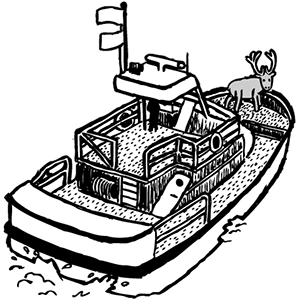
St. Matthew Island is a remote island in the Bering Sea in Alaska. The island has a land area of 138 sq mi, making it the 43rd largest island in the United States. In 1944, 29 reindeer were introduced to the island by the United States Coast Guard to provide an emergency food source. The coast guard abandoned the island a few years later, leaving the reindeer. Subsequently, the reindeer population rose to about 6,000 by 1963 and then died off in the next two years to 43 animals.
A scientific study attributed the population crash to the limited food supply in interaction with climatic factors (the winter of 1963-64 was exceptionally severe in the region). By the 1980s, the reindeer population had completely died out. American ecologist, Garrett Hardin cited the ‘natural experiment’ of St. Matthew Island of the reindeer population explosion and collapse as a paradigmatic example of the consequences of overpopulation.
Posted in Politics, Science, World |
Leave a Comment »
February 8, 2011
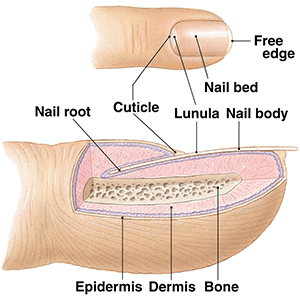
The lunula [loo-nyuh-luh] (‘little moon’ in Latin) is the crescent-shaped whitish area of the bed of a fingernail or toenail. The lunula is the visible part of the nail matrix (i.e. the root of the nail). In humans, it appears by week 14 of gestation, and has a primary structural role in defining the free edge of the distal nail plate (the part of the nail that grows outward). The lunula is most noticeable on the thumb, however, not everyone’s lunula is visible. In some cases, the eponychium may partially or completely cover the lunula.
It is located at the end of the nail (that is closest to the skin of the finger), but it still lies under the nail. It is not actually white, but it only appears so, when it is seen through the nail. Outlining the nail matrix, the lunula is a very delicate part of the nail structure. If one damages the lunula, the nail will permanently be deformed. Even when the totality of the nail is removed, the lunula remains in place and is similar in appearance to another smaller fingernail embedded in the nail bed.
Posted in Health, Language, Science |
Leave a Comment »
February 3, 2011

Prince Rupert’s Drops (also known as Rupert’s Balls or Dutch tears) are a glass curiosity created by dripping hot molten glass into cold water. The glass cools into a tadpole-shaped droplet with a long, thin, tail. The water rapidly cools the molten glass on the outside of the drop, while the inner portion of the drop remains hot. When the glass on the inside eventually cools, it contracts inside the already-solid outer part. This contraction sets up very large compressive stresses on the exterior, while the core of the drop is in a state of tensile stress. It can be said to be a kind of tempered glass.
The very high residual stress within the drop gives rise to unusual qualities, such as the ability to withstand a blow from a hammer on the bulbous end without breaking, while the drops will disintegrate explosively if the tail end is even slightly damaged. When the tail end is damaged, the large amount of potential energy stored in the drop’s crystalline or amorphous atomic structure is released, causing fractures to propagate through the material at very high speeds. Due to glass’s inherent transparency, the internal stress within these objects can be demonstrated by viewing them through polarizing filters.
Posted in Science |
Leave a Comment »
February 3, 2011

Petrichor [peh-truh-kuhr] is the name of the scent of rain on dry earth. The term was coined in 1964 by two Australian researchers, Bear and Thomas, for an article in the journal Nature. In the article, the authors describe how the smell derives from an oil exuded by certain plants during dry periods, whereupon it is absorbed by clay-based soils and rocks. During rain, the oil is released into the air along with another compound, geosmin, producing the distinctive scent. In a follow-up paper, Bear and Thomas (1965) showed that the oil retards seed germination and early plant growth.
Posted in Language, Science |
Leave a Comment »
February 3, 2011

Eigengrau [eye-gen-graw] (German for ‘intrinsic gray’), also called eigenlicht (‘intrinsic light’), dark light, or brain gray, is the color seen by the eye in perfect darkness. Even in the absence of light, some action potentials are still sent along the optic nerve, causing the sensation of a uniform dark gray color. Eigengrau is perceived as lighter than a black object in normal lighting conditions, because contrast is more important to the visual system than absolute brightness. For example, the night sky looks darker than eigengrau because of the contrast provided by the stars.
Posted in Language, Science, World |
Leave a Comment »
February 3, 2011
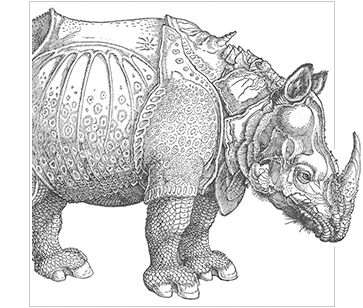
Dürer’s [door-ers] Rhinoceros is the name commonly given to a woodcut created by German painter and printmaker Albrecht Dürer in 1515. The image was based on a written description and brief sketch by an unknown artist of an Indian rhinoceros that had arrived in Lisbon earlier that year. Dürer never saw the actual rhinoceros, which was the first living example in Europe since Roman times. In late 1515, the King of Portugal, Manuel I, sent the animal as a gift for Pope Leo X, but it died in a shipwreck off the coast of Italy in early 1516. A live rhinoceros was not seen again in Europe until a second specimen arrived from India at the court of Sebastian of Portugal in 1577, being later inherited by Philip II of Spain around 1580.
Dürer’s woodcut is not an entirely accurate representation of a rhinoceros. He depicts an animal with hard plates that cover its body like sheets of armor, with a gorget at the throat, a solid-looking breastplate, and rivets along the seams; he also places a small twisted horn on its back, and gives it scaly legs and saw-like rear quarters. Despite these anatomical inaccuracies, it was a very popular woodcut in Europe and was copied many times in the following three centuries. It was regarded as a true representation of a rhinoceros into the late 18th century, when it was supplanted by more realistic drawings and paintings, particularly those of Clara the rhinoceros, who toured Europe in the 1740s and 1750s.
Posted in Art, Science |
Leave a Comment »
February 3, 2011

Endorphins (‘endogenous morphine’) are proteins that are similar to opioids. They are hormones made by the endocrine system of many vertebrates. When they are released into the body, they cause a sense of well-being. They also act as analgesics, and are sometimes named ‘natural pain killers.’ Endorphins were first found in 1970s. They are produced by the pituitary gland and the hypothalamus during exercise, excitement, pain, consumption of spicy food, love and orgasm, and they resemble the opiates in their abilities to produce analgesia and a feeling of well-being. The sudden release of endorphins during strenuous exercise is sometimes called a ‘runner’s high.’
The term endorphin rush has been adopted in popular speech to refer to feelings of exhilaration brought on by pain, danger, or other forms of stress, supposedly due to the influence of endorphins. When a nerve impulse reaches the spinal cord, endorphins are released which prevent nerve cells from releasing more pain signals. Immediately after injury, endorphins allow animals to feel a sense of power and control over themselves that allows them to persist with activity for an extended time.
Posted in Drugs, Health, Science |
Leave a Comment »
February 2, 2011

Ironic processing is the psychological process whereby an individual’s deliberate attempts to suppress or avoid certain thoughts (thought suppression) render those thoughts more persistent.
read more »
Posted in Health, Science |
Leave a Comment »
February 2, 2011
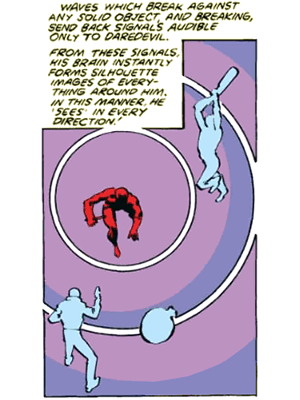
Human echolocation [ek-oh-loh-key-shuhn] is the ability of humans to detect objects in their environment by sensing echoes from those objects. This ability is used by some blind people to navigate within their environment. They actively create sounds, such as by tapping their canes, lightly stomping their foot or by making clicking noises with their mouths (however, because humans click with much lower frequencies and slower rates than other animals, only larger objects can be sensed). The principle is comparable to active sonar in submarines and to echolocation by bats and dolphins.
Vision and hearing are closely related in that they can process reflected waves of energy. Vision processes light waves as they travel from their source, bounce off surfaces throughout the environment and enter the eyes. Similarly, the auditory system processes sound waves as they travel from their source, bounce off surfaces and enter the ears. Both systems can extract a great deal of information about the environment by interpreting the complex patterns of reflected energy that they receive. In the case of sound, these waves of reflected energy are called ‘echoes.’
Posted in Health, Science |
Leave a Comment »
February 1, 2011

In vitro meat, also known as cultured meat, is an animal flesh product that has never been part of a complete, living animal. Several current research projects are growing in vitro meat experimentally, although no meat has yet been produced for public consumption. The first-generation products will most likely be minced meat, and a long-term goal is to grow fully developed muscle tissue. Potentially, any animal’s muscle tissue could be grown through the in vitro process.
Posted in Food, Money, Science |
Leave a Comment »
January 29, 2011
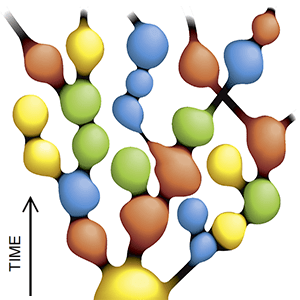
The multiverse is the hypothetical set of multiple possible universes (including the historical universe we consistently experience) that together comprise everything that exists: the entirety of space, time, matter, and energy as well as the physical laws and constants that describe them. The term was coined in 1895 by the American philosopher and psychologist William James. The various universes within the multiverse are sometimes called parallel universes.
The structure of the multiverse, the nature of each universe within it and the relationship between the various constituent universes, depend on the specific multiverse hypothesis considered. Multiverses have been hypothesized in cosmology, physics, astronomy, religion, and philosophy. In these contexts, parallel universes are also called ‘alternative universes,’ ‘quantum universes,’ and ‘alternative realities,’ among others.
read more »
Posted in Language, Philosophy, Science |
Leave a Comment »