January 10, 2012

Surrogacy [sur-uh-guh-see] is an arrangement in which a woman carries and delivers a child for another couple or person. This woman, the surrogate mother, may be the child’s genetic mother (called traditional surrogacy), or she may be biologically unrelated to the child (called gestational surrogacy).
If the surrogate receives compensation beyond the reimbursement of medical and other reasonable expenses, the arrangement is called commercial surrogacy, otherwise it is often referred to as altruistic surrogacy.
read more »
Posted in Money, Politics, Sex |
Leave a Comment »
December 30, 2011
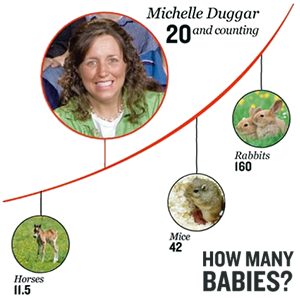
Quiverfull is a movement among some conservative evangelical Christian couples chiefly in the United States, but with some adherents in Canada, Australia, New Zealand, Britain and elsewhere. It promotes procreation, and sees children as a blessing from God, eschewing all forms of birth control, including natural family planning and sterilization. The movement derives its name from Psalm 127:3-5, where many children are metaphorically referred to as the arrows in a full quiver.
Some refer to the Quiverfull position as Providentialism (the belief that God’s will is evident in all occurrences), while other sources have referred to it as a manifestation of natalism (the promotion of child-bearing). Some of the beliefs held among Quiverfull adherents have been held among various Christians during prior eras of history. As birth control methods advanced during the late 19th and early 20th centuries, many conservative Christian movements issued official statements against their use.
read more »
Posted in Philosophy, Sex |
Leave a Comment »
December 30, 2011

Natalism [neyt-l-iz-uhm] is a belief that promotes human reproduction. The term is taken from the Latin adjective form for ‘birth,’ ‘natalis.’ Natalism promotes child-bearing and glorifies parenthood. It typically advocates policies such as limiting access to abortion and contraception, as well as creating financial and social incentives for the population to reproduce.
The degree of natalism is individual; the extreme end is ‘Natalism’ as a life stance (with the first letter capitalized), which holds natalism as of ultimate importance and everything else is only good to the extent it serves this purpose. The more moderate stance holds that there ought to be a higher rate of population growth than what is currently mainstream in industrialized countries. Philosophic motivations for natalism may include that of considering value in bringing potential future persons into existence.
read more »
Posted in Philosophy, Politics, Sex |
Leave a Comment »
December 30, 2011

‘Breeder‘ is a denigrating term for heterosexuals used in LGBT slang. It is often used pejoratively. The use in homosexual groups is drawn from the fact that their sexual activity cannot lead to reproduction, where as heterosexual sexual intercourse can, with implicit mocking by connotation of animal husbandry, the original usage of the word. Along these lines a particularly fecund woman may be referred to as a ‘brood sow,’ implying low ethical standards and an absence of due diligence in the reproductive process.
‘Breeder’ may also be used as a derogatory term by childfree people of any sexual orientation, to refer to parents who focus on their children and abandon their previous friends and lifestyle. The phrases ‘breeder, not parent’ (BNP) or ‘parent, not breeder’ (PNB) are used by some childfree communities to differentiate between what they regard as positive and negative parenting.
Posted in Politics, Sex |
1 Comment »
December 30, 2011

Last Tango in Paris (Italian: ‘Ultimo Tango a Parigi’) is a 1972 Italian romantic drama film directed by Bernardo Bertolucci which portrays a recent American widower who takes up an anonymous sexual relationship with a young, soon-to-be-married Parisian woman. It stars Marlon Brando, Maria Schneider, and Jean-Pierre Léaud. The film’s raw portrayal of sexual violence and emotional turmoil led to international controversy and drew various levels of government censorship. The MPAA gave the film an X rating upon release in the United States. After revisions were made to the MPAA ratings code, it was classified as an NC-17 in 1997.
The idea grew from Bernardo Bertolucci’s sexual fantasies, stating ‘he once dreamed of seeing a beautiful nameless woman on the street and having sex with her without ever knowing who she was.’
read more »
Posted in Art, Politics, Sex |
Leave a Comment »
December 1, 2011
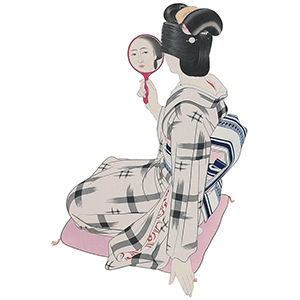
‘Pink Box: Inside Japan’s Sex Clubs’ is a book by photojournalist Joan Sinclair, chronicling her exploration of the secret world of fuzoku (prostitution) in Japan. Sinclair was joined by contributor James Farrer, a British sociologist who attempted to ‘place[s] the images in the context of contemporary Japanese culture.’
The book was published in 2006. Sinclair, a lawyer, describes being triggered to write the book by a comment she overheard ten years earlier, when she spent a year teaching English in Japan. Sinclair describes encountering, and overcoming, difficulties researching and getting access to the clubs—usually reserved for Japanese born patrons.
Posted in Politics, Sex, World |
Leave a Comment »
December 1, 2011

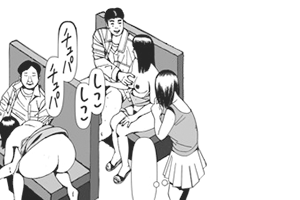
A pink salon, or pinsaro for short, is a type of brothel in Japan which specializes in oral sex. A pink salon is unusual in that the service is offered in small booths within a large open-plan room. The client is served soft drinks or alcoholic beverages by the ‘companion’ who performs fellatio on him. There may also be additional activities such as fingering the ‘companion’ and sumata (a Japanese term for a non-penetrative sex act where the sex worker rubs the client’s penis with her hands, thighs (intercrural sex), and labia majora).
Unlike the west, Japan does not have the same stigmas attached to sex work. Many young Japanese women work in pink salons throughout late high school and college as work is plentiful and pay is much better than in customer service positions. However, the work is demanding and an employee may be required to fellate over a dozen men in a single four hour shift.
Posted in Money, Sex, World |
Leave a Comment »
December 1, 2011

An image club, is a type of brothel in Japan similar to ‘fashion health’ parlors (a form of massage parlor which circumvents Japanese anti-prostitution laws by offering a range of services that stop short of sexual intercourse).
They differ in that image clubs are themed along popular sexual fantasies such as a business office, a doctor’s office, a classroom, or a subway car. The prostitutes themselves, whose activities are usually limited to oral sex, wear exaggerated costumes appropriate to the setting and the desire of the customer.
Posted in Money, Sex, World |
Leave a Comment »
December 1, 2011

No-pan kissa (literally ‘no-panties cafe’) is a Japanese term for cafes where the waitresses wear short skirts with no underwear. The floors, or sections of the floor, are often mirrored. Customers order drinks and snacks and may look at, but not generally touch, the staff. The shops otherwise look like normal coffee shops, rather than sex establishments, although they charge around four times as much for coffee.
A later development in certain no-pan kissa was the creation of small private rooms where the staff provided sexual services like oral sex or masturbation. Eventually such coffee shops gave way to ‘fashion health’ clubs (a form of massage parlor which circumvents Japanese anti-prostitution laws by offering a range of services that stop short of sexual intercourse), and few, if any, remain. In addition to no-pan kissa, there have also been no-pan shabu-shabu, and no-pan yakiniku restaurants; and no-pan karaoke.
Posted in Money, Sex, World |
Leave a Comment »
November 30, 2011
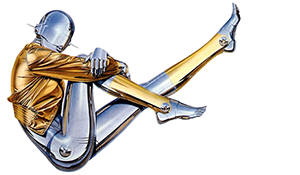

A gynoid refers to female robots. Android is a gender neutral term for humanoid robots, but which has male connotations. The term ‘gynoid’ was used by Gwyneth Jones in her 1985 novel ‘Divine Endurance’ to describe a robot slave in a futuristic China, that is judged by her beauty.
The tongue-in-cheek portmanteau ‘fembot’ (female robot) was used in the ‘Austin Powers films,’ a cultural play on the fembots originating in the TV series ‘The Bionic Woman.’ Robotess is the oldest gender-specific term, originating in 1921 from the same source as robot, a 1920 Czech play: ‘R.U.R. (Rossum’s Universal Robots).’
read more »
Posted in Politics, Sex, Technology |
Leave a Comment »
November 28, 2011

Erotophobia [ih-rot-uh-foh-bee-uh] is a term coined by a number of researchers in the late 1970s and early 1980s to describe one pole on a continuum of attitudes and beliefs about sexuality. The model of the continuum is a basic polarized line, with erotophobia (fear of sex or negative attitudes about sex) at one end and erotophilia (positive feelings/attitudes about sex) at the other end.
Erotophobia has many manifestations. An individual or culture can have one or multiple erotophobic attitudes. Some types of erotophobia include fear of nudity, fear of sexual images, homophobia, fear of sex education, fear of sexual discourse, etc.
read more »
Posted in Health, Sex |
Leave a Comment »
November 25, 2011

In Hinduism and yoga kundalini [koon-dl-ee-nee] (literally ‘coiled’) is a ‘corporeal energy,’ an unconscious, instinctive or libidinal force or Shakti, which lies coiled at the base of the spine. It is envisioned either as a goddess or else as a sleeping serpent, hence a number of English renderings of the term such as ‘serpent power.’ The kundalini resides in the sacrum bone in three and a half coils and has been described as a residual power of pure desire.
Kundalini is described as a sleeping, dormant potential force in the human organism. It is one of the components of an esoteric description of man’s ‘subtle body,’ which consists of nadis (energy channels), chakras (psychic centers), prana (subtle energy), and bindu (drops of essence).
read more »
Posted in Philosophy, Sex |
Leave a Comment »



 The Daily Omnivore