January 28, 2011

The Heineken WOBO (World Bottle) was a beer bottle designed for use as a building material in the developing world. According to the company, when brewing magnate Alfred Heineken was in Curaçao in 1960 he saw many bottles littering the beach because the island had no economic means of returning them to bottling plants. He was also concerned with the lack of affordable building materials and the inadequate living conditions plaguing Curaçao’s lower-class. Envisioning a solution for these problems, he asked Dutch architect N. John Habraken to design what he called ‘a brick that holds beer.’
The bottle was designed to be interlocking, laid horizontally and bonded with cement mortar with a silicon additive. A 10 ft (3.0 m) x 10 ft (3.0 m) shack would take approximately 1,000 bottles to build. In 1963, 100,000 WOBO’s were produced in two sizes, 350 and 500 mm. This size difference was necessary in order to bond the bottles when building a wall, in the same way as a half brick is necessary when building with bricks. Unfortunately, most of them were destroyed, and they are now very rare and have become a collector’s item.
Posted in Food, Money, Technology |
Leave a Comment »
January 28, 2011

Cabinet noir (French for ‘black room’) was the name given in France to the office where the letters of suspected persons were opened and read by public officials before being forwarded to their destination. This practice had been in use since the establishment of posts, and was frequently used by the ministers of Louis XIII and Louis XIV; but it was not until the reign of Louis XV that a separate office for this purpose was created. Although declaimed against at the time of the French Revolution, it was used both by the revolutionary leaders and by Napoleon.
read more »
Posted in Politics, Technology, War |
Leave a Comment »
January 28, 2011

Room 641A is an intercept facility operated by AT&T for the U.S. National Security Agency (NSA), beginning in 2003. It is fed by fiber optic lines from beam splitters installed in fiber optic trunks carrying Internet backbone traffic and, therefore, presumably has access to all Internet traffic that passes through the building.The existence of the room was revealed by a former AT&T technician, Mark Klein, and was the subject of a 2006 class action lawsuit by the Electronic Frontier Foundation (EFF) against AT&T. Klein claims he was told that similar black rooms are operated at other facilities around the country.
The EFF suit accused the telecommunication company of violating the law and the privacy of its customers by collaborating with the NSA in a massive, illegal program to wiretap and data-mine Americans’ communications. Room 641A is located in the SBC Communications building at 611 Folsom Street, San Francisco, three floors of which were occupied by AT&T before SBC purchased AT&T. The room was referred to in internal AT&T documents as the SG3 (Study Group 3) Secure Room. The room measures about 24 by 48 feet (7.3 by 15 m) and contains several racks of equipment, including a Narus STA 6400, a device designed to intercept and analyze Internet communications at very high speeds.
Posted in Politics, Technology, War |
Leave a Comment »
January 26, 2011

The Shard is an 87-story skyscraper in London that forms part of the London Bridge Quarter development. The Shard’s construction began in 2009 and finished in late 2012. Standing approximately 306 metrs (1,004 ft) high, it is currently the tallest building in the European Union. It is the second-tallest freestanding structure in the UK, after the concrete tower at the Emley Moor transmitting station.
It was designed by the Italian architect Renzo Piano, and replaced Southwark Towers, a 24-story office block built on the site in Southwark in 1975. The Shard was developed by Sellar Property on behalf of LBQ Ltd, and is jointly owned by Sellar Property and the State of Qatar.
Posted in Art, Money, Technology |
Leave a Comment »
January 26, 2011

In computer terminology, a honeypot is a trap set to detect, deflect, or in some manner counteract attempts at unauthorized use of information systems. Generally it consists of a computer, data, or a network site that appears to be part of a network, but is actually isolated and monitored, and which seems to contain information or a resource of value to attackers.
A honeypot is valuable as a surveillance and early-warning tool. They should have no production value, and hence should not see any legitimate traffic or activity. Whatever they capture is therefore malicious or unauthorized. One practical application of this is a honeypot that thwarts spam by masquerading as a type of system abused by spammers. Honeypots can carry risks to a network, and must be handled with care. If they are not properly walled off, an attacker can use them to break into a system.
Posted in Language, Money, Technology |
Leave a Comment »
January 26, 2011
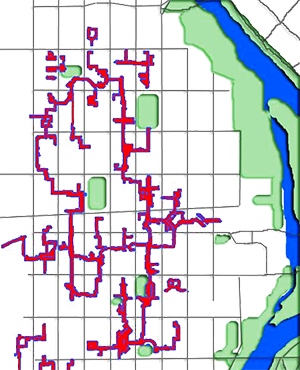
The Plus 15 or +15 Skyway network in Calgary, Alberta, Canada, is the world’s most extensive pedestrian skywalk system with a total length of 16 kilometers (10 mi) and 59 bridges. The system is so named because the skywalks are approximately 15 feet (approximately 4.5 metres) above street level. (Some Plus 15 skywalks are multi-level, with higher levels being referred to as +30’s and +45’s.)
Opening in 1970, the +15 network has expanded to include dozens of downtown Calgary buildings. The central core of the system is a series of enclosed shopping centers, and the city’s flagship department stores. Although there are currently no plans to remove bridges or to discontinue building new ones, the system has been subject to criticism in recent years. It has been identified with a decline in street life in the Downtown Commercial Core. Street life is instead concentrated on streets (such as Stephen Avenue) or in neighbourhoods where there are no bridges (such as Eau Claire and the Beltline).
Posted in Money, Politics, Technology |
Leave a Comment »
January 26, 2011

The term black fax refers to a prank fax transmission, consisting of one or more pages entirely filled with a uniform black tone and often made into a loop the sending machine will transmit endlessly. The sender’s intention is typically to consume as much of the recipient’s fax ink, toner or thermal paper or disk space as possible, thus costing the recipient money and/or denying the recipient the use of their machine (this is similar to computer-based denial of service attacks).
Black faxes can be particularly effective as the fax algorithm compresses the solid black image very well, so a very short fax call can produce many pages. They have been used to harass large institutions or government departments, to retaliate against the senders of junk faxes, or merely as simple pranks. In a black fax attack, one or more sheets are fed halfway through the sender’s fax machine and taped end to end, forming an endless loop that cycles through the machine. Not only can solid black be used, but also images which will repeat endlessly on the receiver’s machine until his or her toner runs out.
Posted in Humor, Politics, Technology |
Leave a Comment »
January 25, 2011

‘Ambient 1: Music for Airports‘ is an ambient album by Brian Eno released in 1978. Of four albums released on Eno’s own, then new, Ambient label, ‘Music for Airports’ was the first to carry explicitly the name ‘ambient’ – a term which he coined to differentiate his minimalistic approach to the album’s material and ‘the products of the various purveyors of canned music.’ Notice of similarly quiet, unobtrusive music had been given on his albums such as ‘Evening Star,’ ‘Discreet Music,’ ‘Music for Films,’ and Harold Budd’s ‘The Pavilion of Dreams’ (which Eno produced), but in this album it was given precedence as a fully developed concept.
The music was designed to be continuously looped as a sound installation, with the intent to defuse the tense, anxious atmosphere of an airport terminal. Eno conceived this idea while being stuck at Cologne Bonn Airport in Germany in the mid 70s. He had to spend several hours there and was extremely annoyed by the uninspired sound atmosphere. It was installed at the Marine Air Terminal of New York’s LaGuardia Airport.
Posted in Art, Money, Technology |
Leave a Comment »
January 25, 2011

In the context of the World Wide Web, content farms are companies (or their divisions) that employ large numbers of (often freelance) writers to generate large amounts of textual content. The articles in content farms are written by human beings but may not be written by a specialist in the area. In one of Google’s own promotional videos the majority of the links available were actually produced at content farms.
Content farms contain huge number of articles. For instance, Demand Media will soon be publishing 1 million items a month, the equivalent of four English-language Wikipedias a year. Big content farms are expensive resources, sold for many millions.
read more »
Posted in Language, Money, Technology |
Leave a Comment »
January 25, 2011

Happy slapping is a fad in which someone assaults an unwitting victim while others record the assault. The ease and general availability of video cameras in mobile phones means that such attacks need not be planned carefully beforehand and are more easily watched and circulated for comedy purposes afterwards.
The practice started in the South London London Borough of Lewisham. Initially the attacks were, as the phrase would have us believe, fairly minor pranks … As the craze spread the attacks became more vicious – often serious assaults known in British legal circles as grievous bodily harm.
Posted in Humor, Technology |
Leave a Comment »
January 25, 2011

A robot jockey is commonly used on camels in camel racing. Early designs confused or frightened the camels, so the robots were modified to include more human-like features, including a mannequin-like face, sunglasses, hats, racing silks and even traditional perfumes used by human jockeys. Developed since 2004, the robotic jockeys are slowly phasing out the use of human jockeys, which, in the case of camel racing in the Middle East, often employs small children who reportedly suffer repeated systemic human rights abuses. In response to international condemnation of such abuses, the nations of Qatar and the UAE have banned the use of human jockeys in favor of robots.
Camel racing has been around for thousands of years. ‘The Sport of Sheiks’ almost exclusively utilized small children, usually boys around the age of four, to ride and direct the camels. Often, the boys would be starved to be as light as possible. Many of the boys used for the races were often sold to race organizers or camel owners, and there was an active child slave trade for camel jockeys, involving victims of kidnapping or the children of destitute families who sold them into servitude.
Posted in Politics, Technology, World |
Leave a Comment »
January 24, 2011

A keytar is a relatively lightweight keyboard that is supported by a strap around the neck and shoulders, similar to the way a guitar is supported by a strap. Keytars allow players a greater range of movement compared to conventional keyboards, which are placed on stands. The instrument has a musical keyboard for triggering musical notes and sounds. Controls for pitch bends, vibrato, portamento, and sustain are placed on the instrument’s ‘neck.’ Keytars may either contain their own synthesizers, or simply be controllers, triggering notes on another MIDI capable synthesizer.
In early 1970s, Edgar Winter often performed with keyboards slung around his neck, but they were not technically keytars because they had no ‘neck.’ One of the earliest keytars commercially released and widely known was be the Moog Liberation in 1980. Notable manufacturers of keytar models have included Moog, Roland, Yamaha, Korg and Casio. As of 2010, the Roland AX-Synth and the Roland Lucina are the only mass-manufactured keytars on the market, but with the Synthpop revival of the late 2000s, keytars are enjoying a mild resurgence.
Posted in Art, Technology |
Leave a Comment »





