January 3, 2011

Personal rapid transit (PRT), also called personal automated transport (PAT) or podcar, is a public transportation mode featuring small automated vehicles operating on a network of specially-built guide ways. PRT is a type of automated guideway transit (AGT), which also includes systems with larger vehicles, all the way to small subway systems.
read more »
Posted in Money, Technology |
Leave a Comment »
January 3, 2011

Masdar (Arabic for ‘source’) is a project in Abu Dhabi, in the United Arab Emirates. Its core is a planned city, designed by the British architectural firm Foster + Partners. Masdar City will rely entirely on solar energy and other renewable energy sources, with a sustainable, zero-carbon, zero-waste ecology, and is designated as a car-free zone.
It is being built by the Abu Dhabi Future Energy Company, a subsidiary of Mubadala Development Company, with the majority of seed capital provided by the government of Abu Dhabi. Construction is underway 11 mi east-south-east of the city of Abu Dhabi, beside Abu Dhabi International Airport. Skeptics are concerned that the city will be only symbolic for Abu Dhabi, and that it may become just a luxury development for the wealthy, a city sized gated community.
read more »
Posted in Money, Technology, World |
Leave a Comment »
January 2, 2011

A panorama is any wide-angle view or representation of a physical space, whether in painting, drawing, photography, film/video, or a three-dimensional model. The word was originally coined by the Irish painter Robert Barker to describe his panoramic paintings of Edinburgh. Shown on a cylindrical surface and viewed from the inside, they were exhibited in London in 1792. The motion-picture term ‘panning’ is derived from panorama. Panoramic photography eventually came to displace painting as the most common method for creating wide views.
Not long after the introduction of the Daguerreotype in 1839, photographers began assembling multiple images of a view into a single wide image. In the late 19th century, panoramic cameras using curved film holders employed clockwork drives to scan a line image in an arc to create an image over almost 180 degrees. Digital photography of the late twentieth century greatly simplified this assembly process, which is now known as image stitching. Such stitched images may even be fashioned into forms of virtual reality movies, using technologies such as QuickTime VR, Flash, or Java.
Posted in Art, Technology |
Leave a Comment »
January 2, 2011
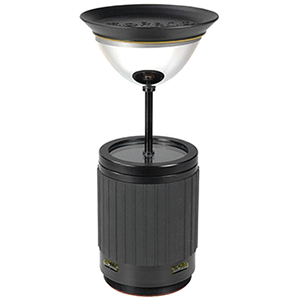
In photography, an omnidirectional camera is a camera with a 360-degree field of view in the horizontal plane, or with a visual field that covers (approximately) the entire sphere. Omnidirectional cameras are important in areas where large visual field coverage is needed, such as in panoramic photography and robotics.
Posted in Art, Technology |
Leave a Comment »
January 2, 2011
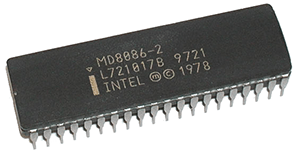

x86 refers to a family of instruction sets based on the 8086 CPU, which was launched by Intel in 1978. The architecture has been implemented in processors from Intel, Cyrix, AMD, VIA, and many others, and is still dominant in the microprocessor market. An instruction set is a list of all the instructions that a processor can execute (e.g. add, subtract, move, load, store, etc.). Many additions and extensions have been added to the x86 instruction set over the years, almost consistently with full backward compatibility.
There have been several attempts, also within Intel itself, to break the market dominance of the inelegant x86 architecture that descended directly from the first simple 8-bit microprocessors. But, continuous refinement of x86 microarchitectures, circuitry, and semiconductor manufacturing have made x86 hard to replace. The scalability of x86 chips such as the eight-core Intel Xeon and 12-core AMD Opteron is underlining x86 as an example of how continuous refinement of established industry standards can resist the competition from completely new architectures.
Posted in Money, Technology |
Leave a Comment »
January 1, 2011

The Magpul FMG-9 is a prototype for a folding machine gun, designed by Magpul Industries in 2008. It is made out of a light-weight polymer material rather than metal, making it easy to carry and conceal. It is also small enough even to fit in the back pocket of most pants.
It was developed for use by personal protection details such as the United States Secret Service. It is still a prototype and may or may not be made in large numbers for law enforcement agencies. The prototype uses Glock pistol firing mechanisms, specifically the 9mm Glock 17 pistol and the Glock 18 machine pistol.
Posted in Money, Technology, War |
Leave a Comment »
January 1, 2011

TED (Technology Entertainment and Design) is a global set of conferences curated by the American private non-profit Sapling Foundation, formed to disseminate ‘ideas worth spreading.’ over 700 talks are available free online. TED was founded in 1984, and the conference was held annually from 1990 in Monterey, California. The speakers are given a maximum of 18 minutes to present their ideas in the most innovative and engaging ways they can
Past presenters include Bill Clinton, Jane Goodall, Malcolm Gladwell, Al Gore, Richard Dawkins, Bill Gates, and Larry Page and Sergey Brin. TED’s current curator is the British former computer journalist and magazine publisher Chris Anderson. TED’s early emphasis was largely technology and design, consistent with a Silicon Valley center of gravity. The events are now held in Long Beach and Palm Springs in the U.S. as well as in Europe and Asia, offering live streaming of the talks. They address an increasingly wide range of topics within the research and practice of science and culture.
Posted in Politics, Technology, World |
Leave a Comment »
January 1, 2011

Dox (short for documents) is internet slang for personal information, often including real name, known aliases, addresses, phone numbers, SSN, credit card numbers, place of employment, etc. A person is ‘doxed’ when all their personal information is made public.
Posted in Language, Technology |
Leave a Comment »
December 24, 2010

Dubstep is a genre of electronic dance music, originating from Croydon, UK. Its overall sound has been described as ‘tightly coiled productions with overwhelming bass lines and reverberant drum patterns, clipped samples, and occasional vocals.’
The earliest dubstep releases, which date back to 1998, were darker, more experimental, instrumental dub remixes of 2-step garage tracks attempting to incorporate the funky elements of breakbeat, or the dark elements of drum and bass into 2-step.
read more »
Posted in Art, Technology |
1 Comment »
December 23, 2010
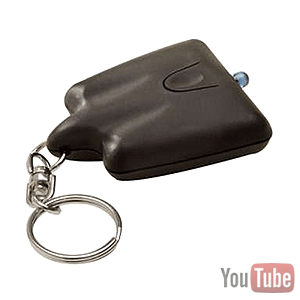
TV-B-Gone is a type of simple universal remote control device for turning off a large majority of the current available brands of television sets. It was created to allow people in a public place to turn off nearby television sets, presumably because the broadcast was distracting them from other activities. Its inventor has referred to it as ‘an environmental management device.’
The device is part of a key-chain, and, like other remote devices, is battery-powered. Although it can require up to 69 seconds for the device to find the proper code for a particular television receiver, the most popular televisions turn off in the first few seconds. During the 2008 Consumer Electronics Show, some individuals from gadget blog, Gizmodo brought a TV-B-Gone remote control and shut off many display monitors at booths and during demos affecting several companies. These actions caused the individual from Gizmodo to be banned for life from future CES events.
Posted in Humor, Technology |
Leave a Comment »
December 23, 2010

A cochlear [kok-leer] implant (CI) is a surgically implanted electronic device that provides a sense of sound to a person who is profoundly deaf or severely hard of hearing. The cochlear implant is often referred to as a bionic ear. It will not cure deafness or hearing impairment, but is a prosthetic substitute for hearing.
While cochlear implants restore physical ability to hear, this does not mean the brain can learn to process and distinguish speech if the recipient has passed the critical period of adolescence. As a result, those born profoundly deaf who receive an implant as an adult can only distinguish simple sounds, such as a ringing phone vs. a doorbell, while others who receive implants early can understand speech.
read more »
Posted in Health, Technology |
Leave a Comment »
December 23, 2010

FakeTV is a burglar deterrent that makes it look like someone is home watching television by recreating the sort of light produced by an HDTV. It comes with an internal light sensor which allows the device to activate when it becomes totally dark (0.5 lux or lower) and a built in timer with four modes of operation: Always On, Dusk +4 HRS, Dusk +7 HRS, and Off. It retails for $30.
Posted in Money, Technology |
Leave a Comment »




