December 22, 2010

Freestyle is a touch screen soda fountain introduced by The Coca-Cola Company in 2009. The machine features over 100 different Coca-Cola drink products, and custom flavors. Microdosing blends one or more concentrated ingredients in 46-ounce packets with water and sweetener at the point where the beverage is dispensed, thus avoiding the use of traditional 5-gallon boxes of syrup (also known as a bag-in-a-box). Cartridges store concentrated ingredients in the dispenser cabinet and are RFID enabled. The machine uses RFID chips to detect its supplies and to radio resupplying needs to other units.
These machines include flavors not previously available to the American market including Orange Coke which was previously sold only in Russia and the Baltics, and flavored Dasani waters. The machines transmit supply and demand data to both Coca-Cola and the owner including brands sold, times of the day of sales, troubleshooting information, and service data. They also use Coca-Cola’s loyalty program to let people earn secret flavors.
Posted in Food, Money, Technology |
Leave a Comment »
December 22, 2010
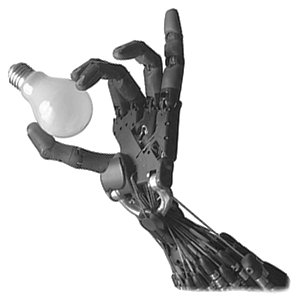
The Shadow Dexterous Hand is a humaniform robot hand system developed by The Shadow Robot Company in London. The hand is comparable to a human hand in size and shape, and reproduces all of its degrees of freedom. The Hand is commercially available and currently used by NASA, Bielefeld University and Carnegie Mellon University. It reportedly costs more than $100,000. The Hand uses the sense of touch, pressure, and position to reproduce the human grip in all its strength, delicacy, and complexity.
The SDRH was first developed by Richard Greenhill and his team of engineers in Islington, London, as part of The Shadow Project, (now known as the Shadow Robot Company) an ongoing research and development program whose goal is to complete the first convincing humanoid. An early prototype can be seen in NASA’s collection of humanoid robots, or robonauts. The Hand has haptic sensors embedded in every joint and finger pad, which relay information to a central computer for processing and analysis.
Posted in Money, Technology |
1 Comment »
December 22, 2010
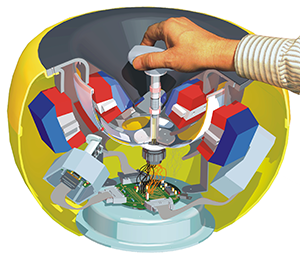

Haptic technology, or haptics [hap-tiks], is a tactile feedback technology that takes advantage of a user’s sense of touch by applying forces, vibrations, and/or motions. This mechanical stimulation aids in the creation and control of virtual objects, and enhances the remote control of machines and devices by teleoperators, such as remote surgeons and military drone pilots. The word haptic, from the Greek (haptikos), means pertaining to the sense of touch.
read more »
Posted in Language, Technology |
Leave a Comment »
December 20, 2010

Metropolis is a 1927 German expressionist film in the science-fiction genre directed by Fritz Lang. Produced in Germany during a stable period of the Weimar Republic, ‘Metropolis’ is set in a futuristic urban dystopia and makes use of this context to explore the social crisis between workers and owners in capitalism. The most expensive silent film ever made, it cost approximately 5 million Reichsmark. The film was written by Lang and his wife Thea von Harbou in 1924, and published a novelization in 1926. Lang was influenced by the Soviet science fiction film ‘Aelita’ by Yakov Protazanov (1924), which was an adaptation of a novel by Alexei Tolstoy. The plot of ‘Aelita’ included a revolution taking place on the planet Mars. However, Metropolis advocates non-violent cooperation rather than the Marxist ideal of ‘class struggle.’
‘Metropolis’ was cut substantially after its German premiere, and much footage was lost over the passage of successive decades. There have been several efforts to restore it, as well as discoveries of previously lost footage. In 2008, a copy of the film 30 minutes longer than any other known surviving was located in Argentina. After a long period of restoration in Germany, the film was shown publicly for the first time simultaneously at Berlin and Frankfurt on February 12, 2010.
Posted in Art, Money, Technology |
Leave a Comment »
December 20, 2010
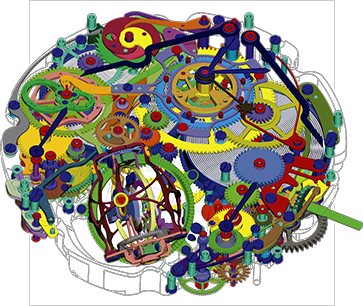
In horology, a movement is the internal mechanism of a clock or watch, as opposed to the case, which encloses and protects the movement, and the face which displays the time. The term originated with mechanical timepieces, whose movements are made of many moving parts. It is less frequently applied to modern electronic or quartz timepieces, where the word module is often used instead.
read more »
Posted in Technology |
Leave a Comment »
December 19, 2010

Paprika is a 2006 Japanese animated science fiction film, based on Yasutaka Tsutsui’s 1993 novel of the same name, about a research psychologist who uses a device that permits therapists to help patients by entering their dreams. The film was directed by the late Satoshi Kon, animated by Madhouse Studios, and produced and distributed by Sony Pictures Entertainment. The film’s music was composed by Susumu Hirasawa, who also composed the soundtrack for Kon’s award-winning film, Millennium Actress, and equally lauded television series, Paranoia Agent. The soundtrack is significant for being the first film to use a Vocaloid (a singing synthesizer) for various tracks.
The protagonist of the film is, Atsuko, a psychiatrist who uses advanced technology to study the human mind. She has developed a machine that will allow her to enter the dreams of her patients and study their psyches from the inside. Atsuko also does double duty as Paprika, a high-tech detective who uses this new innovation to find out the truth about what the people she’s trailing really think. However, Atsuko falls victim to a thief who steals the one-of-a-kind machine, and Paprika sets out to find it as a wave of psychological instability tears through the city.
Posted in Art, Technology |
Leave a Comment »
December 19, 2010

Shock diamonds (also known as Mach diamonds, Mach disks or dancing diamonds) are a formation of stationary wave patterns that appears in the exhaust plume of an aerospace propulsion system, such as a supersonic jet engine, rocket, ramjet, or scramjet when it is operated in an atmosphere.
Shock diamonds are formed when the supersonic exhaust from a nozzle is slightly over or under-expanded, meaning that the pressure of the gases exiting the nozzle is different from the ambient air pressure. A complex flow field results as the shock wave is reflected back and forth between the free fluid jet boundary and a visible repeating diamond-shaped pattern is formed which gives the shock diamonds their name.
Posted in Technology |
Leave a Comment »
December 17, 2010
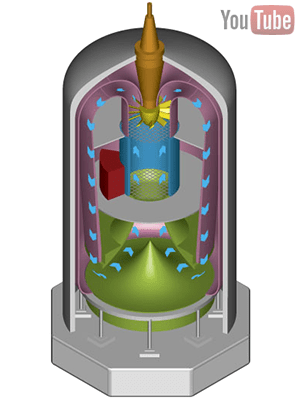
Bodyflight is the art of ‘flying your body’ in a controlled manner. This include turns, rolls, lateral movement, fall rate control, and other acrobatics in the air. The skill of bodyflight makes it possible for skydivers to fly closer to each other while they are falling, to allow them to link together in formation skydiving, then fly apart to a safe distance before opening parachutes. Many skills of bodyflight can be learned in a vertical wind tunnel, to enable skydivers to become better at controlling their bodies in the sky.
The first human to fly in a vertical wind tunnel was Jack Tiffany in 1964 at Wright Patterson Air Force Base. The first recreational vertical wind tunnel was developed by a Canadian company named AERODIUM in Quebec, patented as the ‘Levitationarium’ in 1979.
read more »
Posted in Games, Technology |
1 Comment »
December 17, 2010


The Manhattan Project was the codename for a project conducted during World War II to develop the first atomic bomb, before the Germans or the Japanese. The project was led by the United States, and included participation from the United Kingdom and Canada. From 1942 to 1946 the project was under the command of Major General Leslie R. Groves, Jr. of the U.S. Army Corps of Engineers. Robert Oppenheimer was the scientific director.
read more »
Posted in Science, Technology, War |
Leave a Comment »
December 16, 2010

An amplified cactus is a cactus plant used as a musical instrument. It harnesses the acoustic properties of a cactus (preferably a Denmoza or Geohintonia), by applying contact microphones and amplifying their projection and tone. The effect is somewhat ethereal: Vivien Schweitzer of The New York Times reports ‘Jason Treuting played an amplified cactus, running his hand over the plant’s unfriendly spikes to produce an alluring sound like a babbling brook.’
The amplified cactus is a medium rarely written for, even in the contemporary music genre. John Cage, perhaps one of the most recognizable names in the contemporary music genre, composed Child of Tree (1975) and Branches (1976) for what he described as ‘amplified plant materials.’ Cage was a large proponent of chance music and felt that the organic nature of music without man-made instruments was very strong and influential. Another of the most famous pieces for amplified cactus is called Degrees of Separation ‘Grandchild of Tree’ by Paul Rudy which received mention at the Bourges International Competition for Electroacoustic Music in 2000.
Posted in Art, Technology |
Leave a Comment »
December 16, 2010

A deck prism (sometimes called a deadlight) is a prism inserted into the deck of a ship to provide light down below. For centuries, sailing ships used deck prisms to provide a safe source of natural sunlight to illuminate areas below decks Before electricity, light below a vessel’s deck was provided by candles, oil and kerosene lamps – all dangerous aboard a wooden ship. The deck prism was a clever solution: laid flush into the deck, the glass prism refracted and dispersed natural light into the space below from a small deck opening without weakening the planks or becoming a fire hazard.
In normal usage, the prism hangs below the ceiling and disperses the light sideways; the top is flat and installed flush with the deck, becoming part of the deck. A plain flat glass would just form a single bright spot below– not very useful general illumination– hence the prismatic shape. On colliers (coal ships), prisms were also used to keep check on the cargo hold; light from a fire would be collected by the prism and be made visible on the deck even in daylight.
Posted in Technology |
1 Comment »
December 16, 2010
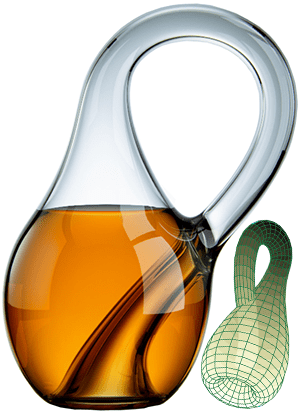
In mathematics, the Klein bottle is a geometrical object, named after the German mathematician Felix Klein. He described it in 1882, and named it Klein’sche Fläche (Klein surface). Like the Möbius strip, it only has one surface. Mathematicians call this a non-orientable surface. Klein bottles only exist in four-dimensional space, but a model of a Klein bottle can be made in 3D.
This model is different from the original because at some point the shape touches itself. In 3D, part of the shape is ‘inside’ the rest. Because the surface is non-orientable, there is no ‘inside’ or ‘outside.’ This means that if a liquid were filled ‘in the bottle,’ it would run down its surface. This may not be true for the 3D models of the bottle.
Posted in Art, Science, Technology |
Leave a Comment »