December 15, 2010

Light tubes or light pipes are used for transporting or distributing natural or artificial light. In their application to daylighting, they are also often called sun pipes, sun scopes, solar light pipes, or daylight pipes. The first commercial reflector systems were patented and marketed in the 1850s by British photographer Paul Emile Chappuis, utilising various forms of angled mirror designs.
Posted in Technology |
1 Comment »
December 15, 2010


The United States Cyber Command (USCYBERCOM), located on Ft. Meade in Maryland, was officially activated in May of 2010. The command is led by National Security Agency Director General Keith B. Alexander. Elements of the command are responsible for the evolving mission of Computer Network Attack (CNA) – destroying networks and penetrating enemy computers to steal or manipulate data, and taking down command-and-control systems, for example. Some of these capabilities are known as Special Technical Operations (STO).
It has been suggested within the military that the cultures of the Army, Navy and Air Force are fundamentally incompatible with that of cyber warfare, and requires a fourth branch, a cyber-warfare branch. COL John Surdu (chief of staff of the United States Army Research, Development and Engineering Command) stated that the three major services are ‘properly positioned to fight kinetic wars, and they value skills such as marksmanship, physical strength, the ability to leap out of airplanes and lead combat units under enemy fire. These skills are irrelevant in cyber warfare.’
Posted in Politics, Technology, War |
Leave a Comment »
December 15, 2010

Wood engraving is a technique in printmaking where the ‘matrix’ worked by the artist is a block of wood. It is a variety of woodcut and so a relief printing technique, where ink is applied to the face of the block and printed by using relatively low pressure. A normal engraving, like an etching, has a metal plate as a matrix and is printed by the intaglio method.
Wood engraving traditionally utilizes the end grain of wood as a medium for engraving, while in the older technique of woodcut the softer side grain is used. The technique of wood engraving developed at the end of the 18th century and the beginning of the 19th century, with the works of Thomas Bewick.
Posted in Art, Technology |
Leave a Comment »
December 15, 2010

Woodcut—formally known as xylography—is a relief printing artistic technique in printmaking in which an image is carved into the surface of a block of wood. the non-printing parts are removed, typically with gouges. The areas to show ‘white’ are cut away with a knife or chisel, leaving the characters or image to show in ‘black’ at the original surface level.
The block is cut along the grain of the wood (unlike wood engraving where the block is cut in the end-grain). Beechwood is commonly used in Europe. Cherry wood is favored in Japan. The surface is covered with ink by rolling over the surface with an ink-covered roller (brayer), leaving ink upon the flat surface but not in the non-printing areas. Multiple colors can be printed by keying the paper to a frame around the woodblocks (where a different block is used for each color).
Posted in Art, Technology |
Leave a Comment »
December 14, 2010
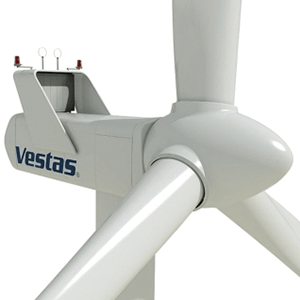
Vestas Wind Systems is a Danish manufacturer, seller, installer, and servicer of wind turbines. It is the largest in the world, but due to very rapid growth of its competitors – GE (US), Sinovel (China), Enercom (Germany), and Gamesa (Spain) – its market share decreased from 28% in 2007 to 12.5% in 2009. Vestas has installed over 41,000 wind turbines in 63 countries on five continents. The company employs more than 22,000 people globally, and has built production facilities in more than 12 countries.
Vestas spent €92 million ($128 million), or 1.4% of revenue, on research and development in 2009. It has filed 787 wind turbine patents (165 in 2009) according to United Kingdom Intellectual Property Office (UK-IPO), while General Electric has 666 and Siemens Wind Power has 242. In October 2009, Vestas and QinetiQ claimed a successful test of a stealth wind turbine blade mitigating radar reflection problems for aviation.
Posted in Money, Technology, World |
Leave a Comment »
December 14, 2010

The term life hack refers to productivity tricks that programmers devise and employ to cut through information overload and organize their data. The original definition of the term referred to utilities that filtered and processed data streams like email and RSS feeds. Examples of these types of life hacks might include utilities to synchronize files, track tasks, remind yourself of events or filter email. As the meme spread, the definition of the term expanded. Today, anything that solves an everyday problem in a clever or non-obvious way might be called a life hack. The term became popularized in the blogosphere and is primarily used by geeks who suffer from information overload or those with a playful curiosity in the ways they can accelerate their workflow.
The terms hack, hacking, and hacker have a long history of ambiguity in the computing and geek communities, particularly within the free and open source software crowds. However, in the context used here a ‘hack’ is a clever trick or stratagem. British technology journalist Danny O’Brien coined the term after polling a group of productive geeks on the details of their work processes. O’Brien discovered a pattern among these super-productive programmers: that they devised and used ’embarrassing’ scripts and shortcuts to get their work done.
Posted in Language, Technology |
Leave a Comment »
December 13, 2010

Chartjunk refers to all visual elements in charts and graphs that are not necessary to comprehend the information represented on the graph, or that distract the viewer from this information. Examples of unnecessary elements which might be called chartjunk include heavy or dark grid lines, unnecessary text or inappropriately complex typefaces, ornamented chart axes and display frames, pictures or icons within data graphs, ornamental shading and unnecessary dimensions.
Another kind of chartjunk skews the depiction and makes it difficult to understand the real data being displayed. Examples of this type include items depicted out of scale to one another, noisy backgrounds making comparison between elements difficult in a chart or graph, and 3-D simulations in line and bar charts. The term was coined by American statistician Edward Tufte in his 1983.
Posted in Art, Technology |
Leave a Comment »
December 13, 2010

The Tata Nano is a low-cost, rear-engined, four-passenger city car built by the Indian company Tata Motors, which began selling its ‘one-lakh’ (100,000 Rupees or $2,200) car in 2009. The price has risen somewhat since its introduction due to increasing materials costs. It features a 623cc, 2 cylinder engine with a top speed of 43 mph. It is an example of ‘Gandhian engineering,’ a concept involving deep frugality and a willingness to challenge conventional wisdom.
The Nano’s design implements many cost-reducing innovations: the trunk is only accessible from inside the car, as the rear hatch does not open; one windscreen wiper instead of the usual pair; no power steering, unnecessary due to its light weight; three lug nuts on the wheels instead of the usual four; only one side-view mirror; no radio, no air-conditioning, and no airbags.
Posted in Money, Technology, World |
Leave a Comment »
December 13, 2010

Bubble car is a subjective term used for some small, economical automobiles, usually produced in the 1950s and 1960s. The Messerschmitt KR175 and KR200, and the FMR Tg500, had aircraft-style bubble canopies, giving rise to the term bubble car to refer to all these post-war microcars. Bubble cars became popular in Europe at that time as a demand for cheap personal motorized transport emerged and fuel prices were high due in part to the 1956 Suez Crisis. Most of them were three-wheelers, which in many places qualified them for inexpensive taxes and licensing as motorcycles. Most bubble cars were manufactured in Germany, including by the former German military aircraft manufacturers, Messerschmitt and Heinkel.
BMW manufactured the Italian Iso Rivolta Isetta under licence, using an engine from one of their own motorcycles. France also produced large numbers of similar tiny vehicles called voiturettes, but unlike the German makes, these were rarely sold abroad. There were a small number of British three wheeled microcars, including the larger Regal and Robin from the Reliant Motor Company in Staffordshire and the smaller P50 and Trident from the Peel Engineering Company on the Isle of Man. Bubble cars were superseded by a new wave of ‘proper small cars’ like the 1959 Austin Mini, which gave far more functionality for their owners for only slightly higher costs.
Posted in Money, Technology |
Leave a Comment »
December 10, 2010
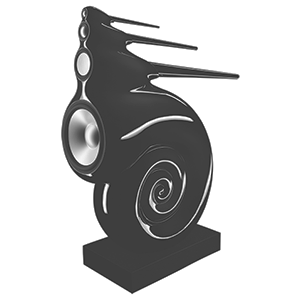
The Nautilus is a Bowers & Wilkins concept loudspeaker first released in 1993. It uses tapering tubes filled with absorbent wadding to reduce resonances to an insignificant minimum. Nautilus Tapering Tubes are fitted to nearly all Bowers & Wilkins speakers, even when they’re not visible to the eye. Tapering the tube enables you to make it shorter for the same level of absorption; it acts like a horn in reverse – reducing the sound level instead of increasing it.
The limit of this type of loading is reached when the wavelength gets small enough to be comparable with the diameter of the tube. To maintain the effectiveness of tube loading, you must restrict the bandwidth of each driver. This is one reason why the Nautilus loudspeaker is divided into a 4-way system. A more complex type of loading is required to cover a wider bandwidth and the sphere/tube enclosure was developed for the Nautilus 800 Series.
Posted in Art, Technology |
Leave a Comment »
December 10, 2010
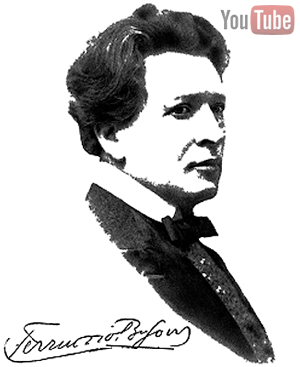
Ferruccio [fer-root-chaw] Busoni [byoo-soh-nee] (1866 – 1924) was an Italian composer. His philosophy that ‘Music was born free; and to win freedom is its destiny,’ greatly influenced his students Percy Grainger and Edgard Varèse, both of whom played significant roles in the 20th century opening of music to all sound. In 1907 he published Sketch of a New Esthetic of Music, which discussed the use of electrical and other new sound sources in future music.
He deplored that his own keyboard instrument had conditioned our ears to accept only an infinitesimal part of the infinite gradations of sounds in nature. He wrote of the future of microtonal scales in music, made possible by Cahill’s Dynamophone: ‘Only a long and careful series of experiments, and a continued training of the ear, can render this unfamiliar material approachable and plastic for the coming generation, and for Art.’
Posted in Art, Technology |
Leave a Comment »
December 10, 2010

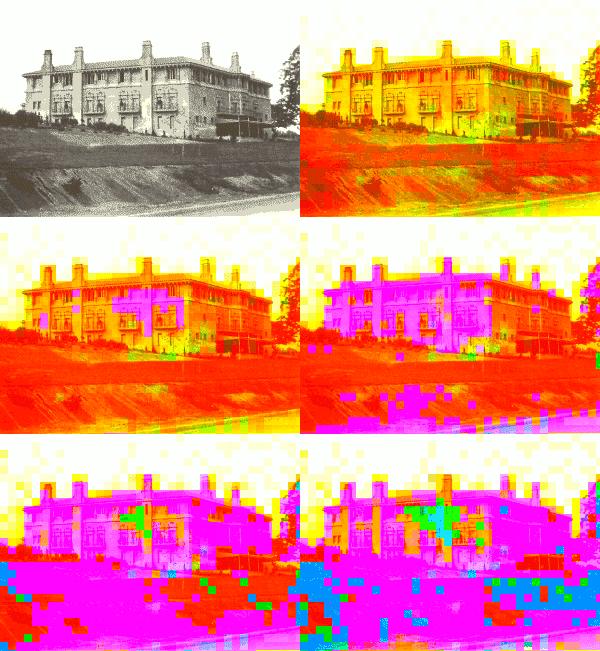
A compression artifact is a noticeable distortion of media – an image, audio, or video – due to the application of an overly aggressive or inappropriate lossy data compression algorithm. These lossy data compression schemes discard some data to simplify the media sufficiently to store it in the desired space. If there is not enough data in the compressed version to reproduce the original with acceptable fidelity, artifacts will result. Alternatively, the compression algorithm may incorrectly determine certain distortions to be of little subjective importance, but they may in fact be objectionable to the viewer.
Compression artifacts occur in many common media such as DVDs, common computer file formats such as JPEG, MP3, or MPEG files, and Sony’s ATRAC compression algorithm. Uncompressed media (such as on Laserdiscs, Audio CDs, and WAV files) or losslessly compressed media (FLAC, PNG, etc.) do not suffer from compression artifacts. The minimization of artifacts is a key goal in implementation of lossy compression schemes. However, artifacts are occasionally intentionally produced for artistic purposes, a style known as glitch art.
Posted in Art, Technology |
Leave a Comment »





