December 9, 2010
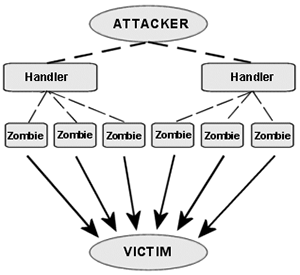
A denial-of-service attack (DoS attack) or distributed denial-of-service attack (DDoS attack) is an attempt to make a computer resource unavailable to its intended users. Perpetrators of DoS attacks typically target sites or services hosted on high-profile web servers such as banks, credit card payment gateways, and even root nameservers. The term is generally used with regards to computer networks, but is not limited to this field, for example, it is also used in reference to CPU resource management. DoS attacks are prosecuted in a number of nations under a variety of computer crime laws. They can also constitute acts of cyberwarfare.
One common method of attack involves saturating the target machine with external communications requests, such that it cannot respond to legitimate traffic, or responds so slowly as to be rendered effectively unavailable. In general terms, DoS attacks are implemented by either forcing the targeted computer(s) to reset, or consuming its resources so that it can no longer provide its intended service or obstructing the communication media between the intended users and the victim so that they can no longer communicate adequately.
Posted in Politics, Technology, War |
Leave a Comment »
December 8, 2010


A Fresnel [fruh-nel] lens was originally developed by French physicist Augustin-Jean Fresnel for lighthouses. The design enables the construction of lenses of large aperture and short focal length without the mass and volume of material that would be required by a lens of conventional design. Compared to conventional bulky lenses, the Fresnel lens is much thinner, larger, and flatter, and captures more oblique light from a light source, thus allowing lighthouses to be visible over much greater distances. The first Fresnel lens was used in 1823 in the Cordouan lighthouse, north of Bordeaux; its light could be seen from more than 32 km out.
Posted in Technology |
Leave a Comment »
December 7, 2010

Area code 321 is the area code serving Brevard County, Florida and home to the Kennedy Space Center. It has been in use since November 1, 1999, and was assigned to the area after a successful petition drive due to the Space Coast’s impact on the county (if pronounced properly – ‘three, two, one’– the code resembles the countdown which launches the many spacecraft from Cape Canaveral).
Posted in Humor, Politics, Technology |
Leave a Comment »
December 7, 2010

Dan Deacon (b. 1981) is an American electronic musician. Dan was born and raised in suburban Long Island, New York. After high school he attended the Conservatory of Music at State University of New York where, in addition to performing his solo material, he played in many bands, including tuba for Langhorne Slim and guitar in the improvisational grindcore band Rated R. He completed his graduate studies in electro-acoustic and computer music composition.
In 2004 he moved to Baltimore, Maryland and moved into the Copycat Building and, along with friends from SUNY Purchase, formed Wham City, an arts and music collective.
read more »
Posted in Art, Technology |
Leave a Comment »
December 3, 2010


Issey Miyake (b. 1938) is a Japanese fashion designer. He is known for his technology-driven clothing designs, exhibitions and fragrances. Miyake was born in Hiroshima; as a seven year-old, he witnessed and survived the nuclear bomb. He studied graphic design at the Tama Art University in Tokyo, graduating in 1964. After graduation, he worked in Paris and New York City. Returning to Tokyo in 1970, he found the Miyake Design Studio. In the late ’80s, he began to experiment with new methods of pleating that would allow both flexibility of movement for the wearer as well as ease of care and production.
This eventually resulted in a new technique called ‘garment pleating’ and in 1993’s ‘Pleats Please’ in which the garments are cut and sewn first, then sandwiched between layers of paper and fed into a heat press, where they are pleated. The fabric’s ‘memory’ holds the pleats and when the garments are liberated from their paper cocoon, they are ready-to wear. He had a long friendship with Austrian-born pottery artist Dame Lucie Rie. She bequeathed to him her substantial collection of ceramic and porcelain buttons, which he integrated into his designs and presented them in new collections.
Posted in Art, Money, Technology |
Leave a Comment »
December 3, 2010

In 1938 American engineer, Buckminster Fuller coined the term ephemeralization to describe the increasing tendency of physical machinery to be replaced by what is now called software. It describes the ability of technological advancement to do ‘more and more with less and less until eventually you can do everything with nothing.’ Fuller’s vision was that ephemeralization will result in ever-increasing standards of living for an ever-growing population despite finite resources. The concept is a counterargument to Malthusian philosophy, where that the dangers of population growth (famine, disease, etc.) would preclude endless progress towards a utopian society.
Fuller uses Henry Ford’s assembly line as an example of how ephemeralization can continuously lead to better products at lower cost with no upper bound on productivity. Another example is found in length measurement technologies: ruler > rod > rope > telescope > radio. The technological progression is a continuing increase in length-measuring ability per pound of instrument, with no apparent upper limit according to Fuller. However, increasing system complexity and information overload make it difficult and stressful for the people who must control the ephemeralized systems. This can negate the advantages of ephemeralization.
Posted in Language, Technology |
Leave a Comment »
December 3, 2010

A QR Code is a matrix barcode (or two-dimensional code), readable by QR scanners, mobile phones with a camera, and smartphones. The code consists of black modules arranged in a square pattern on white background. The information encoded can be text, URL or other data. Common in Japan, where it was created by Toyota subsidiary Denso-Wave in 1994, the QR code is one of the most popular types of two-dimensional barcodes.
QR is the abbreviation for Quick Response, as the creator intended the code to allow its contents to be decoded at high speed. The maximum information a QR code can represent is about 4300 alphanumeric characters or just under 3 kilobytes.
Posted in Technology |
Leave a Comment »
December 1, 2010

The NatureMill is an automated, indoor composter. Powered by about 10 watts of electricity per month, it heats and mixes food scraps every four hours. Steady aeration and low heat accelerates the composting process; it takes two to the three weeks to convert waste into usable soil.
Natural compost cultures consume waste quickly, without odors. They produce a mild aroma like sourdough, mushrooms, or straw. Sawdust and baking soda reduce acidity, and a fan draws air into the machine, providing oxygen to the cultures. A powerful carbon filter removes any lingering odors. The NatureMill Pro costs $399. Maximum input is 120 lbs. per month. Bones and peach and avocado pits will not compost in a NatureMill, and acidic foods like citrus, tomatoes, and grapes will only compost in limited quantities.
Posted in Food, Technology |
Leave a Comment »
December 1, 2010

Asteroid mining refers to exploiting raw materials from asteroids and planetoids in space, especially near-Earth objects. Minerals and volatiles could be mined from an asteroid or spent comet to provide space construction material (e.g., iron, nickel, titanium), to extract water and oxygen to sustain the lives of prospector-astronauts on site, as well as hydrogen and oxygen for use as rocket fuel. In space exploration, these activities are referred to as in-situ resource utilization.
A relatively small metallic asteroid with a diameter of 1 mile contains more than $20 trillion US dollars worth of industrial and precious metals. The gold, cobalt, iron, manganese, nickel, palladium, platinum, and other metals that we now mine from the Earth’s crust, and that are essential for economic and technological progress, came originally from the rain of asteroids that struck the primordial Earth. Earth’s massive gravity pulled all such siderophilic (iron loving) elements into the planet’s core during its molten youth more than four billion years ago. Initially, this left the crust utterly depleted of such valuable elements. Asteroid impacts re-infused the depleted crust with metals.
Posted in Money, Science, Technology |
Leave a Comment »
December 1, 2010

Landfill mining and reclamation (LFMR) is the excavation and processing of solid wastes which have previously been landfilled to reduce the amount of landfill mass encapsulated within the closed landfill and/or to remove hazardous materials. In the process, mining recovers valuable recyclable materials, a combustible leachate (liquid that, in passing through matter, extracts solutes, suspended solids or any other component of the material through which it has passed), soil, and landfill space.
The aeration of the landfill soil is a secondary benefit regarding the landfill’s future use, and the combustible leachate is useful for the generation of power. The concept was introduced as early as 1953 at the Hiriya landfill near the city of Tel Aviv, Israel. Waste contains many resources with high value, the most notable of which are non-ferrous metals such as aluminium cans and scrap metal. The concentration of aluminium in many landfills is higher than the concentration of aluminum in bauxite from which the metal is derived.
Posted in Money, Technology |
Leave a Comment »
November 30, 2010

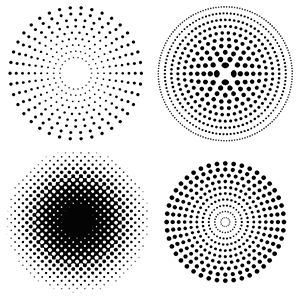
Halftone is the reprographic technique that simulates continuous tone imagery through the use of dots, varying either in size, in shape or in spacing. ‘Halftone’ can also be used to refer specifically to the image that is produced by this process. Whereas continuous tone imagery contains an infinite range of colors or greys, the halftone process reduces visual reproductions to a binary image that is printed with only one color of ink. This binary reproduction relies on a basic optical illusion— tiny halftone dots are perceived as smooth tones by the human brain.
At a microscopic level, developed black and white photographic film also consists of only two colors, and not an infinite range of continuous tones. For details, see film grain. Just as color photography evolved with the addition of filters and film layers, color printing is made possible by repeating the halftone process for each subtractive color—most commonly using what is called the ‘CMYK color model.’ The semi-opaque property of ink allows halftone dots of different colors to create another optical effect—full-color imagery.
Posted in Art, Technology |
Leave a Comment »
November 23, 2010

The Congressional Space Medal of Honor was authorized by the United States Congress in 1969 to recognize ‘any astronaut who in the performance of his duties has distinguished himself by exceptionally meritorious efforts and contributions to the welfare of the Nation and mankind.’ The highest award given in NASA, it is awarded by the President of the United States in Congress’s name on recommendations from the NASA Administrator. The award is a separate decoration from the Medal of Honor, which is a military award for extreme bravery and gallantry in combat.
Although the Congressional Space Medal of Honor is a civilian award of the United States government, it is authorized as a military decoration for display on U.S. military uniforms due to the prestige of the decoration. In such cases, the Congressional Space Medal of Honor is worn as a ribbon following all United States Armed Forces decorations. The Congressional Space Medal of Honor may also be presented posthumously to those astronauts who die while performing a United States space mission, and as of 2008 all 17 astronauts killed on U.S. missions have been awarded the medal.
Posted in Politics, Technology |
Leave a Comment »