September 13, 2010

Washlet is a registered trademark of Japanese toilet industry giant TOTO, referring to electric toilets with bidet functions. The first toilet with an integrated bidet was produced in the United States in 1964. The age of the high-tech toilet in Japan started in 1980 with the introduction of the Washlet G Series by Toto, and since then the product name washlet has been used to refer to all types of Japanese high-tech toilets. As of 2002, almost half of all private homes in Japan have such a toilet, exceeding the number of households with a personal computer.
While the toilet looks like a Western-style toilet at first glance, there are numerous additional features—such as blow dryer, seat heating, massage options, water jet adjustments, automatic lid opening, automatic flushing, wireless control panel, room heating and air conditioning for the room—included either as part of the toilet or in the seat. Recently, researchers have added medical sensors into these toilets, which can measure the blood sugar based on the urine, and also measure the pulse, blood pressure, and the body fat content of the user.
Posted in Health, Technology, World |
2 Comments »
September 13, 2010
Thorium [thawr-ee-uhm] is a chemical element with the symbol Th and atomic number 90. It is a naturally occurring, lustrous white metal. It is estimated to be about three to four times more abundant than uranium in the Earth’s crust. It has been considered a waste product in mining rare earths, so its abundance is high and cost low. One ton of thorium produces the same energy as 200 tons of uranium, or 3.5 million tons of coal.
Edward Teller, co-founder and director of Lawrence Livermore National Laboratory, promoted thorium energy until his death, and scientists in the United States, France, Japan, India, and Russia are now creating their own thorium-based power plants.
Posted in Science, Technology |
Leave a Comment »
September 13, 2010

Y Combinator is an American seed-stage startup funding firm, started in 2005 by Paul Graham, Robert Morris, Trevor Blackwell, and Jessica Livingston. Y Combinator provides seed money, advice, and connections at two 3-month programs per year. In exchange, they take an average of about 6% of the company’s equity. Compared to other startup funds, Y Combinator provides very little money ($17,000 for startups with 2 founders and $20,000 for those with 3 or more). This reflects Graham’s theory that between free software, dynamic languages, the web, and Moore’s Law, the cost of founding a startup has greatly decreased. The firm is named after a construct in the theory of functional programming.
Y Combinator was started after Graham gave a talk at his alma mater, Harvard (where he earned a PhD in Computer Science). He suggested founders seek seed funding from angel investors preferably those who had made money in technology. He soon after organized Y Combinator to offer seed funding to startups. As of June 2009, Y Combinator had funded over 118 startups. The number of startups funded in each cycle has been gradually increasing. The first cycle in summer 2005 had eight startups. In the summer 2010 cycle, there were 38. Some of the better-known funded companies include Reddit and Dropbox.
Posted in Money, Technology |
Leave a Comment »
September 11, 2010

The Phantom Works division is the main research and development arm of The Boeing Company. Founded by McDonnell Douglas before the merger with Boeing, its primary focus had been development of advanced military products and technologies. After the merger, research and development expanded to cover commercial and space applications as well. Phantom Works has been a driving factor behind nearly all of the company’s large contracts, including the upcoming X-45 UCAV (unmanned combat air vehicle).
Posted in Money, Technology, War |
Leave a Comment »
September 11, 2010

Skunk Works is an official alias for Lockheed Martin’s Advanced Development Programs. Skunk Works is responsible for a number of famous aircraft designs, including the U-2, the SR-71 Blackbird, the F-117 Nighthawk, and the F-22 Raptor. Its largest current project is the F-35 Lightning II, which will be used in the air forces of several countries around the world. Production is expected to last for up to four decades. The designation ‘skunk works’ is widely used in business, engineering, and technical fields to describe a group within an organization given a high degree of autonomy and unhampered by bureaucracy, tasked with working on advanced or secret projects.
The term came from Al Capp’s satirical, hillbilly comic strip Li’l Abner, which was immensely popular in the 1940s and ’50s. The ‘Skonk Works’ was a dilapidated factory in the backwoods of Kentucky. According to the strip, scores of people were done in yearly by the toxic fumes of the concentrated ‘skonk oil,’ which was brewed and barreled daily for some mysterious, never specified purpose. The original Lockheed facility was located adjacent to a malodorous plastics factory. Engineer, Irving Culver, first referred to the facility as ‘Skonk Works.’ The name stuck, and at the request of the comic strip copyright holders, Lockheed changed the name of the advanced development company to ‘Skunk Works’ in the 1960s.
Posted in Money, Technology, War |
Leave a Comment »
September 11, 2010

The 386 Generation is a generation of South Koreans born in the 1960s who were very active politically as young adults, and instrumental in the democracy movement of the 1980s. The term refers to the Intel i386 CPU, released in 1985, and used in Korean universities in that era. This was the first generation of South Koreans to grow up free from the poverty that had marked Korea in the recent past.
The broad political mood of the generation was far more left-leaning than that of their parents, or their eventual children. They played a pivotal role in the democratic protests which forced President Chun Doo-hwan to call democratic elections in 1987, marking the transition from military rule to democracy. Members of the 386 Generation now comprise much of the elite of Korean society, including Nobel laureate and former president Kim Dae-jung (1925 – 2009).
Posted in Politics, Technology, World |
Leave a Comment »
September 10, 2010

A memristor (‘memory resistor’) is a circuit element first theorized to exist by U.S. electronic engineer, Leon Chua in a 1971 and first demonstrated in a laboratory in 2008. There are several proposed applications for memristors, including computer memory that retains data even after the power is shut off. A common analogy for a resistor is a pipe that carries water. The water itself is analogous to electrical charge, the pressure at the input of the pipe is similar to voltage, and the rate of flow of the water through the pipe is like electrical current. Just as with an electrical resistor, the flow of water through the pipe is faster if the pipe is shorter and/or it has a larger diameter.
An analogy for a memristor is an interesting kind of pipe that expands and shrinks. If water flows through the pipe in one direction, the diameter of the pipe increases, thus enabling the water to flow faster. If water flows through the pipe in the opposite direction, the diameter of the pipe decreases, thus slowing down the flow of water. If the water pressure is turned off, the pipe will retain it most recent diameter until the water is turned back on. Thus, the pipe does not store water like a bucket (or a capacitor) – it remembers how much water flowed through it.
Posted in Technology |
Leave a Comment »
September 10, 2010
The Electronic Frontier Foundation (EFF) is an international non-profit digital rights advocacy and legal organization based in the United States.
EFF provides funds for legal defense in court, defends individuals and new technologies from what it considers baseless or misdirected legal threats, works to expose government malfeasance, provides guidance to the government and courts, organizes political action and mass mailings, supports some new technologies which it believes preserve personal freedoms, maintains a database and web sites of related news and information, monitors and challenges potential legislation that it believes would infringe on personal liberties and fair use, and solicits a list of what it considers patent abuses with intentions to defeat those that it considers without merit.
Posted in Money, Politics, Technology |
Leave a Comment »
September 10, 2010
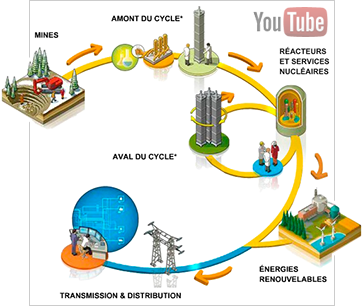
Areva is a French public multinational industrial conglomerate formed in September of 2001, and is the world’s largest supplier of nuclear energy. It is the only company with a presence in each industrial activity linked to nuclear energy: mining, chemistry, enrichment, combustibles, services, engineering, nuclear propulsion and reactors, treatment, recycling, stabilization, and dismantling. The corporate name Areva is inspired by the Trappist Santa Maria de la Real monastery in Arevalo in Spain.
Posted in Money, Technology, World |
Leave a Comment »
September 3, 2010

A hype cycle is a graphic representation of the maturity, adoption and social application of specific technologies. The term was coined by information technology research and advisory firm Gartner.
Posted in Money, Technology |
Leave a Comment »
September 2, 2010


A hackerspace or hackspace (also referred to as a hacklab, makerspace or creative space) is a location where people with common interests, usually in computers, technology, or digital or electronic art can meet, socialise and/or collaborate. A hackerspace can be viewed as an open community labs incorporating elements of machine shops, workshops and/or studios where hackers can come together to share resources and knowledge to build and make things. Some hackspaces are freely available, and others charge dues for access to equipment and networks.
One notable hackerspace is the Hacker Dojo, a non-profit community center and hackerspace in Mountain View, California, inspired by nearby facilities like Noisebridge, TechShop, The Crucible, and Coworking locations like Citizen Space, Sandbox Suites, and The Hat Factory. The Dojo is a membership organization – nearly all funds come from $100/month membership subscriptions, though the organization has been sponsored by Google and Microsoft. Membership provides access to the 8180 square foot facility, equipped with computers, electronics, and a high speed network.
Posted in Money, Technology |
Leave a Comment »
August 25, 2010
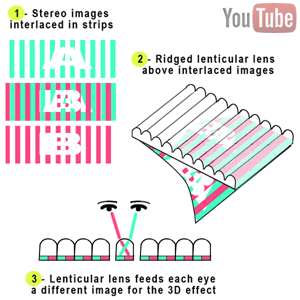

Lenticular [len-tik-yuh-ler] printing is a technology in which a lenticular lens (an array of magnifying lenses, designed so that when viewed from slightly different angles, different images are magnified) is used to produce images with an illusion of depth, or the ability to change or move as the image is viewed from different angles. This technology was created in the 1940s but has evolved in recent years to show more motion and increased depth.
Posted in Art, Technology |
Leave a Comment »