October 11, 2010

Jailbreaking is a process that allows iPad, iPhone and iPod Touch users to install homebrew applications on their devices by unlocking the operating system and allowing the user root access. Once jailbroken, iPhone users are able to download many extensions and themes previously unavailable through the App Store via unofficial installers such as Cydia.
A jailbroken iPad, iPhone or iPod Touch is still able to use the App Store and iTunes. Jailbreaking is different from SIM unlocking, which, once completed, means that the mobile phone will accept any SIM without restriction on, for example, the country or network operator of origin.
Posted in Politics, Technology |
Leave a Comment »
October 10, 2010

Stanley is an autonomous vehicle created by Stanford University’s Stanford Racing Team in cooperation with the Volkswagen Electronics Research Laboratory (ERL). It competed in, and won, the 2005 DARPA Grand Challenge, earning the Stanford Racing Team the 2 million dollar prize. Stanley’s descendant ‘Junior’ placed second in the 2007 DARPA Urban Challenge. Stanley is based on a diesel engined Volkswagen Toureg, Junior on a Passat. The Stanford Racing Team chose the Touareg for its ‘drive by wire’ control system which could be adapted to run directly from an on-board computer.
To navigate, Stanley used five roof mounted LIDAR units to build a 3-D map of the environment, supplementing the position sensing GPS system. An internal guidance system utilizing gyroscopes and accelerometers monitored the orientation of the vehicle and also served to supplement GPS and other sensor data. Additional guidance data was provided by a video camera used to observe driving conditions out to eighty meters (beyond the range of the LIDAR) and to ensure room enough for acceleration. Stanley also had sensors installed in a wheel well to record a pattern imprinted on the tire and to act as an odometer in case of loss of signal (such as when driving through a tunnel). Using the data from this sensor, the on-board computer can extrapolate how far it has traveled since the signal was lost.
Posted in Technology |
Leave a Comment »
October 1, 2010

The Olduvai Gorge in northern Tanzania is commonly referred to as ‘The Cradle of Mankind.’ The old name for the Gorge was Olduvai Gorge, which was a mispronunciation of Oldupai. The Gorge was re-named in 2005 to correct this mistake. Oldupai is the Maasai word for the wild plant which grows in the gorge that is used as an antiseptic and natural bandage. Excavation work there was pioneered by Louis and Mary Leakey beginning in 1931 and continued into the twenty-first century by Professor Fidelis Masao of the Open University of Tanzania supported by Earthwatch; there have also been teams from Rutgers University.
The earliest archaeological deposit, known as Bed I, has produced evidence of campsites and living floors along with stone tools made of local basalt and quartz. Since this is the site where these kinds of tools were first discovered, these tools are called Oldowan. It is now thought that the Oldowan toolmaking tradition started about 2.6 million years ago. Above this, in Bed II, pebble tools begin to be replaced by more sophisticated handaxes of the Acheulean industry and made by H. ergaster. This layer has not yet been successfully dated, but likely falls between 1.75 and 1.2 million years.
Posted in Technology |
Leave a Comment »
October 1, 2010


The Scratchophone is a portable scratch instrument, featuring a turntable, a special tonearm, scratch mixer, and a pair of speakers, a battery, and a harness. They are hand-made in Quebec, Canada and feature a direct drive Numark turntable, a 2-channel Vestax mixer, and a Stanton cartdidge needle. It sells for $2,179.99.
Posted in Art, Money, Technology |
Leave a Comment »
September 30, 2010

Internet2 is a not-for-profit networking consortium, which operates a next-generation Internet Protocol and optical network. As the Internet gained in public recognition and popularity, universities were among the first institutions to outgrow their bandwidth limitations. The National Science Foundation and MCI developed the very-high-performance Backbone Network Service (vBNS) in 1995 to support high-bandwidth applications like data mining, medical imaging and particle physics. The Internet2 project was established in 1996, and in partnership with Qwest, built the first Internet2 Network, called Abilene in 1998.
In 2003 it was a prime investor in the National LambdaRail project, the first transcontinental 10-Gigabit Ethernet network. In 2007, Internet2 officially retired Abilene and now refers to its new, higher capacity network as the Internet2 Network. The network itself is a dynamic, robust and cost-effective hybrid optical and packet network. It furnishes a 100Gb/s network backbone to more than 210 U.S. educational institutions, 70 corporations and 45 non-profit and government agencies.
Posted in Education, Technology |
Leave a Comment »
September 30, 2010
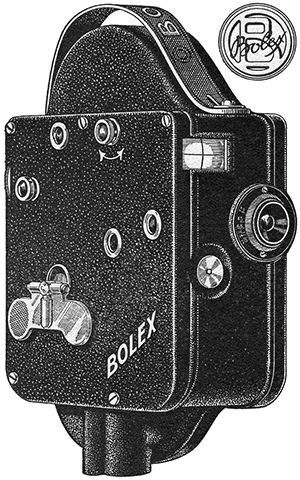

Bolex is a Swiss company that manufactures motion picture cameras and lenses. The most notable products of which are in the 16 mm and Super 16 mm formats. The Bolex was initially founded by Ukranian engineer and inventor Jacques Bogopolsky in the 1940s. Bolex is derived from his name. He had previously designed cameras for Alpa. Bolex cameras were particularly important for early television news, nature films, documentaries and the avant garde, and are still favoured by many animators today.
Some later models are electrically powered, the majority of those manufactured since the 1930s use a spring-wound clockwork. The 16 mm spring-wound Bolex is a popular introductory camera in film schools. Today, the Bolex factory in Switzerland continues to produce new 16mm and Super 16 film cameras and also can convert Bolex H16 reflex models to super 16mm.
Posted in Art, Technology, World |
1 Comment »
September 27, 2010

Stuxnet is a Windows computer worm discovered in July 2010 that targets industrial software and equipment. While it is not the first time that hackers have targeted industrial systems, it is the first discovered malware that spies on and subverts industrial systems. The worm initially spreads indiscriminately, but includes a highly specialized malware payload that is designed to target only Siemens Supervisory Control And Data Acquisition systems that are configured to control and monitor specific industrial processes.
The probable target of Stuxnet is widely suspected to be uranium enrichment infrastructure in Iran, which confirmed that its nuclear program had indeed been damaged. The infestation by this worm may therefore have damaged Iran’s nuclear facilities in Natanz and eventually delayed the start up of Iran’s Bushehr Nuclear Power Plant. Security experts have concluded that the sophisticated attack could only have been conducted with nation-state support and it has been speculated that Israel may have been involved.
Posted in Technology, War |
Leave a Comment »
September 21, 2010

ReplayGain is a method, published by David Robinson in 2001, to normalize the perceived loudness of audio in computer audio formats such as MP3 and Ogg Vorbis. It works on a track/ album basis, and is now supported in a growing number of media players including iTunes, VLC, and Winamp. Replay Gain works by analyzing an audio track to measure peak levels and perceived loudness. The difference between the measured perceived loudness and the desired target loudness is calculated; this is considered the ideal replay gain value. The target loudness of almost all Replay Gain utilities is 89 dB.
Usually, the gain value and the peak value are then stored as metadata in the audio file, allowing Replay Gain-capable audio players to automatically attenuate or amplify the signal such that tracks play at a similar loudness level. This avoids the common problem of having to manually adjust volume levels when playing audio files from albums that have been mastered at different levels. Should the original levels of audio be desired (e.g., for burning back to hard copy), the metadata can simply be ignored.
Posted in Technology |
Leave a Comment »
September 21, 2010
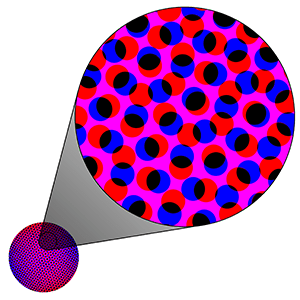

The Ben-Day Dots printing process, named after illustrator and printer Benjamin Day, is similar to Pointillism. Depending on the effect, color and optical illusion needed, small colored dots are closely-spaced, widely-spaced or overlapping. Magenta dots, for example, are widely-spaced to create pink. 1950s and 1960s pulp comic books used Ben-Day dots in the four process colors (cyan, magenta, yellow and black) to inexpensively create shading and secondary colors such as green, purple, orange and flesh tones.
Ben-Day dots differ from halftone dots in that the Ben-Day dots are always of equal size and distribution in a specific area. To apply the dots to a drawing the artist would purchase transparent overlay sheets from a stationery supplier. The sheets were available in a wide variety of dot size and distribution, which gave the artist a range of tones to use in the work. The overlay material was cut in the shapes of the tonal areas desired—i.e. shadow or background or surface treatment and rubbed onto the specific areas of the drawing with a burnisher. When photographically reproduced as a line cut for letterpress printing, the areas of Ben-Day overlay provided tonal shading to the printing plate.
Posted in Art, Money, Technology |
Leave a Comment »
September 20, 2010
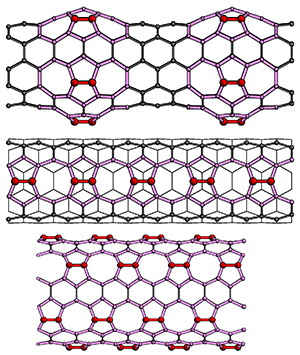
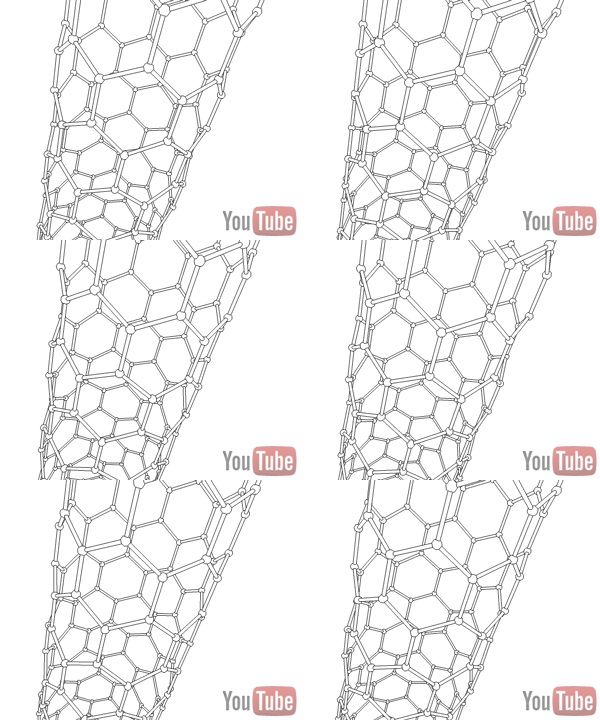
Carbon nanotubes are a molecular configuartion (or allotrope) of carbon with a cylindrical structure. Nanotubes have been constructed with length-to-diameter ratio of up to 132,000,000:1, which is significantly larger than any other material. These cylindrical carbon molecules have novel properties which make them potentially useful in many applications in nanotechnology, electronics, optics, and other fields of materials science, as well as potential uses in architectural fields. They exhibit extraordinary strength and unique electrical properties, and are efficient thermal conductors.
Nanotubes are members of the fullerene structural family, which also include spherical buckyballs. The ends of a nanotube may be capped with a hemisphere of the buckyball structure. Their name is derived from their size, since the diameter of a nanotube is on the order of a few nanometers (approximately 1/50,000th of the width of a human hair), while they can be up to 18 centimeters in length.
Posted in Technology |
Leave a Comment »
September 20, 2010


AOHell was a program that modified early versions of America Online. It included a fake account generator, social engineering (or phishing) tools, and email, IM, and chatroom automation. Released in 1994 by a hacker known as ‘Da Chronic,’ AOHell provided a number of utilities which ran on top of the America Online client software. Upon loading, the program played a short clip from Dr. Dre’s 1993 song ‘Nuthin’ but a ‘G’ Thang.’ It was the first program of its kind, and spawned a large number of copycats. Over a period of 10 years, more than 1000 programs would be released for various versions of AOL.
In the manual, the creator of AOHell claims that he created the program because the AOL administrators would frequently shut down hacker and pirate chatrooms for violation of AOL’s terms of service while refusing to shut down the pedophilia chat rooms which regularly traded child pornography. Da Chronic claimed when he confronted AOL about it, he was met with an account deletion. His goal was,'[To have] 20,000+ idiots using AOHell to knock people offline, steal passwords and credit card information, and to basically annoy the hell out of everyone.’
Posted in Humor, Technology |
Leave a Comment »
September 17, 2010

OLED stands for Organic Light Emitting Diode. The ‘organic’ in OLED refers to organic material. Carbon is the basis of all organic matter. Examples of carbon-based substances include sugar, wood and the majority of plastics. ‘Light Emitting Diode’ describes the process of converting electric energy into light. OLEDs are used in television screens, computer monitors, mobile phones, watches, advertising, information and indication; they can also be used in light sources for general space illumination and in large-area light-emitting elements. An OLED display functions without a backlight. Thus, it can display deep black levels and can be thinner and lighter than liquid crystal displays and more power efficient. Similarly, in low ambient light conditions such as dark rooms, an OLED screen can achieve a higher contrast ratio than an LCD screen using either cold cathode fluorescent lamps or the more recently developed LED backlight. It can also be made up to 85% transparent and printed on flexible substrates.
The layer of organic material is sandwiched between two conductors (an anode and a cathode), which in turn are sandwiched between a glass top plate (seal) and a glass bottom plate (substrate). When electric Current is applied to the two conductors, a bright, electroluminescent light is produced directly from the organic material. OLED has more control over color expression than LCD because it only expresses pure colors when an electric Current stimulates the relevant Pixels. There are two main families of OLEDs. Those based upon small molecules, and more recently, those employing polymers.
Posted in Technology |
Leave a Comment »