August 17, 2010
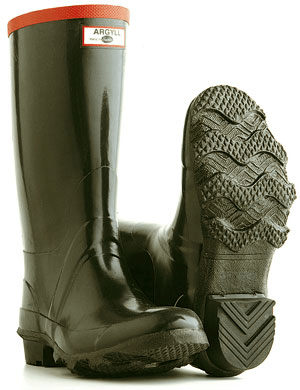
The Wellington boot, also known as wellys, gumboots, or muckboots are a type of boot based upon leather Hessian boots. It was worn and popularised by Arthur Wellesley, 1st Duke of Wellington. The boot then became a fashionable style emulated by the British aristocracy in the early 19th century. Wellington boots are waterproof and are most often made from rubber or polyvinyl chloride (PVC). They are generally just below knee-high. Wellington boots are used in many commercial and industrial settings including chemical plants, food processing plants, hospital operating rooms, and dust-free clean rooms for electronics manufacture.
Hunter Boot is a major rubber wellington boot and footwear designer. The company manufactured vulcanized rubber products in Scotland for over 150 years but now sources product exclusively in China. Besides rubber boots, the company also produces other products such as bags, socks and other related accessories, and historically has been involved in the manufacture of tires, conveyor belts, combs, golf balls, hot water bottles and rubber flooring. The Hunter Boot company was the oldest manufacturer of rubber boots in the UK, and the ubiquitous Green Welly is its best known product, but the French Argyll welly pre-dates it.
Posted in Money, Technology |
Leave a Comment »
August 17, 2010
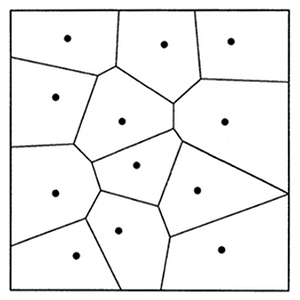
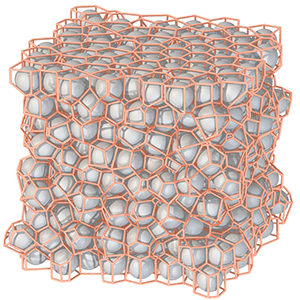
A Voronoi diagram partitions a geometric object into cells, each of which consists of the points closer to one particular object than to any others. They were considered as early at 1644 by René Descartes, but Georgy Voronoy (1868-1908) extended the investigation to higher dimensions in the 19th century.
These diagrams are useful in modeling crystal and cell growth as well as protein molecule volume analysis. They also are used in computer graphics, epidemiology, geophysics, and meteorology. A particularly notable use of a Voronoi diagram was the analysis of the 1854 cholera epidemic in London, in which physician John Snow determined a strong correlation of deaths with proximity to a particular (and infected) water pump on Broad Street.
Posted in Science, Technology |
Leave a Comment »
August 16, 2010

A scramjet (supersonic combustion ramjet) is a type of jet engine in which the combustion process takes place in supersonic airflow. Both ramjets and scramjets rely on high vehicle speed to forcefully compress (ram) the incoming air, but whereas a ramjet decelerates the air to subsonic velocities before combustion, airflow in a scramjet is supersonic throughout the entire engine.
This allows the scramjet to efficiently operate at extremely high speeds: theoretical projections place the top speed of a scramjet between Mach 12 and Mach 24, which is near orbital velocity. For comparison, the fastest manned airbreathing aircraft, the SR-71 Blackbird, has a maximum speed of Mach 3.2.
Posted in Technology |
Leave a Comment »
August 16, 2010

Baidu is a Chinese search engine established in 2000 by co-founders, Robin Li and Eric Xu. Both of the co-founders are Chinese nationals who have studied and worked overseas before returning to China. Baidu.com Inc. is registered in the Cayman Islands. In April 2010, Baidu ranked 7th overall in Alexa’s internet rankings.
In December 2007, Baidu became the first Chinese company to be included in the NASDAQ-100 index. Baidu proactively censors its content in line with government regulations. The name Baidu, whose literal meaning is ‘hundreds of times,’ is taken from the last line of Xin Qiji’s classical poem ‘Green Jade Table in The Lantern Festival.’
Posted in Money, Technology, World |
1 Comment »
August 16, 2010

Yandex is a Russian IT company which operates the largest search engine in Russia (with 64% market share, ranked eighth-largest in the world) and develops a number of Internet-based services and products. Yandex was launched in 1997 and began earning a profit in 2002. Its name stands for ‘Yet Another iNDEXer.’
Posted in Money, Technology, World |
Leave a Comment »
August 12, 2010
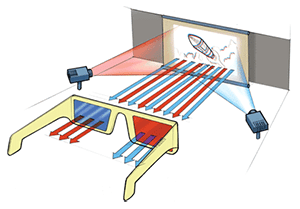

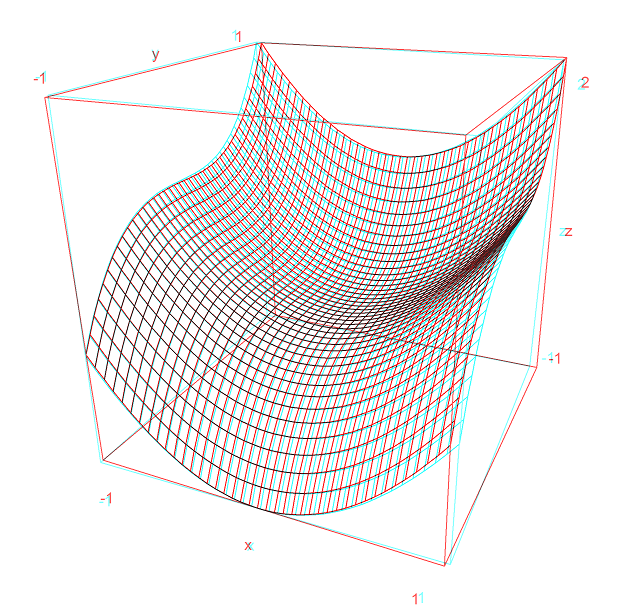
Anaglyph [an-uh-glif] images are used to provide a stereoscopic 3D effect, when viewed with 2 color glasses (usually red and cyan). Video games, theatrical films, and other media can be shown in the anaglyph 3D process. Practical images, for science or design, where depth perception is useful, include the presentation of full scale and microscopic stereographic images.
Examples from NASA include Mars Rover imaging, and 3D images of the sun. Other applications include geological illustrations by the USGS. A recent application is for stereo imaging of the heart using 3D ultra-sound with plastic red/cyan glasses. Anaglyph images are much easier to view than stereograms, but don’t render colors as accurately. Recently, cross-view prismatic glasses with adjustable masking have appeared, that offer a wider image on the new HD video and computer monitors.
Posted in Art, Technology |
Leave a Comment »
August 12, 2010

Anti-climb paint (also known as Anti Vandal Paint) is a class of paint which is a thick glutinous coating that is applied with a stiff brush, trowel or by hand using a protective glove. In appearance it is similar to smooth gloss paint when applied but it remains slippery indefinitely so preventing any intruder from gaining a foothold. It is used to prevent climbing on objects such as lampposts, walls and fences. It owes its effectiveness to the fact that it is based on a non-drying oil and keeps the surface greasy and slippery. As an additional advantage, it leaves its mark on the person touching it and hence makes it possible for intruders to be identified.
Posted in Politics, Technology |
1 Comment »
August 10, 2010
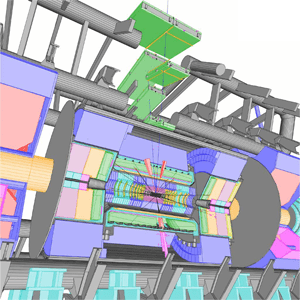
The Higgs Boson [boh-son] is a very small particle, which interacts with a field called the Higgs Field. This field creates a ‘drag’ on particles, and this drag gives the particles mass. An easy way to think of it is that this field grabs onto many other particles, giving them a resistance to being moved. This resistance is observed as the particle’s mass. This field only interacts with particles that have mass, which is why some particles can go the speed of light like photons and some cannot, like neutrons.
As it is much smaller than other particles, it is difficult to detect. The Large Hadron Collider at CERN is the tool that scientists are now using to try to find it. Its existence is required in the Standard Model of particle physics, but it is the only particle in that model which has not yet been observed. If the the results of the work at CERN cannot show that the Higgs Boson exists, then a rewrite of our entire understanding of physics will be required.
Posted in Science, Technology |
Leave a Comment »
August 10, 2010
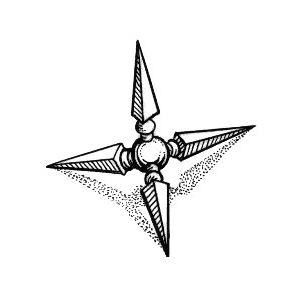
A caltrop is an antipersonnel weapon made up of two or more sharp nails or spines arranged in such a manner that one of them always points upward from a stable base. They may be thought of as the landmines of antiquity, useful to shape the battlefield and force the enemy into certain paths and approaches, or to provide a passive defense as part of a defensive works system. Caltrops served to slow down the advance of horses, war elephants, and human troops. They were said to be particularly effective against the soft feet of camels. In more modern times, caltrops are used against wheeled vehicles with pneumatic tires.
Posted in Technology, War |
Leave a Comment »
August 10, 2010

Van Eck phreaking is the process of eavesdropping on the contents of a CRT or LCD display by detecting its electromagnetic emissions. It is named after Dutch computer researcher Wim van Eck, who in 1985 published the first paper on it, including proof of concept. Phreaking is the process of exploiting telephone networks, used here because of its connection to eavesdropping.
Information that drives the video display takes the form of high frequency electrical signals. These oscillating electric currents create electromagnetic radiation in the RF range. These radio emissions are correlated to the video image being displayed, so, in theory, they can be used to recover the displayed image. In a 2009 test of electronic voting systems in Brazil, Van Eck phreaking was used to successfully compromise ballot secrecy as a proof of concept.
Posted in Politics, Technology |
Leave a Comment »
August 10, 2010
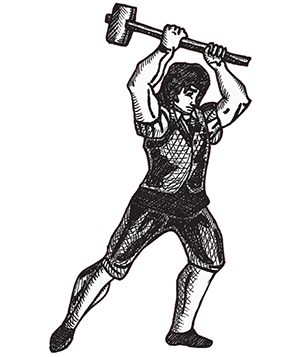
The Luddites [luhd-ahyts] were a social movement of British textile artisans in the nineteenth century who protested – often by destroying mechanized looms – against the changes produced by the Industrial Revolution. It took its name from Ned Ludd, a proletariat folk hero, who was credited with being the first to fight back against mechanization. The principal objection of the Luddites was to the introduction of automated looms that could be operated by cheap, relatively unskilled labour, resulting in the loss of jobs for many skilled textile workers. The movement began in 1811 when mills and pieces of factory machinery were burned by handloom weavers, and for a short time was so strong that Luddites clashed in battles with the British Army. Measures taken by the British government to suppress the movement included a mass trial at York in 1812 that resulted in many executions and penal transportations.
The action of destroying new machines had a long tradition before the Luddites, especially within the textile industry. Many inventors of the 18th century were attacked by vested interests who were threatened by new and more efficient ways of making yarn and cloth. Samuel Crompton, for example, had to hide his new spinning mule in the roof of his house at Hall i’ th’ Wood in 1779 to prevent it being destroyed by the mob. In modern usage, ‘Luddite’ is a term describing those opposed to industrialization, automation, computerization or new technologies in general.
Posted in Money, Politics, Technology |
Leave a Comment »
August 9, 2010
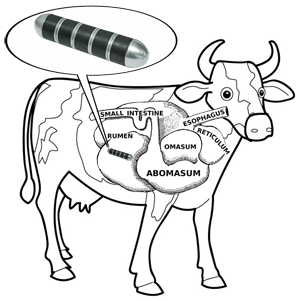
A cow magnet is a preventive veterinary medical device for cattle. A rancher or dairy farmer feeds a magnet to each calf at branding time; the magnet settles in the rumen or reticulum and remains there for the life of the animal. When the cow grazes, it often consumes and swallows what is called tramp iron: baling and barbed wire, staples, nails, and other metallic objects.
These objects are indigestible and would lodge in the reticulum and cause inflammation resulting in lower milk production (for dairy cattle) or lower weight gain (for feeder stock). This condition is called hardware disease. The cow magnet attracts such objects and prevents them from becoming lodged in the animal’s tissue. While the resultant mass of iron remains in the cow’s rumen as a sort of bezoar, it does not cause the severe problems of hardware disease.
Posted in Food, Technology |
1 Comment »