July 11, 2010


Mechanically separated meat also known as mechanically recovered/reclaimed meat, is a paste-like meat product produced by forcing beef, pork, turkey or chicken bones, with attached edible meat, under high pressure through a sieve or similar device to separate the bone from the edible meat tissue.
Mechanically separated meat has been used in certain meat and meat products since the late 1960s, particularly in hot dogs. This product can be contrasted with meat extracted by advanced meat recovery systems, a newer method that shaves the last traces of meat from bone.
Posted in Food, Health, Technology |
Leave a Comment »
June 30, 2010
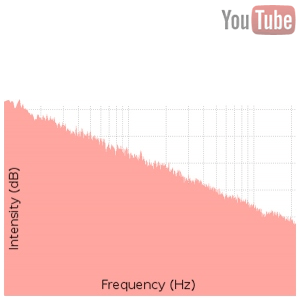
White noise is an audio signal that contains all the frequencies audible to the human ear. It is analogous to white light, which contains all the light frequencies visible to the human eye. Pink noise is a signal that is louder at low frequencies and decreases at a constant rate. It is sometimes referred to as flicker noise particularly, when it describes background noise emitted by an electronic device.
Pink noise is used to make music, sound effects, or merely as a pleasant background sound and is reported to sound more like the ocean than white noise (which is often compared to the sound of rainfall or TV static) because of its bias towards lower frequencies. Other colors of noise include: brown, blue, violet, and grey.
Posted in Science, Technology |
Leave a Comment »
June 30, 2010

Simple English Wikipedia is an English edition of the online encyclopedia Wikipedia, primarily written in Basic English (an 850-word auxiliary language created by Charles Kay Ogden in the 1920s for learning English as a second language) and Special English (avoids idioms; created in 1959 and still presented daily by the Voice of America broadcast). Launched in 2003, the site has the stated aim of providing an encyclopedia for ‘people with different needs, such as students, children, adults with learning difficulties and people who are trying to learn English.’
Articles on the Simple English Wikipedia are usually shorter than their English Wikipedia counterparts, typically presenting only basic information: Tim Dowling of ‘the Guardian’ newspaper explained that ‘the Simple English version tends to stick to commonly accepted facts.’ The interface is also more simply labeled; for instance, the ‘Random article’ link on the English Wikipedia is replaced with a ‘Show Any Page’ link; users are invited to ‘change’ rather than ‘edit’ pages; clicking on a red link shows a ‘not yet started’ message rather than the usual ‘page does not exist.’
Posted in Education, Language, Technology |
Leave a Comment »
June 29, 2010
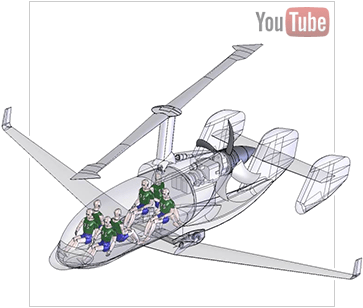
The CarterCopter is an experimental compound autogyro developed by Carter Aviation Technologies to demonstrate slowed rotor technology. In 2005, the CarterCopter became the first rotorcraft to achieve μ-1, an equal ratio of airspeed to rotor tip speed. The prototype has a top speed of about 173 mph. A helicopter requires twice as much power to maintain that velocity.
Posted in Technology |
Leave a Comment »
June 29, 2010

The technological singularity is the theoretical emergence of greater-than-human superintelligence through technological means. Since the capabilities of such intelligence would be difficult for an unaided human mind to comprehend, the occurrence of a technological singularity is seen as an intellectual event horizon, beyond which events cannot be predicted or understood.
Proponents of the singularity typically state that an ‘intelligence explosion,’ where superintelligences design successive generations of increasingly powerful minds, might occur very quickly and might not stop until the agent’s cognitive abilities greatly surpass that of any human. The term was popularized by astrophysicist and science fiction writer Vernor Vinge, who argues that artificial intelligence, human biological enhancement, or brain-computer interfaces could be possible causes of the singularity.
read more »
Posted in Philosophy, Technology |
Leave a Comment »
June 29, 2010

Sir Joseph Wilson Swan was a British physicist and chemist, most famous for the invention of the incandescent light bulb. Swan received a patent for his device in 1878, about a year before Thomas Edison. His house was the first in the world to be lit by a light bulb.
Posted in Science, Technology |
Leave a Comment »
June 28, 2010

Dazzle camouflage, also known as Razzle Dazzle or Dazzle painting, was a camouflage paint scheme used on ships, extensively during World War I and to a lesser extent in World War II. Credited to artist Norman Wilkinson, it consisted of a complex pattern of geometric shapes in contrasting colours, interrupting and intersecting each other.
Dazzle did not conceal the ship but made it difficult for the enemy to estimate its type, size, speed and heading. The idea was to disrupt the visual rangefinders used for naval artillery. Its purpose was confusion rather than concealment. An observer would find it difficult to know exactly whether the stern or the bow is in view; and it would be equally difficult to estimate whether the observed vessel is moving towards or away from the observer’s position.
Posted in Art, Technology, War |
Leave a Comment »
June 28, 2010
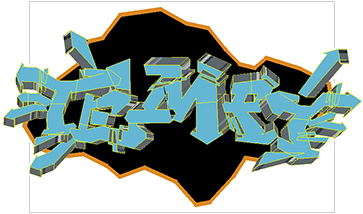

EyeWriter is a low-cost eyetracking system originally designed for paralyzed graffiti artist TEMPT1. The EyeWriter system uses inexpensive cameras and open-source computer vision software to track the wearer’s eye movements of their eye. EyeWriter was developed by artists and engineers from the Free Art & Technology Lab, Graffiti Research Lab and OpenFrameworks teams, including Zachary Lieberman, Evan Roth, James Powderly, Theo Watson and Chris Sugrue. The project received almost $18,000 as a kickstarter project, which surpassed its $15,000 goal. It also received funding support from The Ebeling Group and from Parsons School of Design.
The EyeWriter software consist of eye-tracking software, and a drawing software that allows a user to draw with the movement of their eye. The source code is open source with a Artistic/GPL License (a free use licence). The software for both parts has been developed using openframeworks, a cross platform c++ library for creative development. Eyewriter 2.0 led to the development of Livewriter to be used in the 2010 Cinekid festival: in addition to Eyewriter’s original parameters, a robot arm was integrated allowing the physical recording of visually created content.
Posted in Art, Health, Technology |
Leave a Comment »
June 28, 2010

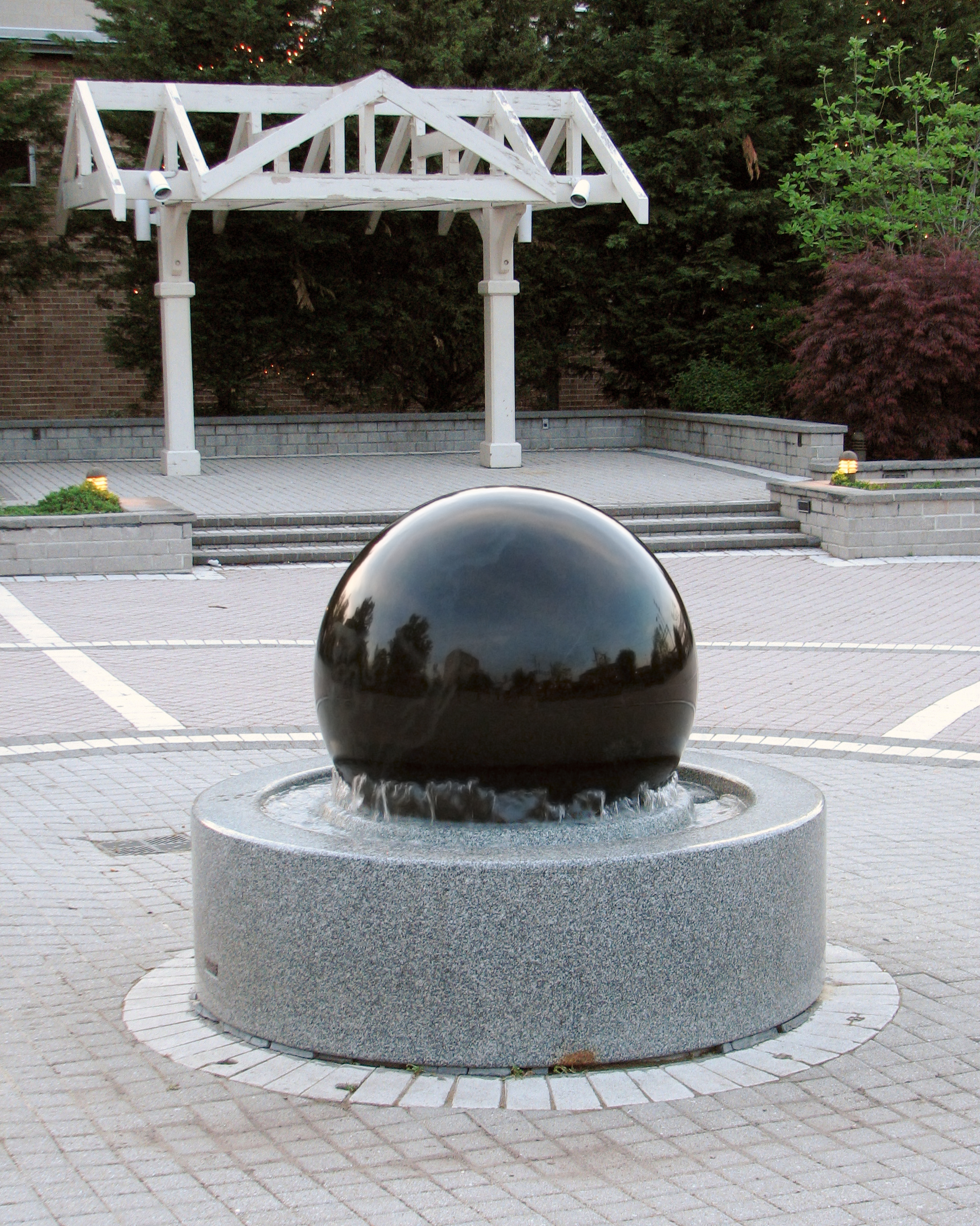
A Kugel ball is a sculpture consisting of a large granite ball supported by a very thin film of water. Water flows beneath a very heavy, perfectly spherical rock from a spherical concave base with the exact same curvature. A Kugel ball can weigh thousands of pounds, but because the thin film of water lubricates it, the ball spins. The term Kugel ball originates from the German word kugel, which can mean ball, sphere or globe.
Posted in Art, Technology |
Leave a Comment »
June 28, 2010

Cymatics [sy-mat-iks] is the study of visible sound and vibration. Typically the surface of a plate, diaphragm, or membrane is vibrated, and patterns are made visible in a thin coating of particles, paste, or liquid. The apparatus employed can be simple, such as a Chladni Plate or advanced such as the CymaScope, a laboratory instrument that makes visible the inherent geometries within sound and music.
Posted in Art, Technology |
Leave a Comment »
June 25, 2010

Mine Resistant Ambush Protected (MRAP) vehicles are a family of armored fighting vehicles designed to survive IED attacks and ambushes, which are replacing many High Mobility Multipurpose Wheeled Vehicles (HMMWVs) in Iraq and Afghanistan. There is no common MRAP vehicle design; there are several vendors, each with a competing entry.
Posted in Politics, Technology, War |
Leave a Comment »




 The Daily Omnivore