January 11, 2016
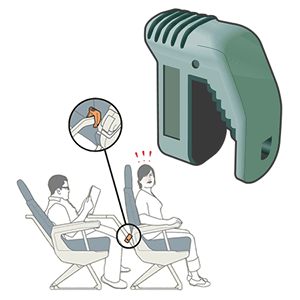
The Knee Defender is a device that an airplane passenger can place on the struts that support his/her drop-down airplane seat tray table to limit the extent to which the seat directly in front of him/her can be reclined. The device was invented by Ira Goldman, and it was first sold to the public in 2003.
In August 2014, on a United Airlines flight from Newark to Denver, an argument developed between a passenger using a Knee Defender and the passenger seated in front of him who wanted to recline. Ultimately the pilot diverted the flight to Chicago and both of those passengers were deplaned.
Posted in Money, Politics, Technology |
Leave a Comment »
December 16, 2015
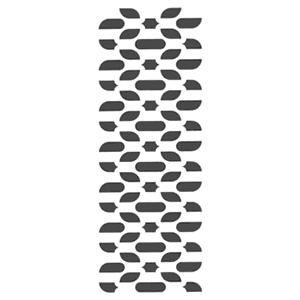
The Dreamachine is a stroboscopic flicker device that produces visual stimuli. Artist Brion Gysin and William S. Burroughs’s ‘systems adviser’ Ian Sommerville created the device after reading neurophysiologist and robotician William Grey Walter’s 1963 book, ‘The Living Brain.’ In its original form, a Dreamachine is made from a cylinder with slits cut in the sides. The cylinder is placed on a turntable and rotated at 78 or 45 revolutions per minute. A light bulb is suspended in the center of the cylinder and the rotation speed allows the light to come out from the holes at a constant frequency of between 8 and 13 pulses per second.
This frequency range corresponds to alpha waves, electrical oscillations normally present in the human brain while relaxing. A Dreamachine is ‘viewed’ with the eyes closed: the pulsating light stimulates the optic nerve and thus alters the brain’s electrical oscillations. Users experience increasingly bright, complex patterns of color, which become shapes and symbols, swirling around. It is claimed that by using a Dreamachine one may enter a hypnagogic state (the dreamlike transfer from wakefulness to sleep). This experience may sometimes be quite intense, but to escape from it, one needs only to open one’s eyes.
Posted in Art, Technology |
Leave a Comment »
December 15, 2015


Phreaking is a slang term coined to describe the activity of hobbyists who study, experiment with, or explore, telecommunication systems, such as equipment and systems connected to public telephone networks. ‘Phreak,’ ‘phreaker,’ or ‘phone phreak’ are names used for and by individuals who participate in phreaking. The term first referred to groups who had reverse engineered the system of tones used to route long-distance calls. By re-creating these tones, phreaks could switch calls from the phone handset, allowing free calls to be made around the world.
Electronic tone generators known as ‘blue boxes’ became a staple of the phreaker community, including future Apple Inc. cofounders Steve Jobs and Steve Wozniak. The blue box era came to an end with the ever increasing use of computerized phone systems, which sent dialling information on a separate, inaccessible channel. By the 1980s, much of the system in the US and Western Europe had been converted. Phreaking has since become closely linked with computer hacking.
read more »
Posted in Money, Politics, Technology |
Leave a Comment »
December 12, 2015

Smell-O-Vision was a system that released odor during the projection of a film so that the viewer could ‘smell’ what was happening in the movie. The technique was created by inventor Hans Laube and made its only appearance in the 1960 film ‘Scent of Mystery,’ produced by Mike Todd, Jr., son of film producer Mike Todd. The process injected 30 odors, such as freshly-baked bread, pipe tobacco, and salty ocean air, into a movie theater’s seats when triggered by the film’s soundtrack.
The use of scents in conjunction with film dates back to 1906, before the introduction of sound. In this first instance, a 1958 issue of ‘Film Daily’ claims that Samuel Roxy Rothafel of the Family Theatre in Forest City, Pennsylvania, placed a wad of cotton wool that had been soaked in rose oil in front of an electric fan during a newsreel about the Rose Bowl Game. Arthur Mayer installed an in-theater smell system in Paramount’s Rialto Theater on Broadway in 1933, which he used to deliver odors during a film. However, it would take over an hour to clear the scents from the theater, and some smells would linger for days afterward.
read more »
Posted in Art, Humor, Technology |
Leave a Comment »
December 2, 2015
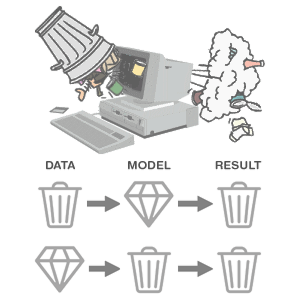
Garbage in, garbage out (GIGO) in the field of computer science or information and communications technology refers to the fact that computers, since they operate by logical processes, will unquestioningly process unintended, even nonsensical, input data (‘garbage in’) and produce undesired, often nonsensical, output (‘garbage out’). The principle applies to other fields as well.
The underlying principle was noted by the inventor of the first programmable computing device design: ‘On two occasions I have been asked, ‘Pray, Mr. Babbage, if you put into the machine wrong figures, will the right answers come out?’ … I am not able rightly to apprehend the kind of confusion of ideas that could provoke such a question.’
read more »
Posted in Humor, Language, Technology |
Leave a Comment »
December 1, 2015


Mechanophilia [muh-kan-uh-fil-ee-uh] is a paraphilia (atypical sexuality) involving a sexual attraction to machines. It is a crime in some nations, such as the UK, with perpetrators placed on a sex-offender registry. Motorcycles in particular are often portrayed as sexualized fetish objects to those who desire them. Designers such as Francis Picabia and Filippo Tommaso Marinetti have been said to have exploited the sexual attraction of automobiles. In 2008, an American named Edward Smith admitted to ‘having sex’ with 1000 cars.
Biologist Edward O. Wilson is quoted describing mechanophilia, the love of machines, as ‘a special case of ‘biophilia,” the instinctive bond between human beings and other living (or lifelike) systems. Conversely, psychologists such as Erich Fromm would see it as a form of necrophilia.
read more »
Posted in Health, Sex, Technology |
1 Comment »
November 12, 2015

Jugaad [joo-gard] is a colloquial Hindi and Punjabi word that can mean an innovative fix or a simple work-around, used for solutions that bend rules, or a resource that can be used as such, or a person who can solve a complicated issue. It is used as much to describe enterprising street mechanics as for political fixers. This meaning is often used to signify creativity to make existing things work or to create new things with meagre resources.
Jugaad is similar to the Western concepts of a ‘hack’ or ‘kludge,’ or to bodge or (‘British English’), but can be thought of more as a survival tactic than a mere workaround. But all such concepts express a need to do what needs to be done, without regard to what is conventionally supposed to be possible.
Posted in Money, Technology, World |
Leave a Comment »
November 11, 2015

A whispering gallery is a circular room in which whispers can be heard clearly across great distances. The sound is carried by waves, known as ‘whispering-gallery waves,’ that travel around the circumference clinging to the walls, an effect that was discovered in the whispering gallery of St Paul’s Cathedral in London. Other historical examples are the Gol Gumbaz mausoleum in India and the Echo Wall of the Temple of Heaven in Beijing.
The gallery may also be in the form of an ellipse or ellipsoid, with an accessible point at each focus. In this case, when a visitor stands at one focus and whispers, the line of sound emanating from this focus reflects directly to the focus at the other end of the gallery, where the whispers may be heard. In a similar way, two large concave parabolic dishes, serving as acoustic mirrors, may be erected facing each other in a room or outdoors to serve as a whispering gallery, a common feature of science museums. Egg-shaped galleries, such as the Golghar Granary in India, and irregularly shaped smooth-walled galleries in the form of caves, such as the Ear of Dionysius in Syracuse, also exist.
Posted in Science, Technology |
Leave a Comment »
November 5, 2015
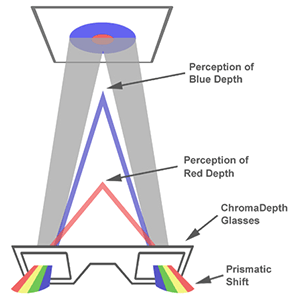
Chromadepth is a patented system from the company Chromatek (a subsidiary of American Paper Optics since 2002) that produces a stereoscopic effect based upon differences in the diffraction of color through a special prism-like holographic film. Chromadepth glasses purposely exacerbate chromatic aberration (the failure of a lens to focus all colors to the same convergence point) and give the illusion of colors taking up different positions in space, with red being in front, and blue being in back.
The effect works particularly well with the sky, sea or grass as a background, and redder objects in the foreground. From front to back the scheme follows the visible light spectrum, from red to orange, yellow, green and blue. This means any color is associated in a fixed fashion with a certain depth when viewing. As a result, ChromaDepth works best with artificially produced or enhanced pictures, since the color indicates the depth.
Posted in Money, Technology |
Leave a Comment »
October 29, 2015
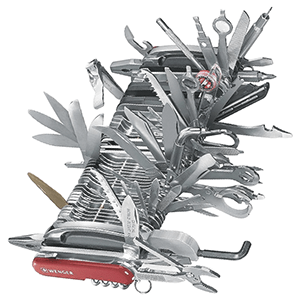
You ain’t gonna need it (YAGNI) is a principle of extreme programming (XP) that states a programmer should not add functionality until deemed necessary. XP co-founder Ron Jeffries said: ‘Always implement things when you actually need them, never when you just foresee that you need them.’ Jeffries argues that prematurely adding features leads to software bloat, feature creep, and takes time away from core functionality improvement.
YAGNI is a principle behind the XP practice of ‘do the simplest thing that could possibly work’ (DTSTTCPW). It is meant to be used in combination with several other practices, such as continuous refactoring (code reorganization), continuous automated unit testing, and continuous integration (conforming code segments work within the larger codebase). However, the efficacy of YAGNI, even when considered in combination with safeguards, is controversial.
Posted in Humor, Language, Technology |
Leave a Comment »
October 26, 2015
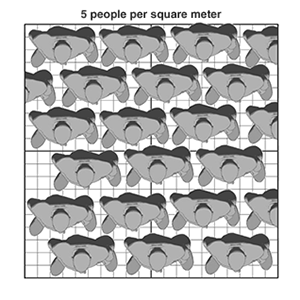
A stampede is uncontrolled concerted running as an act of mass impulse among herd animals or a crowd of people. Cattle are particularly prone to stampedes. Any sudden, unusual event can set one off, such as a horse shaking itself, a lightning strike, or even just a tumbleweed. Other species that stampede include elephants, walruses, wild horses, rhinoceros, and humans. Human crushes often occur during religious pilgrimages and professional sporting and music events. They also occur in times of panic (e.g. as a result of a fire or explosion) as people try to get away.
Crushes are very often referred to as stampedes but, unlike true stampedes, they can cause many deaths. They typically occur when members at the back of a large crowd continue pushing forward not knowing that those at the front are being crushed, or because of something that forces them to move. It has been suggested that crowd density rather than size is important, with a density of about four people per square meter beginning to be dangerous, even if the crowd is not very large.
read more »
Posted in Death, Health, Technology |
1 Comment »
October 17, 2015
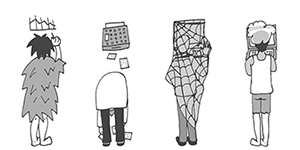
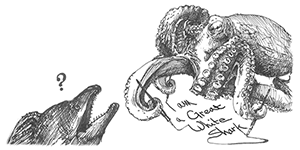
Unstructured Data refers to information that is not organized in a predefined manner. Properly formated computerized data is stored in a database (making it easily retrievable) and labeled with metadata (‘data about data,’ e.g., author, subject, size). Unstructured information has missing or conflicting metadata and may lack contextual clues that make it difficult to understand using traditional programs.
Techniques such as data mining, Natural Language Processing (NLP), and ‘noisy-text’ analytics provide different methods to find patterns in, or otherwise interpret, this information. NLP is a field in Artificial Intelligence, related to linguistics that attempts to program computers to understand human languages. There is considerable commercial interest in the field because of its application to news-gathering, text categorization, voice-activation, archiving, and large-scale content-analysis.
read more »
Posted in Language, Technology |
Leave a Comment »


 The Daily Omnivore