August 7, 2014


The right to be forgotten is a nascent legal concept arising from the need to ‘determine the development of [one’s] life in an autonomous way, without being perpetually or periodically stigmatized as a consequence of a specific action performed in the past.’ France law began recognizing this new right in 2010. Critics claim the laws are vague, unenforceable, and potentially a threat to open access to information, which is an existing legal right in many countries. There are also concerns about its interaction with the right to privacy and whether it would decrease the quality of the Internet through censorship and a rewriting of history.
Many nations have very strong domestic freedom of speech laws, which would be challenging to reconcile with the right to be forgotten. Some academics see that only a limited form of the right to be forgotten would be reconcilable with US constitutional law; the right of an individual to delete data that he or she has personally submitted. In this limited form, individuals could not have material removed that has been uploaded by others, as demanding the removal of information could constitute censorship and a reduction in the freedom of expression.
read more »
Posted in Politics, Technology, World |
1 Comment »
August 5, 2014
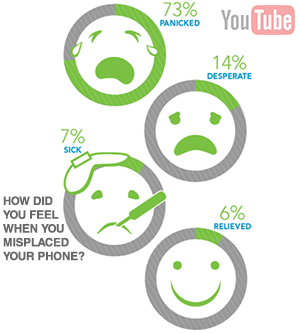
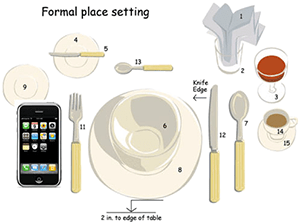
Nomophobia (‘no-mobile-phone phobia’) is the fear of being out of mobile phone contact. The term was coined during a 2010 study by the UK Post Office who commissioned YouGov, a UK-based research organization to look at anxieties suffered by mobile phone users. The study found that nearly 53% of mobile phone users in Britain tend to be anxious when they ‘lose their mobile phone, run out of battery or credit, or have no network coverage.’ The study found that about 58% of men and 47% of women suffer from the phobia, and an additional 9% feel stressed when their mobile phones are off.
The study indicated that stress levels induced by the average case of nomophobia are similar in severity to ‘wedding day jitters’ and trips to the dentists. Ten percent of those questioned said they needed to be contactable at all times because of work. It is, however, arguable that the word ‘phobia’ is misused and that in the majority of cases it is only a normal anxiety. More than one in two nomophobes never switch off their mobile phones. The study prompted two editorial columns authored by those who minimize their mobile phone use or choose not to own one at all, treating the condition with levity or outright disbelief.
Posted in Health, Humor, Technology |
Leave a Comment »
July 30, 2014

The Monobloc [mon-uh-blok] chair is a lightweight stackable polypropylene chair, often described as the world’s most common plastic chair. Based on original designs by the Italian designer Vico Magistretti in 1967, variants of the one-piece plastic chair went into production with Allibert Group and Grossfillex Group in the 1970s. Since then, millions have been manufactured globally. Many design variants of the basic idea exist.
The Monobloc chair is so named because it is injection molded from thermoplastic polypropylene, the granules being heated to about 220 degrees Celsius, and the melt injected into a mold. The gate of the mold is usually located in the seat to ensure smooth flow to all parts of the tool. The chairs cost approximately $3 to produce, making them affordable across the world. Social theorist Ethan Zuckerman describes them as having achieved a global ubiquity: ‘The Monobloc is one of the few objects I can think of that is free of any specific context. Seeing a white plastic chair in a photograph offers you no clues about where or when you are.’
Posted in Money, Technology, World |
Leave a Comment »
July 24, 2014
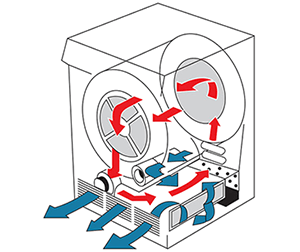

A combo washer dryer (also known more simply as a washer-dryer in the UK) is a combination in a single cabinet of a washing machine and a clothes dryer. It should not be confused with a ‘stackable’ combination of a separate washing machine and a separate clothes dryer.
While combo washer dryers are not as effective and efficient as full-sized, fully functional, separate washer and dryer machines, they are useful in smaller urban properties as they only need half the amount of space and most don’t require an external air vent (water vapor is condensed from moist air and flushed out the drain hose). Additionally, combination washer dryers allow clothes to be washed and dried ‘in one go,’ saving time and effort from the user. Many units are also designed to be portable so they can be attached to a sink instead of requiring a separate water line.
read more »
Posted in Technology |
Leave a Comment »
July 21, 2014


The nothing to hide argument broadly states that police surveillance is only adverse to those doing something wrong. By this line of reasoning, government data mining and surveillance programs do not threaten privacy unless they uncover illegal activities, and if they do, the guilty person does not have the right to keep them private. The motto ‘If you’ve got nothing to hide, you’ve got nothing to fear’ was used to advertise closed-circuit television programs in the UK.
Geoffrey Stone, a legal scholar, said that the use of the argument is ‘all-too-common.’ Cryptographer Bruce Schneier described it as the ‘most common retort against privacy advocates.’ He cites French statesman Cardinal Richelieu’s statement ‘If one would give me six lines written by the hand of the most honest man, I would find something in them to have him hanged,’ to describe how a state government can find aspects in a person’s life in order to prosecute, defame, or blackmail that individual. Schneier also argued ‘Too many wrongly characterize the debate as ‘security versus privacy.’ The real choice is liberty versus control.’
read more »
Posted in Politics, Technology |
1 Comment »
July 17, 2014
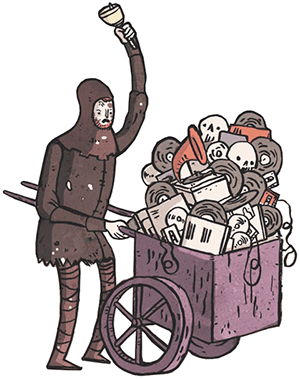
The Album Era was a period in English-language popular music from the mid 1960s to the mid 2000s in which the album was the dominant form of recorded music expression and consumption. It was primarily driven by three successive music recording formats, the 331⁄3 rpm phonograph record (1931), the audiocassette (1964), and the compact disc (1982).
In 1999, peer-to-peer file sharing application Napster was released, popularizing digital copies of music. The ease of downloading individual songs facilitated by it and later networks is often credited with ushering in the end of the Album Era in popular music.
read more »
Posted in Art, Money, Technology |
2 Comments »
July 16, 2014

Napster was a peer-to-peer (P2P) music sharing application first developed in 1999 by Shawn Fanning at Northeastern University. The original program was available for three years before being shut down by a court order for copyright violations. The company’s brand and other assets was subsequently acquired at a bankruptcy proceeding by Roxio, maker of CD burning software. In its second incarnation Napster became an online music store until it was bought by music streaming site Rhapsody in late 2011.
Fanning lead the original company along with his uncle John Fanning and entrepreneur Sean Parker (who would go on to make billions as an early employee of Facebook). Later companies and projects successfully followed its P2P file sharing example such as Gnutella, Freenet, and many others. Some services, like LimeWire, Grokster, Madster and the original eDonkey network, were brought down or changed due to similar circumstances.
read more »
Posted in Money, Politics, Technology |
Leave a Comment »
July 14, 2014


Neo-Luddism is a philosophy opposing many forms of modern technology. According to a manifesto drawn up by the ‘Second Luddite Congress’ in 1996: Neo-Luddism is ‘a leaderless movement of passive resistance to consumerism and the increasingly bizarre and frightening technologies of the Computer Age.’ The name is based on the historical legacy of the British Luddites, textile artisans who rebelled against the Industrial Revolution and newly developed labor-saving machinery that threatened their livelihoods. Both the original Luddites and their modern counterparts are characterized by the practice of destroying or avoiding technological equipment as well as advocating simple living.
Neo-Luddism stems from the concept that technology has a negative impact on individuals, their communities and the environment. It also seeks to examine the unknown effects that new technologies might unleash. The modern Neo-Luddite movement has connections with the anti-globalization movement, anarcho-primitivism (a political critique of the origins and progress of civilization), radical environmentalism, and Deep Ecology (a contemporary environmental philosophy advocating for the inherent worth of living beings regardless of their instrumental utility to humans). The word Luddite is also used as ‘a derogatory term applied to anyone showing vague technophobic leanings.’
read more »
Posted in Politics, Technology |
Leave a Comment »
July 11, 2014


Open-source economics is an economic platform (a two-sided market with two distinct user groups that provide each other with network benefits) based on open collaboration for the production of software, services, or other products. First applied to the open-source software industry, this economic model may be applied to a wide range of enterprises. The system requires work or investment to be carried out without an expressed expectation of return; products or services are produced through collaboration between users and developers; there is no direct individual ownership of the enterprise itself.
The structure of open source is based on user participation. According to technology law professor Yochai Benkler, ‘networked environment makes possible a new modality of organizing production: radically decentralized, collaborative, and non-proprietary; based on sharing resources and outputs among widely distributed, loosely connected individuals who cooperate with each other without relying on either market signals or managerial commands.’
read more »
Posted in Money, Politics, Technology |
1 Comment »
July 1, 2014

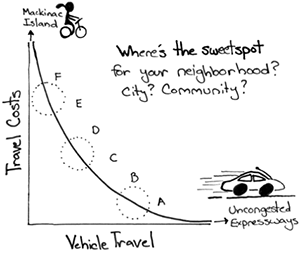
Induced demand, or latent demand, refers to the phenomenon that after supply increases, more of a good is consumed. This is entirely consistent with the economic theory of supply and demand; however, the idea has become important in the debate over the expansion of transportation systems, and is often used as an argument against widening roads, such as major commuter roads. It is considered by some to be a contributing factor to urban sprawl.
Latent demand has been recognized by road traffic professionals for many decades. J. J. Leeming, a British road-traffic engineer and county surveyor between 1924 and 1964, described the phenomenon is his 1969 book: ‘Motorways and bypasses generate traffic, that is, produce extra traffic, partly by inducing people to travel who would not otherwise have done so by making the new route more convenient than the old, partly by people who go out of their direct route to enjoy the greater convenience of the new road, and partly by people who use the towns bypassed because they are more convenient for shopping and visits when through traffic has been removed.’
read more »
Posted in Money, Politics, Technology |
Leave a Comment »
June 27, 2014
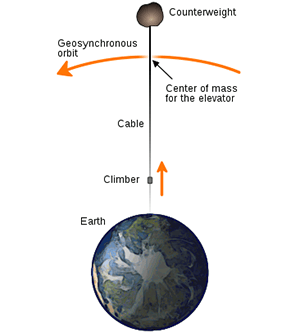

Megastructures are very large man made objects, ranging from ziggurats, to skyscrapers, to hypothetical, star-sized artificial constructs. One requirement of a megastructure is that it is self-supporting; other criteria such as rigidity or contiguousness are sometimes also applied (so large clusters of associated smaller structures may or may not qualify). Megastructures are the products of megascale engineering (building things larger than 1000 km, e.g. the Great Wall of China) or astroengineering (building in outer space, e.g. the International Space Station).
Most megastructure designs could not be constructed with today’s level of industrial technology. This makes their design examples of speculative (or exploratory) engineering. Those that could be constructed easily qualify as megaprojects (construction projects in the billion dollar range).
read more »
Posted in Technology, World |
Leave a Comment »
June 25, 2014


To reinvent the wheel is to duplicate a basic method that has already previously been created or optimized by others. The inspiration for this idiomatic metaphor lies in the fact that the wheel is the archetype of human ingenuity, both by virtue of the added power and flexibility it affords its users, and also in the ancient origins which allow it to underlie much, if not all, of modern technology. As it has already been invented, and is not considered to have any operational flaws, an attempt to reinvent it would be pointless and add no value to the object, diverting the investigator’s resources from possibly more worthy goals which his skills could advance more substantially.
‘Reinventing the wheel’ may itself be an ironic cliche—-it is not clear when the wheel itself was actually invented. The modern ‘invention’ of the wheel might actually be a ‘re-invention’ of an age-old invention. Additionally, many different wheels featuring enhancements on existing wheels (such as the many types of available tires) are regularly developed and marketed. The metaphor emphasizes understanding existing solutions, but not necessarily settling for them.
read more »
Posted in Education, Language, Technology |
1 Comment »


 The Daily Omnivore