July 16, 2014

Napster was a peer-to-peer (P2P) music sharing application first developed in 1999 by Shawn Fanning at Northeastern University. The original program was available for three years before being shut down by a court order for copyright violations. The company’s brand and other assets was subsequently acquired at a bankruptcy proceeding by Roxio, maker of CD burning software. In its second incarnation Napster became an online music store until it was bought by music streaming site Rhapsody in late 2011.
Fanning lead the original company along with his uncle John Fanning and entrepreneur Sean Parker (who would go on to make billions as an early employee of Facebook). Later companies and projects successfully followed its P2P file sharing example such as Gnutella, Freenet, and many others. Some services, like LimeWire, Grokster, Madster and the original eDonkey network, were brought down or changed due to similar circumstances.
read more »
Posted in Money, Politics, Technology |
Leave a Comment »
July 14, 2014


Neo-Luddism is a philosophy opposing many forms of modern technology. According to a manifesto drawn up by the ‘Second Luddite Congress’ in 1996: Neo-Luddism is ‘a leaderless movement of passive resistance to consumerism and the increasingly bizarre and frightening technologies of the Computer Age.’ The name is based on the historical legacy of the British Luddites, textile artisans who rebelled against the Industrial Revolution and newly developed labor-saving machinery that threatened their livelihoods. Both the original Luddites and their modern counterparts are characterized by the practice of destroying or avoiding technological equipment as well as advocating simple living.
Neo-Luddism stems from the concept that technology has a negative impact on individuals, their communities and the environment. It also seeks to examine the unknown effects that new technologies might unleash. The modern Neo-Luddite movement has connections with the anti-globalization movement, anarcho-primitivism (a political critique of the origins and progress of civilization), radical environmentalism, and Deep Ecology (a contemporary environmental philosophy advocating for the inherent worth of living beings regardless of their instrumental utility to humans). The word Luddite is also used as ‘a derogatory term applied to anyone showing vague technophobic leanings.’
read more »
Posted in Politics, Technology |
Leave a Comment »
July 11, 2014
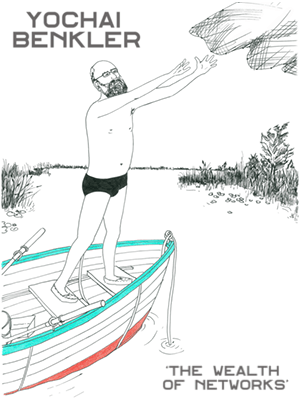

Open-source economics is an economic platform (a two-sided market with two distinct user groups that provide each other with network benefits) based on open collaboration for the production of software, services, or other products. First applied to the open-source software industry, this economic model may be applied to a wide range of enterprises. The system requires work or investment to be carried out without an expressed expectation of return; products or services are produced through collaboration between users and developers; there is no direct individual ownership of the enterprise itself.
The structure of open source is based on user participation. According to technology law professor Yochai Benkler, ‘networked environment makes possible a new modality of organizing production: radically decentralized, collaborative, and non-proprietary; based on sharing resources and outputs among widely distributed, loosely connected individuals who cooperate with each other without relying on either market signals or managerial commands.’
read more »
Posted in Money, Politics, Technology |
1 Comment »
July 1, 2014

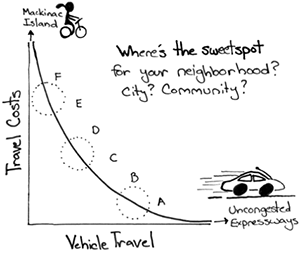
Induced demand, or latent demand, refers to the phenomenon that after supply increases, more of a good is consumed. This is entirely consistent with the economic theory of supply and demand; however, the idea has become important in the debate over the expansion of transportation systems, and is often used as an argument against widening roads, such as major commuter roads. It is considered by some to be a contributing factor to urban sprawl.
Latent demand has been recognized by road traffic professionals for many decades. J. J. Leeming, a British road-traffic engineer and county surveyor between 1924 and 1964, described the phenomenon is his 1969 book: ‘Motorways and bypasses generate traffic, that is, produce extra traffic, partly by inducing people to travel who would not otherwise have done so by making the new route more convenient than the old, partly by people who go out of their direct route to enjoy the greater convenience of the new road, and partly by people who use the towns bypassed because they are more convenient for shopping and visits when through traffic has been removed.’
read more »
Posted in Money, Politics, Technology |
Leave a Comment »
June 27, 2014
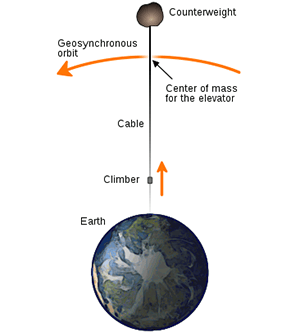

Megastructures are very large man made objects, ranging from ziggurats, to skyscrapers, to hypothetical, star-sized artificial constructs. One requirement of a megastructure is that it is self-supporting; other criteria such as rigidity or contiguousness are sometimes also applied (so large clusters of associated smaller structures may or may not qualify). Megastructures are the products of megascale engineering (building things larger than 1000 km, e.g. the Great Wall of China) or astroengineering (building in outer space, e.g. the International Space Station).
Most megastructure designs could not be constructed with today’s level of industrial technology. This makes their design examples of speculative (or exploratory) engineering. Those that could be constructed easily qualify as megaprojects (construction projects in the billion dollar range).
read more »
Posted in Technology, World |
Leave a Comment »
June 25, 2014


To reinvent the wheel is to duplicate a basic method that has already previously been created or optimized by others. The inspiration for this idiomatic metaphor lies in the fact that the wheel is the archetype of human ingenuity, both by virtue of the added power and flexibility it affords its users, and also in the ancient origins which allow it to underlie much, if not all, of modern technology. As it has already been invented, and is not considered to have any operational flaws, an attempt to reinvent it would be pointless and add no value to the object, diverting the investigator’s resources from possibly more worthy goals which his skills could advance more substantially.
‘Reinventing the wheel’ may itself be an ironic cliche—-it is not clear when the wheel itself was actually invented. The modern ‘invention’ of the wheel might actually be a ‘re-invention’ of an age-old invention. Additionally, many different wheels featuring enhancements on existing wheels (such as the many types of available tires) are regularly developed and marketed. The metaphor emphasizes understanding existing solutions, but not necessarily settling for them.
read more »
Posted in Education, Language, Technology |
1 Comment »
June 24, 2014


Antipatterns are common practices that initially appear to be beneficial, but ultimately result in bad consequences that outweigh hoped-for advantages. The term, coined in 1995 by programmer Andrew Koenig, was inspired by a book, ‘Design Patterns,’ in which the authors highlighted a number of practices in software development that they considered to be highly reliable and effective.
The term was popularized three years later by the book ‘AntiPatterns,’ which extended its use beyond the field of software design and into general social interaction and may be used informally to refer to any commonly reinvented but bad solution to a problem. Examples include analysis paralysis (over-analyzing a situation while indefinitely delaying making a decision), cargo cult programming (the ritual inclusion of code that serves no real purpose), death march (pressing ahead on a project members feel is destined to fail), groupthink (a desire for harmony in the group results in an irrational decision-making outcome), and vendor lock-in (preventing customers from seeking alternatives).
read more »
Posted in Money, Technology |
Leave a Comment »
June 11, 2014
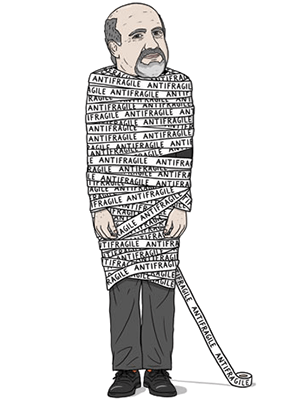
The Lindy Effect is a theory of the permanence of non-perishable things. Unlike biological organisms, the life expectancy of an idea or technology increases as it ages. The origin of the concept can be traced to biographer Albert Goldman and a 1964 article he wrote for ‘The New Republic’ titled ‘Lindy’s Law.’ In it he stated that ‘the future career expectations of a television comedian is proportional to the total amount of his past exposure on the medium.’ The term refers to a NY deli known as a hangout for comedians; they would ‘foregather every night at Lindy’s, where… they conduct post-mortems on recent show biz ‘action.’
Mathematician Benoit Mandelbrot formally coined the term ‘Lindy Effect’ in his 1984 book ‘The Fractal Geometry of Nature.’ Mandelbrot expressed mathematically that for certain things bounded by the life of the producer, like human promise, future life expectancy is proportional to the past: ‘However long a person’s past collected works, it will on the average continue for an equal additional amount. When it eventually stops, it breaks off at precisely half of its promise.’
read more »
Posted in Philosophy, Science, Technology |
1 Comment »
June 5, 2014


The sentience [sen-shuhns] quotient [kwoh-shuhnt] (SQ) was introduced by nanotechnology researcher Robert A. Freitas Jr. in the late 1970s. It defines sentience as the relationship between the information processing rate (in bits per second) of each individual processing unit (neuron), the weight/size of a single unit, and the total number of processing units (expressed as mass). This is a non-standard usage of the word ‘sentience,’ which normally relates to an organism’s capacity to perceive the world subjectively (it is derived from the Latin word ‘sentire’ meaning ‘to feel’ and is closely related to the word ‘sentiment’; intelligence or cognitive capacity is better denoted by ‘sapience’).
The potential and total processing capacity of a brain, based on the amount of neurons and the processing rate and mass of a single one, combined with its design (e.g. myelin coating, specialized areas) and programming, lays the foundations of the brain level of the individual. Not just in humans, but in all organisms, even artificial ones such as computers (although their ‘brain’ is not based on neurons). The SQ of an individual is therefore a measure of the efficiency of an individual brain, not its relative intelligence.
read more »
Posted in Science, Technology |
1 Comment »
June 4, 2014
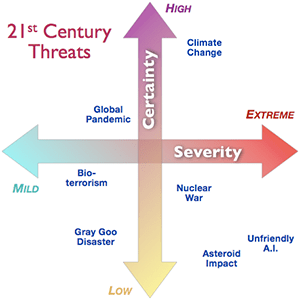

Ecophagy [ih-koh-fuh-jee] is a term coined by molecular engineering scientist Robert Freitas that means the literal consumption of an ecosystem. He wrote: ‘Perhaps the earliest-recognized and best-known danger of molecular nanotechnology is the risk that self-replicating nanorobots capable of functioning autonomously in the natural environment could quickly convert that natural environment (e.g., ‘biomass’) into replicas of themselves (e.g., ‘nanomass’) on a global basis, a scenario usually referred to as the ‘grey goo problem’ but perhaps more properly termed ‘global ecophagy.”
The term has since been used to describe several other world destroying events including nuclear war, catastrophic monoculture (lack of biodiversity in farming), and mass extinction due to climate change. Scholars suggest that these events might result in ecocide in that they would undermine the capacity of the Earth’s biological population to repair itself. Others suggest that more mundane and less spectacular events—the unrelenting growth of the human population, the steady transformation of the natural world by human beings—will eventually result in a planet that is considerably less vibrant, and one that is, apart from humans, essentially lifeless.
Posted in Death, Technology, World |
Leave a Comment »
June 3, 2014

‘The Machine Stops’ is a science fiction short story written in 1909 by E. M. Forster, who known for his ironic and well-plotted novels examining class difference and hypocrisy in early 20th-century British society. After initial publication in ‘The Oxford and Cambridge Review,’ the story was republished in Forster’s ‘The Eternal Moment and Other Stories’ in 1928. It is particularly notable for predicting new technologies such as instant messaging and the Internet.
Forster describes a world in which most of the human population has lost the ability to live on the surface of the Earth. Individuals lives in isolation below ground in a standard ‘cell,’ with all bodily and spiritual needs met by the omnipotent, global ‘Machine.’ Travel is permitted but unpopular and rarely necessary. Communication is made via a kind of instant messaging/video conferencing machine called the speaking apparatus, with which people conduct their only activity: the sharing of ideas and what passes for knowledge.
read more »
Posted in Language, Philosophy, Technology |
1 Comment »
May 30, 2014

Fordite, also known as ‘Detroit agate,’ is old automobile paint which has hardened sufficiently to be cut and polished.
It was formed from the built up of layers of enamel paint slag on tracks and skids on which cars were hand spray-painted (a now automated process), which have been baked numerous times. In recent times the material has been recycled as eco-friendly jewelry.
Posted in Art, Technology |
Leave a Comment »



