June 10, 2013

There are a number of disputes relating to the Church of Scientology’s efforts to suppress material critical of Scientology on the Internet through the use of lawsuits and legal threats. In late 1994, the Church of Scientology began using various legal tactics to stop distribution of unpublished documents written by L. Ron Hubbard.
The Church of Scientology is often accused of barratry (litigation for the purpose of harassment or profit) through the filing of SLAPP suits (lawsuits intended to censor, intimidate, and silence critics by burdening them with the cost of a legal defense until they abandon their criticism or opposition). The official church response is that its litigious nature is solely to protect its copyrighted works and the unpublished status of certain documents.
read more »
Posted in Philosophy, Politics, Technology |
Leave a Comment »
June 4, 2013

Patent monetization refers to the generation of revenue or the attempt to generate revenue by a person or company by selling or licensing the patents it owns.
The so-called patent trolls—which is a pejorative term—attempt to generate revenue by buying and enforcing patents against one or more alleged infringers in a manner considered by the target or observers as unduly aggressive or opportunistic, often with no intention to further develop, manufacture or market the patented invention. Other persons or companies, which are not regarded as patent trolls, also try to make money from patents on inventions they develop, manufacture or market.
Posted in Money, Politics, Technology |
Leave a Comment »
June 4, 2013

Nathan Myhrvold (b. 1959), formerly Chief Technology Officer at Microsoft, is co-founder and 40% owner of Intellectual Ventures, a patent portfolio holding company.
Myhrvold, usually with coinventors, holds 17 U.S. patents assigned to Microsoft and has applied for more than 500 patents. In addition, Myhrvold and coinventors hold 115 U.S. patents assigned mostly to The Invention Science Fund I, LLC.
read more »
Posted in Food, Money, Technology |
Leave a Comment »
June 4, 2013

Intellectual Ventures is a private company notable for being one of the top-five owners of U.S. patents, as of 2011. Its business model has a focus on buying patents and aggregating them into a large patent portfolio and licensing this ‘IV’ portfolio to companies.
Publicly, it states that a major goal is to assist small inventors against corporations. In practice, the vast majority of IV’s revenue comes from buying patents, aggregating them into a large portfolio and licensing this portfolio to other companies or filing lawsuits for infringement of patents, a controversial practice known as patent trolling.
read more »
Posted in Money, Politics, Technology |
Leave a Comment »
June 4, 2013
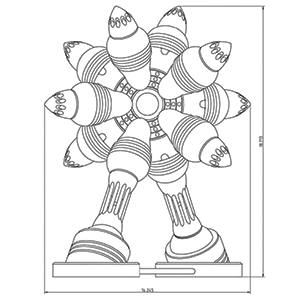
Chris Bathgate is a self-taught metal sculptor working and residing in Baltimore. He has spent the last several years learning how to build and use a variety of metalworking tools. In addition to exploring the finer intricacies of both manual and computer-assisted machining, he also has applied electroplating and heat coloring techniques to his intricate and precise sculptures.
Bathgate’s sculptures are as much about the processes he uses as they are about his imagination. He is represented by Gallery Imperato, located in Baltimore, and a member of Viridian Artists Inc, an artist cooperative in the Chelsea District of New York City.
Posted in Art, Technology |
1 Comment »
June 3, 2013

Hyperloop is a hypothetical mode of high-speed transportation proposed by inventor and SpaceX founder Elon Musk. Musk has envisioned the system as a ‘fifth mode’ of transportation, an alternative to boats, planes, automobiles and trains. The system would, in theory, be able to travel from downtown Los Angeles to downtown San Francisco in under 30 minutes (at more than 685 mph).
In 2013, Musk said that the hyperloop would be like a ‘cross between a Concorde and a railgun and an air hockey table,’ but no further details have been released. Musk is quoted as saying, ‘I think we could actually make it self-powering if you put solar panels on it, you generate more power than you would consume in the system. There’s a way to store the power so it would run 24/7 without using batteries. Yes, this is possible, absolutely.’
Posted in Technology |
Leave a Comment »
June 3, 2013

Area 51 is a military base, and a remote detachment of Edwards Air Force Base. It is in the southern portion of Nevada, 83 miles north-northwest of downtown Las Vegas. At its center, on the southern shore of Groom Lake, is a large military airfield. The base’s primary purpose is to support development and testing of experimental aircraft and weapons systems. Though the name ‘Area 51’ is used in official CIA documentation, other names used for the facility include ‘Dreamland,’ ‘Paradise Ranch,’ ‘Home Base,’ ‘Watertown Strip,’ ‘Groom Lake,’ and most recently ‘Homey Airport.’
The area is part of the Nellis Military Operations Area, and the restricted airspace around the field is referred to as R- 4808N, known by the military pilots in the area as ‘The Box’ or ‘the Container.’ The intense secrecy surrounding the base, the very existence of which the US government did not even acknowledge until 2003, has made it the frequent subject of conspiracy theories and a central component to unidentified flying object (UFO) folklore.
Posted in Humor, Technology, War |
Leave a Comment »
May 23, 2013


Morphological freedom refers to a proposed civil right of a person to either maintain or modify his or her own body, on his or her own terms, through informed, consensual recourse to, or refusal of, available therapeutic or enabling medical technology.
The term may have been coined by strategic philosopher Max More in his 1993 article, ‘Technological Self-Transformation: Expanding Personal Extropy,’ where he defined it as ‘the ability to alter bodily form at will through technologies such as surgery, genetic engineering, nanotechnology, uploading.’ The term was later used by science debater Anders Sandberg as ‘an extension of one’s right to one’s body, not just self-ownership but also the right to modify oneself according to one’s desires.’
read more »
Posted in Health, Politics, Technology |
Leave a Comment »
May 21, 2013

In the classic 1956 science fiction film, ‘Forbidden Planet,’ the extinct race of advanced beings of the planet Altair IV are known as the ‘Krell.’
The Krell had reached a stage of technological and scientific development so advanced that they were able to construct a machine with virtually unlimited power, a machine that turned their thoughts into reality.
read more »
Posted in Art, Technology |
Leave a Comment »
May 21, 2013

From 1955 through 1962, the TWA Moonliner was part of the first futuristic exhibit located in Disneyland’s ‘Tomorrowland.’ It was also an early example of modern product placement advertising by TWA’s Howard Hughes teaming up with Walt Disney.
At 76 feet (23 m) tall, it was the tallest structure in the theme park, 8 feet (2.4 m) taller than the Sleeping Beauty Castle. Adjoining the rocket was the ‘Flight to the Moon’ attraction, which later became ‘Mission To Mars’ in 1975.
read more »
Posted in Money, Technology |
Leave a Comment »
May 20, 2013

‘Captive Audience: the Telecom Industry and Monopoly Power in the New Gilded Age’ is an American non-fiction book by legal expert Susan P. Crawford. It describes high-speed internet access in the United States as essential (like electricity) but currently too slow and too expensive. To ensure national competitiveness ‘most Americans should have access to reasonably priced 1-Gb symmetric fiber-to-the-home networks.’
Crawford explains why the United States should revise national policy to increase competition in a market currently dominated by Comcast, Verizon Wireless, AT&T, and Time Warner Cable. Meanwhile towns and cities should consider setting up local networks after the example of pioneers such as Lafayette, Louisiana’s LUSFiber and Chattanooga, Tennessee’s EPB.
Posted in Language, Money, Technology |
2 Comments »
May 10, 2013
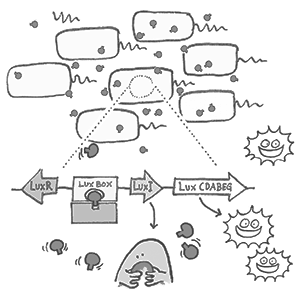
Quorum [kwawr-uhm] sensing is a chemical messaging system employed by bacteria to determine the presence of other bacteria. It is part of a system of stimulus and response correlated to population density (e.g. some bioluminescent bacteria will not produce light unless in sufficient concentration).
Many species of bacteria use quorum sensing to coordinate gene expression according to the density of their local population. In similar fashion, some social insects use a form of quorum sensing to determine where to nest. In addition to its function in biological systems, quorum sensing has several useful applications for computing and robotics.
read more »
Posted in Health, Science, Technology |
Leave a Comment »



 The Daily Omnivore