August 3, 2013

Darren Foreman (b. 1982), better known as Beardyman, is a musician from London renowned for his beatboxing skills and use of live looping technology. He was given the nickname ‘Beardyman’ because a name was quickly needed for a flyer for an early show, and he had a beard at the time.
As well as accomplished solo beatboxer, Beardyman was inspired by MC Xander to use music technology such as the Korg Kaoss Pad 3 in order to loop and sample his vocals. Through his use of looping tools he effectively produces whole DJ sets where the records are constructed live from his vocalisations, as well as live production of original material.
read more »
Posted in Art, Technology |
Leave a Comment »
July 29, 2013

Pagani is an Italian manufacturer of sports cars and carbon fiber components. The company was founded in 1992 by Horacio Pagani and is based in San Cesario sul Panaro, near Modena, Italy.
Horacio Pagani, who formerly managed Lamborghini’s composites department, founded Pagani Composite Research in 1988. This new company worked with Lamborghini on numerous projects, including the restyling of the 25th Anniversary Countach, the Lamborghini LM002, the Lamborghini P140 design concept, and the Diablo. In the late 1980s, Pagani began designing his own car, then referred to as the ‘C8 Project.’
read more »
Posted in Money, Technology |
Leave a Comment »
July 25, 2013

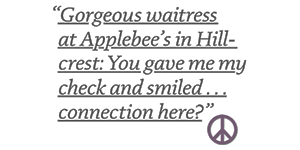
A missed connection is a type of personal advertisement which arises after two people meet but are too shy or otherwise unable to exchange contact details. The ‘Missed Connections’ section of Craigslist gets thousands of ads of this type every month for cities such as New York and San Francisco.
The feature was started by Jim Buckmaster, Craigslist’s CEO, after he noticed a common type of posting in their personal ads, which he characterised as ‘you-smiled-at-me-on-the-subway-platform.’ He sees the format as addressing a common human need and being ideal for romantic comedy, ‘Missed Connections give people that second chance … They represent persistence in the face of long odds, which definitely adds to their artistic appeal.’
read more »
Posted in Humor, Love, Technology |
1 Comment »
July 24, 2013

‘How to Survive a Robot Uprising: Tips on Defending Yourself Against the Coming Rebellion’ is a 2005 semi-satirical book by contributing editor to ‘Popular Mechanics’ Daniel Wilson. The book gives tongue-in-cheek advice on how one can survive in the event that robots become too intelligent and rebel against the human race. The book blends scientific facts with deadpan humor. Wilson received a Ph.D. in Robotics from Carnegie Mellon University’s Robotics Institute in Pittsburgh.
In the summer of 2005, Paramount Pictures optioned film rights to the book and hired Thomas Lennon and Robert Ben Garant (both members of the State comedy troupe and co-creators of the Reno 911! television series) to write a script based on the book. In 2006 comedian Mike Myers signed with Paramount to star in the movie adaptation.
Posted in Humor, Technology, War |
Leave a Comment »
July 24, 2013
The Butlerian Jihad is an event in the back-story of Frank Herbert’s fictional ‘Dune’ universe. Occurring over 11,000 years in the future (10,000 years before the events chronicled in ‘Dune’), this jihad leads to the outlawing of certain technologies, primarily ‘thinking machines,’ a collective term for computers and artificial intelligence of any kind.
This prohibition is a key influence on the nature of Herbert’s fictional setting. Herbert may have coined the name from 19th-century author Samuel Butler, who has the citizens of ‘Erewhon’ enact a prohibition on machines newer than 270 years fearing that, ‘it was the race of the intelligent machines and not the race of men which would be the next step in evolution.’
read more »
Posted in Language, Technology, War |
Leave a Comment »
July 24, 2013
Kevin Kelly (b. 1952) is the founding executive editor of ‘Wired’ magazine, and a former editor/publisher of the ‘Whole Earth Catalog.’ He has also been a writer, photographer, conservationist, and student of Asian and digital culture. Kelly was born in Pennsylvania and graduated from Westfield High School in New Jersey in 1970. He dropped out of University of Rhode Island after only one year. He currently lives in Pacifica, California, a small coastal town just south of San Francisco. He is a devout Christian. He is married and has three children; Tywen, Ting, and Kaileen.
Among Kelly’s personal involvements is a campaign to make a full inventory of all living species on earth, an effort also known as the Linnaean enterprise. The goal is to make an attempt at an ‘all species’ web-based catalog in one generation (25 years). He is also sequencing his genome and co-organizes the Bay Area Quantified Self Meetup Group (a lifelogging organization).
read more »
Posted in Language, Technology |
Leave a Comment »
July 24, 2013

‘What Technology Wants‘ is a 2010 nonfiction book by ‘Wired’ magazine co-founder Kevin Kelly focused on technology as an extension of life. In his young adulthood Kelly spent many years traveling remote parts of the developing world, an experience which helped inform his perspective on what he has coined the ‘technium.’ The opening chapter, entitled ‘My Question,’ chronicles this period in Kelly’s life and gives the reader a sense of how Kelly went from being a nomadic traveler with few possessions to a tech guru.
Kelly focuses on human-technology relations and argues for the existence of technology as the emerging seventh kingdom of life on earth. He offers the anthropomorphic conception that technology is one giant force – the technium, ‘…a word to designate the greater, global, massively interconnected system of technology vibrating around us.’
Posted in Language, Technology |
Leave a Comment »
July 23, 2013

Technological determinism [dih-tur-muh-niz-uhm] is a reductionist theory that presumes that a society’s technology drives the development of its social structure and cultural values. The term is believed to have been coined by American economist and sociologist Thorstein Veblen (1857–1929). The most radical technological determinist in the United States in the twentieth century was most likely economist Clarence Ayres who was a follower of Veblen and American philosopher and psychologist John Dewey. Sociologist William Ogburn was also known for espousing theories of radical technological determinism.
Veblen’s contemporary, popular historian Charles A. Beard, said of the concept: ‘Technology marches in seven-league boots from one ruthless, revolutionary conquest to another, tearing down old factories and industries, flinging up new processes with terrifying rapidity.’
read more »
Posted in Philosophy, Politics, Technology |
1 Comment »
July 23, 2013

The term ‘media ecology‘ was formally introduced in 1968 by cultural critic Neil Postman (who would later become well known for his 1985 book about television, ‘Amusing Ourselves to Death’), but the concept was originally proposed four years earlier by Canadian philosopher of communication theory Marshall McLuhan. Media ecology theory centers on the principles that technology not only profoundly influences society, it also controls virtually all walks of life. It is a study of how media and communication processes affect human perception and understanding.
To strengthen this theory, McLuhan and graphic designer Quentin Fiore claim that it is the media of the epoch that defines the essence of the society by presenting four epochs, inclusive of Tribal Era, Literate Era, Print Era, and Electronic Era, which corresponds to the dominant mode of communication of the time respectively. McLuhan argues that media act as extensions of the human senses in each era, and communication technology is the primary cause of social change.
read more »
Posted in Language, Science, Technology |
Leave a Comment »
July 17, 2013

Etoy is a European digital art group. Their slogan is: ‘leaving reality behind.’ Etoy routinely experiments with the boundaries of art, such as selling shares of ‘stock’ in the etoy.corporation, a registered company in Switzerland and travelling the world as well as living in ‘etoy.tanks’ (cargo containers).
The group was founded in 1994 and is owned now by hundreds of etoy.shareholders such as international art collectors, the etoy.agents and toywar.soldiers (who protected the etoy.brand during the toywar — a legal fight with an online toy retailer over the etoy.com domain). The etoy.inventors own, control and protect the corporate ‘sculpture.’
read more »
Posted in Art, Money, Technology |
Leave a Comment »
July 16, 2013

Douglas Rushkoff (b. 1961) is an American media theorist, graphic novelist, and documentarian. He is best known for his association with the early cyberpunk culture, and his advocacy of open source solutions to social problems. Rushkoff coined the terms: viral media (or media virus), digital native, and social currency. He has written ten books on media, technology, and culture.
He wrote the first syndicated column on cyberculture for ‘The New York Times Syndicate,’ as well as a regular column for ‘The Guardian of London.’ Rushkoff currently teaches in the Media Studies department at The New School University in Manhattan. He has previously lectured at the ITP at New York University’s Tisch School of the Arts and taught a class called ‘Narrative Lab.’
read more »
Posted in Language, Money, Technology |
Leave a Comment »
June 17, 2013

Mark Dery (b. 1959) is an American author, lecturer and cultural critic. He writes about ‘media, the visual landscape, fringe trends, and unpopular culture.’ From 2001 to 2009, he taught media criticism and literary journalism in the Department of Journalism at New York University. In 2000, he was appointed Chancellor’s Distinguished Fellow at the University of California, Irvine. In 2009, he was awarded a scholar-in-residence position at the American Academy in Rome.
He identifies his politics as ‘unrepentantly leftist’ and his religion as the parodic Church of the SubGenius. Dery’s books include ‘The Pyrotechnic Insanitarium: American Culture on the Brink’ and ‘Escape Velocity: Cyberculture at the End of the Century.’ He edited the anthology ‘Flame Wars: The Discourse of Cyberculture’ and wrote the monograph ‘Culture Jamming: Hacking, Slashing, and Sniping in the Empire of Signs.’ His essay collection ‘I Must Not Think Bad Thoughts: Drive-By Essays on American Dread, American Dreams’ was published in 2012.
read more »
Posted in Language, Technology |
Leave a Comment »



