January 2, 2013

In his online essay ‘Digital Maoism: The Hazards of the New Online Collectivism,’ in ‘Edge’ magazine in 2006, futurist Jaron Lanier criticized the sometimes-claimed omniscience of collective wisdom (including examples such as the Wikipedia article about himself), describing it as ‘digital Maoism.’
He writes ‘If we start to believe that the Internet itself is an entity that has something to say, we’re devaluing those people [creating the content] and making ourselves into idiots.’ His criticism aims at several targets which are at different levels of abstraction: any attempt to create one final authoritative bottleneck which channels the knowledge onto society is wrong, regardless whether it is a Wikipedia or any algorithmically created system producing meta information.
read more »
Posted in Politics, Technology |
Leave a Comment »
January 2, 2013
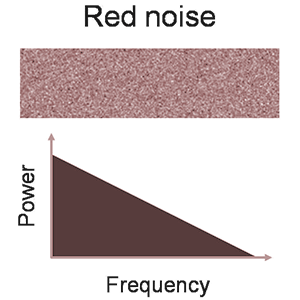
Noises are classified based on their spectral properties; they are named for the color they most resemble in the visible light spectrum. If the sound wave pattern of ‘red noise’ were translated into light waves, the resulting light would be red, and so on. White noise is an audio signal that contains all the frequencies audible to the human ear. It is analogous to white light, which contains all the colors of light visible to the human eye.
Pink noise is a signal that is louder at low frequencies and decreases at a constant rate. It is sometimes referred to as flicker noise particularly when it describes background noise emitted by an electronic device. Pink noise is used to make music, sound effects, or merely as a pleasant background sound and is reported to sound more like the ocean than white noise (which is often compared to the sound of rainfall or TV static) because of its bias towards lower frequencies.
read more »
Posted in Language, Science, Technology |
Leave a Comment »
December 24, 2012

Reclaim the Streets (RTS) is a collective with a shared ideal of community ownership of public spaces. Participants characterize the collective as a resistance movement opposed to the dominance of corporate forces in globalization, and to the car as the dominant mode of transport. Reclaim the Streets often stage non-violent direct action street reclaiming events such as the ‘invasion’ of a major road, highway or freeway to stage a party.
While this may obstruct the regular users of these spaces such as car drivers and public bus riders, the philosophy of RTS is that it is vehicle traffic, not pedestrians, who are causing the obstruction, and that by occupying the road they are in fact opening up public space. The events are usually spectacular and colorful with sand pits for children to play in, free food and music, however they have been known to degenerate into riots and violence. A Temporary Autonomous Zone sometimes results. The style of the parties in many places has been influenced by the rave scene in the UK, with sound systems playing dance music.
read more »
Posted in Money, Politics, Technology |
Leave a Comment »
December 22, 2012

A bandwidth cap, also known as a bit cap, limits the transfer of a specified amount of data over a period of time. Internet service providers commonly apply a cap when a channel intended to be shared by many users becomes overloaded, or may be overloaded, by a few users. Implementation of a bandwidth cap is sometimes termed a Fair Access Policy or Usage-based billing. In many situations, each user of a network is expected to use high speed transmission for only a short time, for example to download a megabyte web page in less than a second.
When use is continuous, as it might be in the case of file sharing, Internet radio or streaming video, a few users who use the connection at high rates for hours at a time may seriously impair the service of others. The concept is more relevant in cable internet where both the core network and the access network are shared, than in DSL where the core network is shared but the access network is not. It is most relevant in wireless internet, particularly satellite internet, where both the core network and the access network are shared and total network bandwidth is relatively narrow.
read more »
Posted in Money, Technology, World |
Leave a Comment »
December 21, 2012

Eclectic Method is the name of an audio-visual remix act, originally formed in London in 2001 by Geoff Gamlen, Ian Edgar, Johnny Wilson.
They quickly developed Eclectic Method’s audio-visual style into a live performance featuring video turntables (Pioneer DVJ-1000) – mixing the visuals and audio in real time. As a live act, they have traveled around the world playing hundreds of gigs in Asia, North America, South America, Europe and the Middle East.
read more »
Posted in Art, Money, Technology |
Leave a Comment »
December 20, 2012

Affective computing is the study and development of systems and devices that can recognize, interpret, process, and simulate human affects.
It is an interdisciplinary field spanning computer sciences, psychology, and cognitive science, which originated at MIT with Rosalind Picard’s 1995 paper on affective computing. A motivation for the research is the ability to simulate empathy. The machine should interpret the emotional state of humans and adapt its behavior to them, giving an appropriate response for those emotions.
read more »
Posted in Health, Language, Technology |
Leave a Comment »
December 6, 2012

The Shockwave Rider is a 1975 science fiction novel by John Brunner, notable for its hero’s use of computer hacking skills to escape pursuit in a dystopian future, and for the coining of the word ‘worm’ to describe a program that propagates itself through a computer network. It also introduces the concept of a ‘Delphi pool’ (a large group of people used as a statistical sampling resource), perhaps derived from the RAND Corporation’s Delphi method – a futures market on world events which bears close resemblance to DARPA’s controversial and cancelled Policy Analysis Market (dubbed the ‘Terrorism Market’ by the media).
The title derives from the futurist work ‘Future Shock’ by Alvin Toffler. The hero is a survivor in a hypothetical world of quickly changing identities, fashions, and lifestyles, where individuals are still controlled and oppressed by a powerful and secretive state apparatus. His highly developed computer skills enable him to use any public telephone to punch in a new identity, thus reinventing himself. As a fugitive, he must do this from time to time in order to escape capture. The title is also a metaphor for survival in an uncertain world.
read more »
Posted in Art, Language, Technology |
Leave a Comment »
December 6, 2012

‘A Logic Named Joe‘ is a science fiction short story by Murray Leinster that was first published in a 1946 issue of ‘Astounding Science Fiction.’ The story actually appeared under Leinster’s real name, Will F. Jenkins, since the issue also included a story under the Leinster pseudonym ‘Adapter.’
The story is particularly noteworthy as a prediction of massively networked personal computers and their drawbacks, written at a time when computing was in its infancy. The story’s narrator is a ‘logic’ (much like a personal computer) repairman nicknamed Ducky. In the story, a logic whom he names ‘Joe’ develops some degree of sapience and ambition.
read more »
Posted in Art, Language, Technology |
Leave a Comment »
December 5, 2012
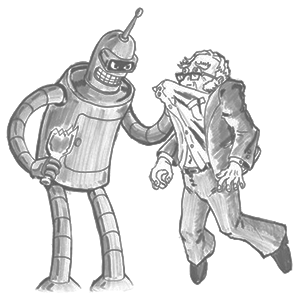
The Three Laws of Robotics are a set of rules devised by the science fiction author Isaac Asimov. The rules were introduced in his 1942 short story ‘Runaround,’ although they had been foreshadowed in a few earlier stories.
The Three Laws are: ‘A robot may not injure a human being or, through inaction, allow a human being to come to harm; A robot must obey the orders given to it by human beings, except where such orders would conflict with the First Law; and A robot must protect its own existence as long as such protection does not conflict with the First or Second Laws. These form an organizing principle and unifying theme for Asimov’s robotic-based fiction, appearing in his ‘Robot’ series, the stories linked to it, and his ‘Lucky Starr’ series of young-adult fiction.
read more »
Posted in Language, Politics, Technology |
1 Comment »
December 5, 2012

The term roboethics was coined by roboticist Gianmarco Veruggio in 2002, who also served as chair of an Atleier (workshop) funded by the European Robotics Research Network to outline areas where research may be needed. The road map effectively divided ethics of artificial intelligence into two sub-fields to accommodate researchers’ differing interests:
Machine ethics is concerned with the behavior of artificial moral agents (AMAs); and Roboethics is concerned with the behavior of humans, how humans design, construct, use and treat robots and other artificially intelligent beings.
read more »
Posted in Philosophy, Politics, Technology |
Leave a Comment »
December 5, 2012
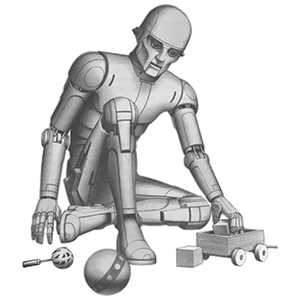
Machine Ethics is the part of the ethics of artificial intelligence concerned with the moral behavior of Artificial Moral Agents (AMAs) (e.g. robots and other artificially intelligent beings). It contrasts with roboethics, which is concerned with the moral behavior of humans as they design, construct, use and treat such beings.
In 2009, academics and technical experts attended a conference to discuss the potential impact of robots and computers and the hypothetical possibility that they could become self-sufficient and able to make their own decisions. They discussed the possibility and the extent to which computers and robots might be able to acquire any level of autonomy, and to what degree they could use such abilities to possibly pose any threat or hazard.
read more »
Posted in Philosophy, Politics, Technology |
Leave a Comment »
December 5, 2012

The ethics of artificial intelligence is the part of the ethics of technology specific to robots and other artificially intelligent beings. It is typically divided into Roboethics, a concern with the moral behavior of humans as they design, construct, use and treat artificially intelligent beings, and Machine Ethics, concern with the moral behavior of artificial moral agents (AMAs).
The term ‘roboethics’ was coined by roboticist Gianmarco Veruggio in 2002. It considers both how artificially intelligent beings may be used to harm humans and how they may be used to benefit humans. ‘Robot rights’ are the moral obligations of society towards its machines, similar to human rights or animal rights. These may include the right to life and liberty, freedom of thought and expression, and equality before the law.
read more »
Posted in Philosophy, Politics, Technology |
Leave a Comment »


 The Daily Omnivore