December 6, 2012

The Shockwave Rider is a 1975 science fiction novel by John Brunner, notable for its hero’s use of computer hacking skills to escape pursuit in a dystopian future, and for the coining of the word ‘worm’ to describe a program that propagates itself through a computer network. It also introduces the concept of a ‘Delphi pool’ (a large group of people used as a statistical sampling resource), perhaps derived from the RAND Corporation’s Delphi method – a futures market on world events which bears close resemblance to DARPA’s controversial and cancelled Policy Analysis Market (dubbed the ‘Terrorism Market’ by the media).
The title derives from the futurist work ‘Future Shock’ by Alvin Toffler. The hero is a survivor in a hypothetical world of quickly changing identities, fashions, and lifestyles, where individuals are still controlled and oppressed by a powerful and secretive state apparatus. His highly developed computer skills enable him to use any public telephone to punch in a new identity, thus reinventing himself. As a fugitive, he must do this from time to time in order to escape capture. The title is also a metaphor for survival in an uncertain world.
read more »
Posted in Art, Language, Technology |
Leave a Comment »
December 6, 2012
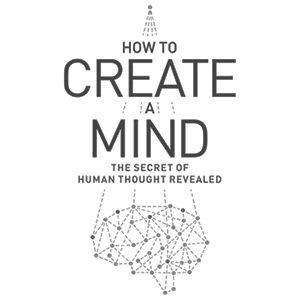
‘A Logic Named Joe‘ is a science fiction short story by Murray Leinster that was first published in a 1946 issue of ‘Astounding Science Fiction.’ The story actually appeared under Leinster’s real name, Will F. Jenkins, since the issue also included a story under the Leinster pseudonym ‘Adapter.’
The story is particularly noteworthy as a prediction of massively networked personal computers and their drawbacks, written at a time when computing was in its infancy. The story’s narrator is a ‘logic’ (much like a personal computer) repairman nicknamed Ducky. In the story, a logic whom he names ‘Joe’ develops some degree of sapience and ambition.
read more »
Posted in Art, Language, Technology |
Leave a Comment »
December 5, 2012
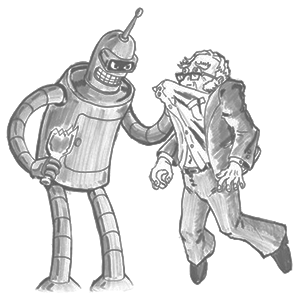
The Three Laws of Robotics are a set of rules devised by the science fiction author Isaac Asimov. The rules were introduced in his 1942 short story ‘Runaround,’ although they had been foreshadowed in a few earlier stories.
The Three Laws are: ‘A robot may not injure a human being or, through inaction, allow a human being to come to harm; A robot must obey the orders given to it by human beings, except where such orders would conflict with the First Law; and A robot must protect its own existence as long as such protection does not conflict with the First or Second Laws. These form an organizing principle and unifying theme for Asimov’s robotic-based fiction, appearing in his ‘Robot’ series, the stories linked to it, and his ‘Lucky Starr’ series of young-adult fiction.
read more »
Posted in Language, Politics, Technology |
1 Comment »
December 5, 2012

The term roboethics was coined by roboticist Gianmarco Veruggio in 2002, who also served as chair of an Atleier (workshop) funded by the European Robotics Research Network to outline areas where research may be needed. The road map effectively divided ethics of artificial intelligence into two sub-fields to accommodate researchers’ differing interests:
Machine ethics is concerned with the behavior of artificial moral agents (AMAs); and Roboethics is concerned with the behavior of humans, how humans design, construct, use and treat robots and other artificially intelligent beings.
read more »
Posted in Philosophy, Politics, Technology |
Leave a Comment »
December 5, 2012
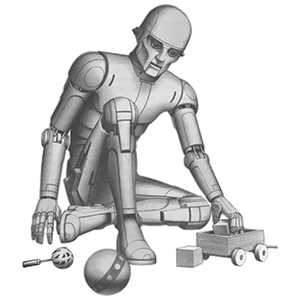
Machine Ethics is the part of the ethics of artificial intelligence concerned with the moral behavior of Artificial Moral Agents (AMAs) (e.g. robots and other artificially intelligent beings). It contrasts with roboethics, which is concerned with the moral behavior of humans as they design, construct, use and treat such beings.
In 2009, academics and technical experts attended a conference to discuss the potential impact of robots and computers and the hypothetical possibility that they could become self-sufficient and able to make their own decisions. They discussed the possibility and the extent to which computers and robots might be able to acquire any level of autonomy, and to what degree they could use such abilities to possibly pose any threat or hazard.
read more »
Posted in Philosophy, Politics, Technology |
Leave a Comment »
December 5, 2012

The ethics of artificial intelligence is the part of the ethics of technology specific to robots and other artificially intelligent beings. It is typically divided into Roboethics, a concern with the moral behavior of humans as they design, construct, use and treat artificially intelligent beings, and Machine Ethics, concern with the moral behavior of artificial moral agents (AMAs).
The term ‘roboethics’ was coined by roboticist Gianmarco Veruggio in 2002. It considers both how artificially intelligent beings may be used to harm humans and how they may be used to benefit humans. ‘Robot rights’ are the moral obligations of society towards its machines, similar to human rights or animal rights. These may include the right to life and liberty, freedom of thought and expression, and equality before the law.
read more »
Posted in Philosophy, Politics, Technology |
Leave a Comment »
December 4, 2012
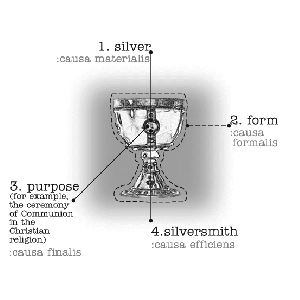
For German philosopher Martin Heidegger broadly, the question of being formed the essence of his philosophical inquiry.
In ‘The Question Concerning Technology‘ (‘Die Frage nach der Technik’), Heidegger sustains this inquiry, but turns to the particular phenomenon of technology, seeking to derive the essence of technology and humanity’s role of being with it. Heidegger originally published the text in 1954, in ‘Vorträge und Aufsätze’ (‘Letters and Essays’).
read more »
Posted in Language, Philosophy, Technology |
2 Comments »
December 4, 2012

Gestell [gesh-tell] is a German word used by philosopher Martin Heidegger to describe what lies behind or beneath modern technology. This concept was applied to Heidegger’s exposition of the essence of technology.
The conclusion regarding the essence of technology was that technology is fundamentally enframing. As such, the essence of technology is Gestell. Indeed, ‘Gestell, literally ‘framing,’ is an all-encompassing view of technology, not as a means to an end, but rather a mode of human existence.’
read more »
Posted in Language, Philosophy, Technology |
Leave a Comment »
December 2, 2012

Internet Killed Television is a web series which documents the lives of Charles Trippy, his wife Alli and their dogs Zoey and Marley. The show consists of episodes averaging around one to twenty minutes that are filmed, edited, and then aired every day onto YouTube by mid-afternoon Eastern Standard Time. The series was originally planned to last for only one year; however, after the success of the first season, the couple have decided to continue.
The YouTube series has now reached its fourth year and every year, so far, they have reached out to their audience, the CTFxC(ers) to create a montage featuring the main events that had occurred that year.
read more »
Posted in Art, Humor, Technology |
1 Comment »
November 30, 2012

The moka pot, also known as a stove top espresso machine, is a coffee maker which produces coffee by passing hot water pressurized by steam through ground coffee. It was first patented by inventor Luigi De Ponti for Alfonso Bialetti in 1933. Bialetti Industrie continues to produce the same model under the name ‘Moka Express.’
The moka pot is most commonly used in Europe and in Latin America. It has become an iconic design, displayed in modern industrial art and design museums.
read more »
Posted in Food, Technology |
Leave a Comment »
November 30, 2012

Heisenbug is a whimsical computer programming jargon term for a software bug (glitch) that seems to disappear or alter its behavior when one attempts to study it.
The term is a pun on the name of Werner Heisenberg, the physicist who first asserted the observer effect of quantum mechanics, which states that the act of observing a system inevitably alters its state.
read more »
Posted in Humor, Technology |
1 Comment »
November 30, 2012
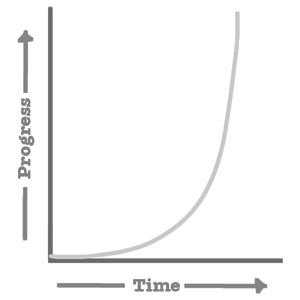
‘Rapture of the Nerds’ is a derisive term for the technological singularity (a theorized future period of superhuman intelligence). Some critics assert that no computer or machine will ever achieve human intelligence, while others hold that the definition of intelligence is irrelevant if the net result is the same.
Cognitive scientist Steven Pinker stated in 2008, ‘There is not the slightest reason to believe in a coming singularity. The fact that you can visualize a future in your imagination is not evidence that it is likely or even possible. Look at domed cities, jet-pack commuting, underwater cities, mile-high buildings, and nuclear-powered automobiles—all staples of futuristic fantasies when I was a child that have never arrived. Sheer processing power is not a pixie dust that magically solves all your problems.’
read more »
Posted in Humor, Technology |
Leave a Comment »



