November 10, 2012


Fair use is a limitation and exception to the exclusive right granted by copyright law to the author of a creative work. Examples of fair use include commentary, search engines, criticism, news reporting, research, teaching, library archiving, and scholarship.
It provides for the legal, unlicensed citation or incorporation of copyrighted material in another author’s work under a four-factor balancing test (Purpose and character; Nature of the copied work; Amount and substantiality; and Effect upon work’s value). Along with Public Domain, Fair use is one of the ‘Traditional Safety Valves’ (techniques that balance the public’s interest in open access with the property interest of copyright owners)
read more »
Posted in Money, Politics, Technology |
Leave a Comment »
November 9, 2012


Founded in 2001 by a team of MIT students, Design that Matters (DtM), is a nonprofit design company that partners with social entrepreneurs to design products that address basic needs in developing countries. DtM’s core competencies include ethnography, design, and engineering. DtM manages a collaborative design process through which hundreds of students and professional volunteers contribute to the design of new product and services for the poor in developing countries. DtM has completed projects in in healthcare, education, microfinance, and renewable energy.
DtM partners include the East Meets West Foundation, Solar Ear, World Education, the Center for Integration of Medicine and Innovative Technology’s Global Health Initiative (CIMIT GHI), the Centre for Mass Education in Science (CMES) in Bangladesh and the Mann Deshi Mahila Sahakari Bank in India.
read more »
Posted in Health, Technology, World |
Leave a Comment »
November 8, 2012

Naïve physics or folk physics is the untrained human perception of basic physical phenomena. In the field of artificial intelligence the study of naïve physics is a part of the effort to formalize the common knowledge of human beings. Many ideas of folk physics are simplifications, misunderstandings, or misperceptions of well understood phenomena, incapable of giving useful predictions of detailed experiments, or simply are contradicted by more thorough observations.
They may sometimes be true, be true in certain limited cases, be true as a good first approximation to a more complex effect, or predict the same effect but misunderstand the underlying mechanism. Naïve physics can also be defined an intuitive understanding all humans have about objects in the physical world. Cognitive psychologists are delving deeper into these phenomena with promising results. Psychological studies indicate that certain notions of the physical world are innate in all of us.
read more »
Posted in Philosophy, Science, Technology |
1 Comment »
November 8, 2012
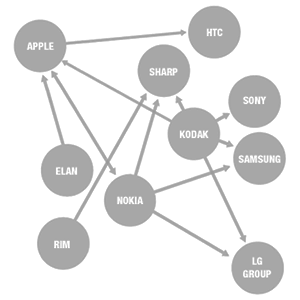
A patent thicket is ‘a dense web of overlapping intellectual property rights that a company must hack its way through in order to actually commercialize new technology,’ or, in other words, ‘an overlapping set of patent rights’ which require innovators to reach licensing deals for multiple patents from multiple sources.’ The expression may come from the ‘SCM Corp. v. Xerox Corp’ patent litigation case in the 1970s, wherein SCM’s central charge had been that Xerox constructed a ‘patent thicket’ to prevent competition. Patent thickets are used to defend against competitors designing around a single patent.
It has been suggested by some that this is particularly true in fields such as software or pharmaceuticals, but Sir Robin Jacob has pointed out that ‘every patentee of a major invention is likely to come up with improvements and alleged improvements to his invention’ and that ‘it is in the nature of the patent system itself that [patent thickets] should happen and it has always happened.’ Patent thickets are also sometimes called ‘patent floods,’ or ‘patent clusters.’
Posted in Money, Politics, Technology |
Leave a Comment »
November 8, 2012

A submarine patent is a patent whose issuance and publication are intentionally delayed by the applicant for a long time, such as several years. This strategy requires a patent system where, first, patent applications are not published, and, second, patent term is measured from grant date, not from priority/filing date. In the United States, patent applications filed before November 2000 were not published and remained secret until they were granted. Analogous to a submarine, therefore, submarine patents could stay ‘under water’ for long periods until they ’emerged’ and surprised the relevant market. Persons or companies making use of submarine patents are sometimes referred to as patent pirates.
Submarine patent practice was possible previously under the United States patent law, but is no longer practical since the U.S. signed the TRIPS agreement of the WTO: since 1995, patent terms (20 years in the U.S.) are measured from the original filing or priority date, and not the date of issuance. A few potential submarine patents may result from pre-1995 filings that have yet to be granted and may remain unpublished until issuance. Submarine patents are considered by some, including the US Federal Courts, as a procedural laches (a delay in enforcing one’s rights, which may cause the rights to be lost).
Posted in Money, Politics, Technology |
Leave a Comment »
November 8, 2012

The Anti Security Movement (also written as antisec and anti-sec) is a movement opposed to the computer security industry. Antisec is against full disclosure of information relating to but not limited to: software vulnerabilities, exploits, exploitation techniques, hacking tools, attacking public outlets, and distribution points of that information. The general thought behind this is that the computer security industry uses full disclosure to profit and develop scare-tactics to convince people into buying their firewalls, anti-virus software, and auditing services. As recently as 2009, attacks against security communities such as ‘Astalavista’ and ‘milw0rm,’ as well as the popular image-host ‘ImageShack,’ have given the movement worldwide media attention.
The ‘anti-security movement” as it is understood today was coined a document which was initially an index on the anti.security.is website: ‘The purpose of this movement is to encourage a new policy of anti-disclosure among the computer and network security communities. The goal is not to ultimately discourage the publication of all security-related news and developments, but rather, to stop the disclosure of all unknown or non-public exploits and vulnerabilities. In essence, this would put a stop to the publication of all private materials that could allow script kiddies from compromising systems via unknown methods.’
Posted in Money, Politics, Technology |
Leave a Comment »
November 8, 2012


A grey hat in the hacking community refers to a skilled hacker whose activities fall somewhere between white hat (lawful) and black hat (unlawful) hackers on a variety of spectra.
They usually do not hack for personal gain or have malicious intentions, but may be prepared to technically commit crimes during the course of their technological exploits in order to achieve better security. Whereas white hat hackers will tend to advise companies of security exploits quietly, grey hat hackers are prone to ‘advise the hacker community as well as the vendors and then watch the fallout.’
read more »
Posted in Money, Politics, Technology |
Leave a Comment »
November 5, 2012

Hot or Not was a rating site that allowed users to rate the attractiveness of photos submitted voluntarily by others. The site offers a matchmaking engine called ‘Meet Me’ and an extended profile feature called ‘Hotlists.’ It is owned by Badoo Trading Limited (a dating-focused social discovery website, founded in 2006 by Russian entrepreneur Andrey Andreev), and was previously owned by Avid Life Media (who owns a dating web site named ‘Ashley Madison’ that is geared toward married individuals looking for an additional relationship).
‘Hot or Not’ was a significant influence on the people who went on to create the social media sites Facebook and YouTube. The site was founded in 2000 by James Hong and Jim Young, two friends and Silicon Valley-based engineers. Both graduated from the University of California, Berkeley in electrical engineering, with Young pursuing a Ph.D at the time.
read more »
Posted in Money, Sex, Technology |
Leave a Comment »
November 1, 2012

Science studies is an interdisciplinary research area that seeks to situate scientific expertise in a broad social, historical, and philosophical context. It is concerned with the history of scientific disciplines, the interrelationships between science and society, and the alleged covert purposes that underlie scientific claims. While it is critical of science, it holds out the possibility of broader public participation in science policy issues.
The word ‘science’ is used in the sense of natural, social and formal sciences – areas of research that tend toward positivism (‘all true knowledge is scientific’). The word ‘science’ thus explicitly excludes the humanities and cultural studies, which tend toward relativism (‘the truth of a statement is based on conditions’). Thus, while the topic of research in ‘science studies’ is the sciences, the main approaches to research come from the humanities (e.g. history) (hence the word ‘study’ in the title, rather than for example ‘theory’). Science studies scholars study (investigate) specific phenomena such as technological milieus, laboratory culture, science policy, and the role of the university.
read more »
Posted in Education, Science, Technology |
Leave a Comment »
October 29, 2012

Game studies or ‘gaming theory’ is an academic discipline that deals with the critical study of games. More specifically, it focuses on game design, players, and their role in society and culture.
Game studies is an interdisciplinary field with researchers and academics from a multitude of other areas such as computer science, psychology, sociology, anthropology, philosophy, arts and literature, media studies, communication, theology, and more. Like other media disciplines, such as television studies and film studies, game studies often involves textual analysis and audience theory. Game studies tends to employ more diverse methodologies than these other branches, however, drawing from both social science and humanities approaches.
read more »
Posted in Education, Games, Technology |
1 Comment »
October 29, 2012

‘Everything Bad Is Good for You: How Today’s Popular Culture Is Actually Making Us Smarter’ is a non-fiction book written by American popular science author Steven Berlin Johnson.
Published in 2005, it is based upon Johnson’s theory that popular culture – in particular television shows and video games – has grown more complex and demanding over time and is improving the society within terms of intelligence and idea. The book’s claims, especially related to the proposed benefits of television, drew media attention.
read more »
Posted in Games, Health, Technology |
2 Comments »
October 28, 2012

‘Understanding Media: The Extensions of Man’ is a 1964 book by Marshall McLuhan. A pioneering study in media theory, it proposes that media themselves, not the content they carry, should be the focus of study. McLuhan suggests that a medium affects the society in which it plays a role not by the content delivered through it, but by the characteristics of the medium itself.
McLuhan pointed to the light bulb as an example. A light bulb does not have content in the way that a newspaper has articles or a television has programs, yet it is a medium that has a social effect; that is, a light bulb enables people to create spaces during nighttime that would otherwise be enveloped by darkness. He describes the light bulb as a medium without any content. McLuhan states that ‘a light bulb creates an environment by its mere presence.’
read more »
Posted in Education, Language, Technology |
Leave a Comment »


 The Daily Omnivore