October 28, 2012

Global Village is a term closely associated with Marshall McLuhan, popularized in his books ‘The Gutenberg Galaxy: The Making of Typographic Man’ (1962) and ‘Understanding Media’ (1964). McLuhan described how the globe has been contracted into a village by electric technology and the instantaneous movement of information from every quarter to every point at the same time. In bringing all social and political functions together in a sudden implosion, electric speed heightened human awareness of responsibility to an intense degree.
The Hindu concept of Vasudhaiva Kutumbakam (the whole world is one single family) is a similar thought, according to which: ‘Only small men discriminate saying: One is a relative; the other is a stranger. For those who live magnanimously the entire world constitutes but a family.’ The same concept is to be found in an ancient Tamil poem as, ‘every country is my own and all the people are my kinsmen.’
read more »
Posted in Language, Technology, World |
Leave a Comment »
October 28, 2012

‘The Gutenberg Galaxy: The Making of Typographic Man’ is a book by Marshall McLuhan, in which he analyzes the effects of mass media, especially the printing press, on European culture and human consciousness.
It popularized the term ‘global village,’ which refers to the idea that mass communication allows a village-like mindset to apply to the entire world; and ‘Gutenberg Galaxy,’ which we may regard today to refer to the accumulated body of recorded works of human art and knowledge, especially books. McLuhan studies the emergence of what he calls ‘Gutenberg Man,’ the subject produced by the change of consciousness wrought by the advent of the printed book.
read more »
Posted in Language, Technology, World |
Leave a Comment »
October 28, 2012

In science fiction, conspiracy theory, and underground comic books, stories or claims circulate linking UFOs to Nazi Germany.
These German UFO theories describe supposedly successful attempts to develop advanced aircraft or spacecraft prior to and during World War II, and further assert the post-war survival of these craft in secret underground bases in Antarctica, South America, or the United States, along with their creators.
read more »
Posted in Humor, Technology, War |
Leave a Comment »
October 27, 2012

The cocktail party effect is the phenomenon of being able to focus one’s auditory attention on a particular stimulus while filtering out a range of other stimuli, much the same way that a party-goer can focus on a single conversation in a noisy room. This effect is what allows most people to ‘tune in’ to a single voice and ‘tune out’ all others. It may also describe a similar phenomenon that occurs when one may immediately detect words of importance originating from unattended stimuli, for instance hearing one’s name in another conversation.
The cocktail party effect works best as a binaural effect, which requires hearing with both ears. People with only one functional ear seems much more disturbed by interfering noise. However, even without binaural location information, individuals can selectively attend to one particular speaker if the pitch of their voice or the topic of their speech is sufficiently distinctive (albeit with greater difficulty). This phenomenon is still very much a subject of research, in humans as well as in computer implementations (where it is typically referred to as source separation or blind source separation).
read more »
Posted in Health, Science, Technology |
Leave a Comment »
October 25, 2012

Generation Z (also known as iGeneration) is a common name for the group of people born from a currently undefined point, defined variously as between 1989 and 2010, through to recent years, as distinct from the preceding ‘Generation Y’ (also referred to as ‘Millennials’). Generation Z is also known as the ‘Pluralist Generation.’ If Generation Z is considered to begin in 1989, it would make Gen Y a very brief generation born from 1977-1988. This flies in the face of the traditional definition of Generation Y beginning at some point in the 1980s and ending in the late 1990s or early 2000s.
However, due to recent cultural developments such as the rise of social networking and the differences in attitudes created by the Great Recession a divide has appeared which suggests an earlier cutoff date between 1989 and 1994 might be warranted. For example, as of 2012 half the users of Facebook are 22 years old or younger, compared to 2008 when the median age peaked at 26 years old. If the traditional definition of Generation Z beginning in the early 2000s is used, Generation Y is a group larger than the baby boomers and spanning a full 20 years.
read more »
Posted in Technology, World |
1 Comment »
October 25, 2012

High speed photography is the science of taking pictures of very fast phenomena. In 1948, the Society of Motion Picture and Television Engineers defined high-speed photography as any set of photographs captured by a camera capable of 128 frames per second or greater, and of at least three consecutive frames. High speed photography can be considered to be the opposite of time-lapse photography (extremely long exposures).
In common usage, high speed photography may refer photographs taken in a way as to appear to freeze the motion, especially to reduce motion blur, or to a series of photographs taken at a high sampling frequency or frame rate. The former requires a sensor with good sensitivity and either a very good shuttering system or a very fast strobe light. The latter requires some means of capturing successive frames, either with a mechanical device or by moving data off electronic sensors very quickly.
read more »
Posted in Art, Technology |
1 Comment »
October 25, 2012

A freeze frame shot is used when one shot is printed in a single frame several times, in order to make an interesting illusion of a still photograph.
‘Freeze frame’ is also a drama medium term used in which, during a live performance, the actors/actresses will freeze at a particular, pre-meditated time, to enhance a particular scene, or to show an important moment in the play/production like a celebration. The image can then be further enhanced by spoken word, in which each character tells their personal thoughts regarding the situation, giving the audience further insight into the meaning, plot or hidden story of the play/production/scene. This is known as ‘thought tracking,’ another Drama Medium (e.g. costumes).
read more »
Posted in Art, Technology |
Leave a Comment »
October 24, 2012

The orgasmatron is a fictional device that appears in the 1973 movie ‘Sleeper,’ which also shows the effects of a related device, an orgasmic orb. Similar devices have appeared in other fictional works. The term has also been applied to a non-fictional device capable of triggering an orgasm-like sensation using electrodes implanted at the lower spine. Author Christopher Turner has suggested that the orgasmatron was a parody of Wilhelm Reich’s ‘orgone accumulator,’ a device which claims to concentrate ‘orgone,’ a bioenergy theorized by Reich.
The orgasmatron is a fictional device in the fictional future society of 2173 in the Woody Allen movie ‘Sleeper.’ It is a large cylinder big enough to contain one or two people. The orgasmatron was made by decorating an elevator in the home where the movie was filmed. Once entered, it contains some (otherwise undescribed) future technology that rapidly induces orgasms. This is required, as almost all people in the ‘Sleeper’ universe are impotent or frigid, although males of Italian descent are considered the least impotent of all groups.
read more »
Posted in Humor, Sex, Technology |
Leave a Comment »
October 22, 2012

In photography and cinematography, a multiple exposure is the superimposition of two or more exposures to create a single image, and double exposure has a corresponding meaning in respect of two images. The exposure values may or may not be identical to each other. Ordinarily, cameras have a sensitivity to light that is a function of time. For example, a one second exposure is an exposure in which the camera image is equally responsive to light over the exposure time of one second. The criterion for determining that something is a double exposure is that the sensitivity goes up and then back down.
The simplest example of a multiple exposure is a double exposure without flash, i.e. two partial exposures are made and then combined into one complete exposure. Some single exposures, such as ‘flash and blur’ use a combination of electronic flash and ambient exposure. Multiple exposures are sometimes used as an artistic visual effect or to create ghostly images (it is frequently used in photographic hoaxes).
Posted in Art, Technology |
2 Comments »
October 21, 2012
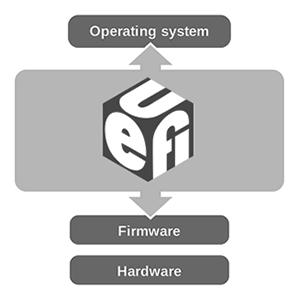
The Unified Extensible Firmware Interface (UEFI) is a specification that defines a software interface between an operating system and platform firmware. UEFI is meant as a replacement for the Basic Input/Output System (BIOS) firmware interface, present in all IBM PC-compatible personal computers. In practice, most UEFI images have legacy support for BIOS services.
It can be used to allow remote diagnostics and repair of computers, even without another operating system. The original EFI (Extensible Firmware Interface) specification was developed by Intel. Some of its practices and data formats mirror ones from Windows. The BIOS is limited to a 16-bit processor mode and 1 MB of addressable space due to the design being based on the IBM 5150 which used the 16-bit Intel 8088. In comparison, the UEFI processor mode can be either 32-bit (x86-32, ARM) or 64-bit (x86-64 and Itanium).
read more »
Posted in Money, Politics, Technology |
Leave a Comment »
October 21, 2012

Sociocybernetics is an independent chapter of science in sociology based upon Systems Theory (a framework to analyze a group of objects that work in concert to produce some result) and cybernetics (the study of control and communication systems in animals and machines). It also has a basis in Organizational Development (OD) consultancy practice and in Theories of Communication, theories of psychotherapies, and computer sciences. The ‘International Sociological Association’ has a specialist research committee in the area, which publishes the (electronic) ‘Journal of Sociocybernetics.’
The study of society as a system can be traced back to the origin of sociology when the emergent idea of functional differentiation was applied for the first time to society by Auguste Comte. From his viewpoint, the principal feature of modern society was the increased process of system differentiation as a way of dealing with the complexity of the environment. This is accomplished through the creation of subsystems in an effort to copy within a system the difference between it and the environment.
read more »
Posted in Politics, Science, Technology |
Leave a Comment »
October 21, 2012

‘Cognitive Surplus: Creativity and Generosity in a Connected Age’ is a 2010 non-fiction book by Clay Shirky. The book is an indirect sequel to Shirky’s ‘Here Comes Everybody,’ which covered the impact of social media. The book’s central theme is that people are now learning how to use more constructively the free time afforded to them since the 1940s for creative acts rather than consumptive ones, particularly with the advent of online tools that allow new forms of collaboration.
It goes on to catalog the means and motives behind these new forms of cultural production, as well as key examples. While Shirky acknowledges that the activities that we use our cognitive surplus for may be frivolous (such as creating ‘LOLcats’), the trend as a whole is leading to valuable and influential new forms of human expression. He also asserts that even the most inane forms of creation and sharing are preferable to the hundreds of billions of hours spent consuming television.
read more »
Posted in Language, Money, Technology |
Leave a Comment »


 The Daily Omnivore