May 27, 2012
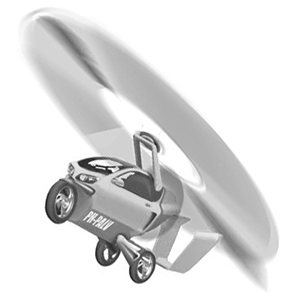
PAL-V Europe is a Dutch company who are developing a flying car, the PAL-V One, an autogyro or gyrocopter, with a pusher propeller at the rear of the fuselage providing forward thrust and a free-spinning rotor providing lift. Directional stability is provided by twin boom-mounted tailfins.
It has a tricycle undercarriage with relatively large wheels. On the ground, the propeller and rotor are stopped and power is diverted to the wheels, allowing it to travel as a three-wheeled car. Unusually, it leans into turns like a motorcycle, a solution pioneered by the Carver vehicle, also produced by a Dutch company.
Posted in Money, Technology |
Leave a Comment »
May 26, 2012
Glitch is a term used to describe a style of electronic music that emerged in the mid to late 1990s that adheres to an ‘aesthetic of failure,’ where the deliberate use of glitch based audio media, and other sonic artifacts, is a central concern.
Sources of glitch sound material are usually malfunctioning or abused audio recording devices or digital technology, such as CD skipping, electric hum, digital or analog distortion, bit rate reduction, hardware noise, computer bugs, crashes, vinyl record hiss or scratches, and system errors. In a ‘Computer Music Journal’ article published in 2000, composer and writer Kim Cascone classifies glitch as a sub-genre of electronica, and used the term ‘post-digital’ to describe the glitch aesthetic.
read more »
Posted in Art, Language, Technology |
Leave a Comment »
May 26, 2012

Glitch art is the aestheticization of digital or analog errors, such as artifacts and other ‘bugs,’ by either corrupting digital code/data or by physically manipulating electronic devices, for example by circuit bending (the intentional short-circuiting of low power electronic devices to create new musical devices). In a technical sense a glitch is the unexpected result of a malfunction. The term is thought to derive from the German ‘glitschig,’ meaning ‘slippery.’ It was first recorded in English in 1962 during the American space program by John Glenn when describing problems they were having, Glenn explained, ‘Literally, a glitch is a spike or change in voltage in an electrical current.’
Glitch is used to describe these kinds of bugs as they occur in software, video games, images, videos, audio, and other forms of data. The term glitch came to be associated with music in the mid 90s to describe a genre of experimental/noise/electronica (see glitch music). Shortly after, as VJs and other visual artist like Tony (Ant) Scott began to embrace the glitch as an aesthetic of the digital age, glitch art came to refer to a whole assembly of visual arts.
Posted in Art, Language, Technology |
3 Comments »
May 24, 2012

3DMark is a computer benchmarking tool created and developed by Futuremark Corporation to determine the performance of a computer’s 3D graphic rendering and CPU workload processing capabilities. Running the application produces a 3DMark score, with higher numbers indicating better performance.
The 3DMark measurement unit is intended to give a normalized mean for comparing different PC hardware configurations (mostly graphics processing units and central processing units), which proponents such as gamers and overclocking enthusiasts assert is indicative of end-user performance capabilities. Founded in 1997 as ‘Futuremark’ by members of the former demoscene group ‘Future Crew,’ the company is the leading producer of computer benchmark applications in the world.
Posted in Money, Technology |
Leave a Comment »
May 24, 2012

Frame rate is the frequency (rate) at which an imaging device produces unique consecutive images called frames. The term applies equally well to computer graphics, video cameras, film cameras, and motion capture systems. Frame rate is most often expressed in frames per second (FPS), and is also expressed in progressive scan monitors as hertz (Hz).
The human visual system can process 10 to 12 separate images per second, perceiving them individually. The visual cortex holds onto one image for about one-fifteenth of a second, so if another image is received during that period an illusion of continuity is created, allowing a sequence of still images to give the impression of motion.
read more »
Posted in Art, Money, Technology |
Leave a Comment »
May 24, 2012
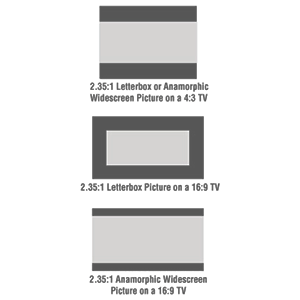
Letterboxing is the practice of transferring film shot in a widescreen aspect ratio to standard-width video formats while preserving the film’s original aspect ratio. The resulting videographic image has mattes (black bars) above and below it; these mattes are part of the image (i.e., of each frame of the video signal). LTBX is the identifying abbreviation for films and images so formatted. The term refers to the shape of a letter box, a slot in a wall or door through which mail is delivered, being rectangular and wider than it is high.
Letterboxing is used as an alternative to a full-screen, pan-and-scan transfer of a widescreen film, in which the original image is cropped to the narrower aspect ratio of the destination format, usually the 1.33:1 (4:3) ratio of the standard television screen, whereas letterboxing preserves the film’s original image composition as seen in the cinema. Letterboxing was developed for use in 4:3 television displays before widescreen television screens were available, but it is also necessary to represent on a 16:9 widescreen display the unaltered original composition of a film with a wider aspect ratio, such as Panavision’s 2.35:1 ratio.
read more »
Posted in Art, Money, Technology |
5 Comments »
May 23, 2012

A retronym [re-truh-nim] is a type of neologism that provides a new name for something to differentiate the original version from a more recent one. The original name is most often augmented with an adjective (rather than being completely displaced) to account for later developments of the object or concept itself. Much retronymy is driven by advances in technology.
Examples of retronyms are ‘acoustic guitar’ (coined when electric guitars appeared), and ‘analog watch’ to distinguish from a digital watch. In the entertainment industry, this can manifest itself as calling a movie ‘Part 1’ once sequels are released or by slightly altering the title (e.g. ‘Star Wars: A New Hope’ or ‘Indiana Jones and the Raiders of the Lost Ark’) to emphasize its connection with the sequel(s), or by referring to a television series as ‘the original,’ as in ‘Star Trek: The Original Series.’
read more »
Posted in Language, Money, Technology |
Leave a Comment »
May 22, 2012

A 4th Dimension roller coaster is a type of steel roller coaster whereby riders are rotated independently of the orientation of the track, generally about a horizontal axis that is perpendicular to the track. The cars do not necessarily need to be fixed to an angle.
John F. Mares, a corporate attorney, invented the 4th Dimension roller coaster concept in 1995 and holds six US patents related to the technology of their spinning seat systems. Three 4D roller coasters: ‘X2,’ ‘Eejanaika,’ and ‘Green Lantern: First Flight,’ which were either built or installed in the United States, have been licensed by Mr. Mares’ company (Meteoro Amusement Corporation).
read more »
Posted in Games, Technology |
Leave a Comment »
May 22, 2012
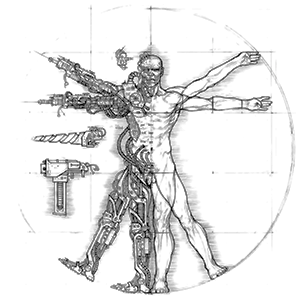
Hypermodernity is a type, mode, or stage of society that reflects a deepening or intensification of modernity. Characteristics include a deep faith in humanity’s ability to understand, control, and manipulate every aspect of human experience. This typically is manifested in a forward-looking commitment to science and knowledge, particularly with regard to the convergence of technology and biology.
The emphasis on the value of new technology to overcome natural limitations lends itself to a diminution or outright repudiation of the past, since yesterday’s knowledge can be considered ‘less’ than today’s. There can be a profound lack of integration between the past and the present since: what happened necessarily took place under ‘lesser’ circumstances than now, which generates a fundamentally separate context; and artifacts from the past superabundantly clutter the cultural landscape and are seamlessly reused to generate an even greater superabundance from which individuals are unable to discern original intent or meaning.
read more »
Posted in Philosophy, Politics, Technology |
Leave a Comment »
May 17, 2012

The Glock is a series of semi-automatic pistols designed and produced in Austria. The company’s founder, engineer Gaston Glock, had no experience with firearm design or manufacture at the time their first pistol, the Glock 17, was being prototyped in 1982.
Glock did, however, have extensive experience in advanced synthetic polymers, knowledge of which was instrumental in the company’s design of the first successful line of pistols with a polymer frame. Glock introduced ferritic nitrocarburizing, a form of case hardening, into the firearms industry as an anti-corrosion surface treatment for metal gun parts.
read more »
Posted in Money, Technology, War |
Leave a Comment »
May 16, 2012

Verner Panton (1926 – 1998) is considered one of Denmark’s most influential 20th-century furniture and interior designers. During his career, he created innovative, funky and futuristic designs in a variety of materials, especially plastics, and in vibrant and exotic colors.
His style was very ‘1960s’ but regained popularity at the end of the 20th century; as of 2004, Panton’s most well-known furniture models are still in production (at Vitra, among others).
read more »
Posted in Art, Money, Technology |
Leave a Comment »
May 16, 2012

Mars to Stay missions propose astronauts sent to Mars for the first time should intend to stay, with their unused emergency return vehicles recycled into settlement construction as soon as the habitability of Mars becomes evident to the initial pioneers. Mars to Stay missions are advocated both to reduce cost and to ensure permanent settlement of Mars.
Among many notable Mars to Stay advocates, former Apollo astronaut Buzz Aldrin has been particularly outspoken, suggesting in numerous forums ‘Forget the Moon, Let’s Head to Mars!’ The Mars Underground, Mars Homestead Foundation, and Mars Artists Community have also adopted Mars to Stay policy initiatives. The earliest formal outline of a Mars to Stay mission architecture was given at the ‘Case for Mars VI Workshop’ in 1990, during a presentation by George Herbert titled ‘One Way to Mars.’
read more »
Posted in Money, Technology, World |
1 Comment »



