June 10, 2012
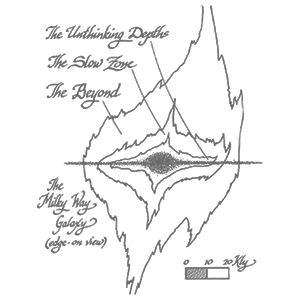
A Fire Upon the Deep is a 1992 science fiction novel by Vernor Vinge. It is a space opera involving superhuman intelligences, aliens, faster-than-light warfare, love, betrayal, genocide, and a galactic Usenet (an early Internet discussion system).
The story is set in Vinge’s ‘Zones of Thought’ in which the results of technological singularities (the achievement of greater-than-human intelligence) are spread out in a predicable pattern: In the ‘Unthinking Depths’ near the core of the galaxy, no intelligence is possible; in the ‘Slow Zone,’ where Earth is, general relativity applies (i.e. faster-than-light travel is impossible); the ‘Beyond’ allows faster-than-light travel and antigravity, and in the ‘Transcend,’ mysterious god-like entities roam the cosmos. Thus, as you head out of the Milky Way, you see the same progression of advancing technologies in other galaxies.
read more »
Posted in Art, Language, Technology |
Leave a Comment »
June 6, 2012

The Neo Geo is an arcade system board and home video game console released in 1990 by Japanese game company SNK. The MVS (Multi Video System), as the Neo Geo was known to the coin-operated arcade game industry, offered arcade operators the ability to put up to six different arcade titles into a single cabinet, a key economic consideration for operators with limited floorspace.
With its games stored on self-contained cartridges, a game-cabinet could be exchanged for a different game-title by swapping the game’s ROM-cartridge and cabinet artwork. Several popular franchise-series, including ‘Fatal Fury,’ ‘The King of Fighters,’ ‘Metal Slug,’ and ‘Samurai Shodown,’ were released for the platform. The Neo Geo system was also marketed as a very costly home console, commonly referred to today as the AES (Advanced Entertainment System).
read more »
Posted in Games, Money, Technology |
Leave a Comment »
June 6, 2012

Sanwa Denshi (‘Three Harmonies Electronics Company’) is a general electronics manufacturer, but is best known internationally as a leading manufacturer of arcade parts; i.e. joysticks, buttons, coin feeds etc.
Its parts are commonly used in Japanese arcade machines and held in high regard by custom builders (especially in the fighting game community).
read more »
Posted in Games, Money, Technology |
Leave a Comment »
June 4, 2012

Retro-futurism is a trend in the creative arts showing the influence of depictions of the future produced prior to about 1960. Characterized by a blend of old-fashioned ‘retro’ styles with futuristic technology, retro-futurism explores the themes of tension between past and future, and between the alienating and empowering effects of technology.
Primarily reflected in artistic creations and modified technologies that realize the imagined artifacts of its parallel reality, retro-futurism has also manifested in the worlds of fashion, architecture, literature and film.
read more »
Posted in Art, Language, Technology |
2 Comments »
June 4, 2012

The Family Trade is the first book of a British writer of science fiction and fantasy writer Charles Stross’ alternate history series ‘The Merchant Princes.’
The first novel introduces us to journalist Miriam Beckstein, who finds herself in a parallel world in which her extended family holds power.
read more »
Posted in Language, Money, Technology |
Leave a Comment »
June 4, 2012

‘The Theory of Interstellar Trade‘ is a paper written in 1978 by economist Paul Krugman. The paper was first published in 2010 in the journal ‘Economic Inquiry.’ He described the paper as something he wrote to cheer himself up when he was an oppressed assistant professor, caught up in the academic rat race.
Krugman analyzed the question of how interest rates on goods in transit should be computed when the goods travel at close to the speed of light. This is a problem because the time taken in transit will appear less to an observer traveling with the goods than to a stationary observer.
read more »
Posted in Humor, Money, Technology |
1 Comment »
June 4, 2012
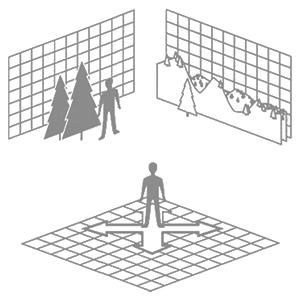
‘Ship in a Bottle‘ is a ‘Star Trek: The Next Generation’ episode (season six) where a sentient holodeck character, Professor James Moriarty, puts the Enterprise in jeopardy in his quest to be freed from confines of holographic environments.
Data and La Forge are enjoying a Sherlock Holmes holodeck program when the two notice that a character programmed to be left-handed was actually right-handed. They call Lt. Barclay to repair the holodeck, but as he checks the status of the Sherlock Holmes programs, he encounters an area of protected memory. He activates it to find the artificial sentient Professor James Moriarty character projected into the Holodeck, who appears to have memory since his creation (‘Elementary, Dear Data’ in season three: Geordi asks the holodeck to make a Sherlock Holmes villain that can defeat Data, creating a foe more powerful than originally planned).
read more »
Posted in Art, Games, Technology |
Leave a Comment »
June 3, 2012

A wobbulator is an electronic device primarily used for the alignment of receiver or transmitter intermediate frequency strips. It is usually used in conjunction with an oscilloscope, to enable a visual representation of a receivers passband to be seen, hence, simplifying alignment; it was used to tune early consumer AM radios. The term ‘wobbulator’ is a portmanteau of wobble and oscillator. A ‘wobbulator’ (without capitalization) is a generic term a frequency-modulated RF oscillator, also called a ‘sweep generator.’
A wobulator was used in some old microwave signal generators to create what amounted to frequency modulation. When capitalized ‘Wobbulator’ refers to the trade name of a specific brand of RF/IF alignment generator. The Wobbulator was made by a company known as TIC (Tel-Instrument Company). The Wobbulator generator, designated model 1200A, when connected to an oscilloscope and television receiver under test, would display a representation of the receiver’s RF/IF response curves with ‘markers’ defining critical frequency reference points as a response curve on the oscilloscope screen. Such an amplitude-versus-frequency graph is also often referred to as a Bode (pronounced ‘bodee’) plot.
Posted in Technology |
Leave a Comment »
June 3, 2012

Alva Noto is a stage name of sound artist Carsten Nicolai who uses art and music as complementary tools to create microscopic views of creative processes.
He is a member of the music groups Signal (with Frank Bretschneider and Olaf Bender aka Byetone) and Cyclo (with Ryoji Ikeda).
read more »
Posted in Art, Technology, World |
Leave a Comment »
May 28, 2012

Chromaroma is a London-based game using players’ public transport passes (Oyster cards and Barclays Cycle Hire accounts). Points are awarded depending on the stations and journeys users complete on the London Underground and London Buses, as well as using ‘Boris bikes.’
It is described by its creators, Mudlark, as ‘location-based top trumps,’ and encourages competition through leaderboards. (Top Trumps is a card game. Each card contains a list of numerical data, and the aim of the game is to compare these values in order to try to trump and win an opponent’s card. A wide variety of different packs of Top Trumps have been published).
Posted in Games, Technology, World |
Leave a Comment »
May 27, 2012

GPS Drawing combines art, travelling (walking, flying, and driving) and technology and is a method of drawing that uses GPS to create large-scale artwork. Global Positioning System receivers determine one’s position on the surface of the Earth by trilateration of microwave signals from satellites orbiting at an altitude of 20,200 km. Tracks of a journey can automatically be recorded into the GPS receiver’s memory and can be downloaded onto a computer as a basis for drawing, sculpture or animation. This journey may be on the surface (e.g. walking) or taken in 3D (e.g. while flying).
The idea was first implemented by artists Hugh Pryor and Jeremy Wood, who have drawn a 13-mile wide fish in Oxfordshire and spiders whose legs reach across cities. They have also provided an answer to the question ‘What is the world’s biggest ‘IF’? It happens to be a pair of letters, ‘I,’ which goes from Iffley in Oxford to Southampton and back, and ‘F” which traverses through the Ifield Road in London down to Iford in East Sussex, through Iford and back up through Ifold in West Sussex. The total length is 537 km, and the height of the drawing in typographic units is 319,334,400 points.
Posted in Art, Technology, World |
Leave a Comment »
May 27, 2012

A paperclip is an instrument used to hold sheets of paper together, usually made of steel wire bent to a looped shape. Most paper clips are variations of the Gem type introduced in the 1890s or earlier, characterized by the almost two full loops made by the wire. Common to paper clips proper is their utilization of torsion and elasticity in the wire, and friction between wire and paper.
When a moderate number of sheets are inserted between the two ‘tongues’ of the clip, the tongues will be forced apart and cause torsion in the bend of the wire to grip the sheets together. Too many sheets will cause the elastic limit of the material to be exceeded, resulting in permanent deformation. Paper clips usually have an oblong shape with straight sides, but may also be triangular or circular, or have more elaborate shapes. The most common material is steel, but molded plastic is also used. Some other kinds of paper clip use a two-piece clamping system. Recent innovations include multi-colored plastic-coated paper clips and spring-fastened binder clips.
read more »
Posted in Money, Technology, World |
Leave a Comment »



