March 9, 2012


Don’t Make Me Think is a book by Steve Krug about human-computer interaction and web usability. The book’s premise is that a good software program or web site should let users accomplish their intended tasks as easily and directly as possible. Krug points out that people are good at satisficing, or taking the first available solution to their problem, so design should take advantage of this.
He frequently cites Amazon.com as an example of a well-designed web site that manages to allow high-quality interaction, even though the site gets bigger and more complex every day. The book itself is intended to be an example of concision (brevity) and well-focused writing. The goal, according to the book’s introduction, was to make a text that could be read by an executive on a two-hour flight of an airplane.
Posted in Language, Technology |
Leave a Comment »
March 9, 2012

DWIM (‘Do What I Mean‘) computer systems attempt to anticipate what users intend to do, correcting trivial errors automatically rather than blindly executing users’ explicit but incorrect input. The term was coined by Lisp programmer Warren Teitelman in 1966. Teitelman’s DWIM package ‘correct[ed] errors automatically or with minor user intervention,’ similarly to a spell checker for natural language. Teitelman and his Xerox PARC colleague Larry Masinter later described this philosophy:
‘Although most users think of DWIM as a single identifiable package, it embodies a pervasive philosophy of user interface design: at the user interface level, system facilities should make reasonable interpretations when given unrecognized input. …the style of interface used throughout Interlisp allows the user to omit various parameters and have these default to reasonable values… DWIM is an embodiment of the idea that the user is interacting with an agent who attempts to interpret the user’s request from contextual information. Since we want the user to feel that he is conversing with the system, he should not be stopped and forced to correct himself or give additional information in situations where the correction or information is obvious.’
Posted in Language, Technology |
Leave a Comment »
March 9, 2012

The Unix philosophy [yoo-niks] is a set of cultural norms and philosophical approaches to developing software based on the experience of leading developers of the Unix operating system. Doug McIlroy, the inventor of Unix, summarized the philosophy as follows: ‘Write programs that do one thing and do it well.’ Additional credos include: ‘Write programs to work together. Write programs to handle text streams, because that is a universal interface.’
Richard P. Gabriel, an expert on the Lisp programming language, suggests that a key advantage of Unix was that it embodied a design philosophy he termed ‘worse is better,’ in which simplicity of both the interface and the implementation are more important than any other attributes of the system—including correctness, consistency, and completeness. Gabriel argues that this design style has key evolutionary advantages, though he questions the quality of some results.
Posted in Money, Philosophy, Technology |
Leave a Comment »
March 9, 2012

Low Orbit Ion Cannon (LOIC) is an open source network stress testing and denial-of-service attack application. LOIC was initially developed by Praetox Technologies, but was later released into the public domain, and now is hosted on several open source platforms. It’s named after a fictitious weapon from the ‘Command & Conquer’ series of video games.
The software has inspired the creation of an independent JavaScript version, enabling a DoS from a web browser. LOIC performs a DoS attack (or when used by multiple individuals, a DDoS attack) on a target site by flooding the server with TCP packets or UDP packets with the intention of disrupting the service of a particular host. People have used LOIC to join voluntary botnets. LOIC attacks are easily identified in system logs, and the attack can be tracked down to the individual users IP address.
Posted in Money, Politics, Technology |
Leave a Comment »
March 9, 2012

Topiary, real name Jake Davis, is a hacker and self-described ‘Simple prankster turned swank garden hedge. Worked with Anonymous, LulzSec, and other such paragons of intense cyber victory.’ He is an associate of the Internet group Anonymous, which have publicly claimed various online attacks, including hacking HBGary, Westboro Baptist Church, and Gawker. They have also claimed responsibility for the defacing of government websites in countries such as Zimbabwe, Syria, Tunisia, Ireland, and Egypt. 18-year Jake Davis was arrested in Scotland in 2011.
Police confiscated a Dell laptop and a 100-gigabyte hard drive that had 16 different virtual machines. The hard drive also contained details relating to an attack on Sony and hundreds of thousands of email addresses and passwords were found on the computer. A London court released Davis on bail under the conditions that he live under curfew with his mother and have no access to the Internet. His lawyer stated that, while his client did help publicize LulzSec and Anonymous attacks, he lacks the technical skills to have been anything but a sympathizer. After his arrest, Anonymous launched a ‘Free Topiary’ campaign.
Posted in Money, Politics, Technology |
Leave a Comment »
March 9, 2012

The Jester (th3j35t3r) is a computer vigilante who describes himself as a grey hat ‘hacktivist.’ He claimed responsibility for attacks on WikiLeaks, 4chan, Iranian President Mahmoud Ahmadinejad, and Islamist websites. He claims to be acting out of American patriotism. The Jester uses a denial-of-service (DoS) tool known as ‘XerXeS,’ that he claims to have developed.
One of The Jester’s habits is to tweet ‘TANGO DOWN’ on Twitter whenever he successfully takes down a website. The Jester had stated that he was a former soldier and had served in Afghanistan and elsewhere.The Jester claims to have originally developed his DoS script as a means to test and harden servers. After learning from an article that Jihadists were using the Internet to recruit and coordinate terror cells, The Jester resolved to disrupting online communications between Jihadists. He weaponized his script and created a front-end known as ‘XerXeS’ in order to solve the script’s usability problems.
read more »
Posted in Politics, Technology, War |
Leave a Comment »
March 9, 2012

Sabu, real name Hector Xavier Monsegur (b. 1983), is an American computer hacker and the founder of the hacking group LulzSec. LulzSec intervened in the affairs of organizations such as News Corporation, Stratfor, British and American law enforcement bodies, and Irish political party Fine Gael.
Sabu later turned informant for the FBI, working with the agency for over ten months to aid them in identifying other hackers from Lulzsec and related groups. His online handle is a reference to a professional wrestler. Monsegur was based out of a housing project on the lower east side of Manhattan while operating as Sabu; he is currently in a witness protection program.
Posted in Money, Politics, Technology |
Leave a Comment »
March 8, 2012

Game Over is a message in video games which signals that the game has ended, often due to a negative outcome – although the phrase sometimes follows the end credits after successful completion of a game. In certain uses; particularly during conversation, ‘Game Over’ is sometimes shortened to the first two letters: ‘GO’ with each letter pronounced individually. The phrase was used as early as the 1950s in devices such as electromechanical pinball machines, which would light up the phrase with a light bulb.
Before the advent of video game consoles and personal computing, arcades were the predominant platform for playing games which required users to deposit a token or coin into an arcade game machine in order to play. Players would usually be given a finite number of lives (or attempts) to progress through the game which when expended would usually result in the display of the message ‘Game Over’ indicating that the game had ended. The phrase might also be followed by the message ‘Continue?’ and a prompt asking the player to insert additional tokens to prevent the game from terminating and allowing the player to continue their progress.
read more »
Posted in Games, Money, Technology |
1 Comment »
March 7, 2012

Selvage denim [sel-vij] is a type of denim which forms a clean natural edge that does not unravel. It is commonly presented in the unwashed or raw state. Typically, the selvage edges will be located along the out-seam of the trousers, making it visible when cuffs are worn. The word ‘selvage’ comes from the phrase ‘self-edge,’ the natural edge of a roll of fabric. As applied to denim, it means that which is made on old-style shuttle looms.These looms weave fabric with one continuous cross thread (the weft) that is passed back and forth all the way down the length of the bolt. As the weft loops back into the edge of the denim it creates this ‘self-edge’ or selvage.
Selvage is desirable because the edge cannot fray like denim made on a projectile loom that has separate wefts, which leave an open edge that must be stitched. This advantage is only realized on one edge of the fabric, however, as the fabric has to be cut to shape and anywhere it is cut the self-edge is lost. Shuttle looms weave a narrower piece of fabric, and thus a longer piece of fabric is required to make a pair of jeans (approximately 3 yards). To maximize yield, traditional jean makers use the fabric all the way to the selvedge edge. When the cuff is turned up, the two selvedge edges (where the denim is sewn together) can be seen.
Posted in Money, Technology |
Leave a Comment »
March 6, 2012
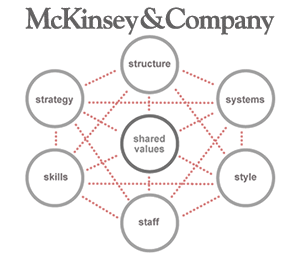

Management consulting refers to both the industry and the practice of helping organizations to improve their performance, primarily through the analysis of existing organizational problems and development of plans for improvement.
Organizations may draw upon the services of management consultants for a number of reasons, including gaining external (and presumably objective) advice and access to the consultants’ specialised expertise. As a result of their exposure to and relationships with numerous organizations, consulting firms are also said to be aware of industry ‘best practices,’ although the transferability of such practices from one organization to another may be limited by the specific nature of situation under consideration.
read more »
Posted in Money, Technology, World |
Leave a Comment »
March 5, 2012

Not safe for work (NSFW) is Internet slang or shorthand to mark URLs or hyperlinks which contain material such as pornography or profanity, which the viewer may not want to be seen accessing in a public or formal setting such as at work. Determining a site to be NSFW is invariably subjective. The less frequently used warnings PNSFW (Probably/Possibly Not Safe for Work), LSFW (Less Safe for Work), TSFW (Technically Safe for Work), and PNFO (Probably Not for the Office) are sometimes used to indicate content possibly considered salacious (lustful) by certain censors, such as images of underwear or swimwear models, or a news story about sexual issues that does not contain explicit images.
NSFW is also sometimes used to refer to any media that produces sound, such as a game or video file; the implication being that the noises may alert others in the vicinity that the user is taking a break with entertainment materials instead of working. An alternative abbreviation is NSFL, meaning not safe for lunch or not safe for life – this indicates subject matter too grim, shocking, stark, or frank to be recommended without a disclaimer.
Posted in Money, Sex, Technology |
Leave a Comment »
March 5, 2012

A viral video is one that becomes popular through the process of Internet sharing, typically through video sharing websites, social media and email. Viral videos often contain humorous content and include televised comedy sketches, such as The Lonely Island’s ‘Lazy Sunday’ and ‘Dick in a Box,’ amateur video clips like ‘Star Wars Kid,’ the ‘Numa Numa’ videos, ‘The Evolution of Dance,’ and ‘Chocolate Rain,’ and web-only productions such as ‘I Got a Crush… on Obama.’ Some eyewitness events have also been caught on video and have ‘gone viral’ such as the ‘Battle at Kruger.’
The proliferation of camera phones and inexpensive video editing and publishing tools credited with fueling phenomena. These consumer-shot videos are typically non-commercial, intended for viewing by friends or family. A video becoming viral is often unexpected, and an accident, and therefore a video cannot be called viral purely in the creator’s intention at the time of recording.
read more »
Posted in Humor, Money, Technology |
Leave a Comment »





