March 5, 2012

Active camouflage is camouflage which adapts to the actual surroundings of an object such as an animal or military vehicle. It is used in several groups of animals including cephalopods (e.g. squid, octopus) and flatfish in the sea, and reptiles on land (e.g. chameleon). Some sea creatures can counterilluminate (emit light to match the background) because in the sea, light comes down from the surface, so animals tend to appear dark when seen from below. Bioluminescence and color change also have other functions in animals including attracting prey and signalling mates.
In military usage, counterillumination camouflage was first investigated during the WWII for marine use. Current research aims at achieving crypsis (avoidance of detection) using cameras to sense the visible background, and panels or coatings which can vary their appearance. Military active camouflage has its origins in the diffused lighting camouflage tested on Canadian Navy corvettes during WWII. Later, a US Air Force program placed low-intensity blue lights on aircraft as counterillumination camouflage. As night skies are not pitch black, a 100 percent black-colored aircraft might be rendered visible.
Posted in Science, Technology, War |
1 Comment »
March 5, 2012
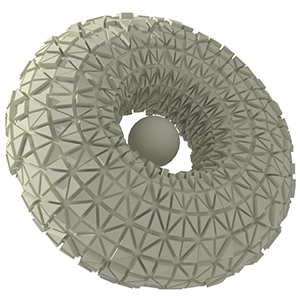
A greeble or nurnie is a small piece of detailing added to break up the surface of an object to add visual interest to a surface or object, particularly in movie special effects. They serve no real purpose other than to add complexity to the object, and cause the flow of the eye over the surface of the object to be interrupted, usually giving the impression of increased size. It is essentially the small detailed technical part of a larger object. The detail can be made from geometric primitives, including cylinders, cubes, and rectangles, combined to create intricate, but meaningless, surface detail.
Greebles are commonly found on models or drawings of fictional spacecraft in science fiction. The earliest recorded use of the term ‘greeble’ found to date was by those working on the special effects for ‘Star Wars’ — the group who would later become Industrial Light and Magic. They also described this design method as ‘guts on the outside.’ Ron Thornton is widely believed to have coined the term ‘nurnies’ referring to CGI technical detail that his company Foundation Imaging produced for the ‘Babylon 5’ series.
read more »
Posted in Art, Language, Technology |
Leave a Comment »
March 5, 2012
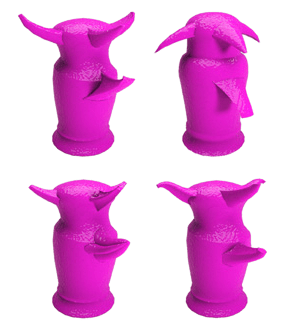
The Greebles refers to a category of novel objects used as stimuli in psychological studies of object and face recognition, created by Scott Yu at Yale University. They were named by the psychologist Robert Abelson. The greebles were created for Isabel Gauthier’s dissertation work at Yale, so as to share constraints with faces: they have a small number of parts in a common configuration.
This makes it difficult to distinguish any individual object on the basis of the presence of a feature, and this is thought to encourage the use of all features and the relationships between them. In other words, greebles, just like faces, can be processed configurally. Yu’s originals (both the symmetrical and asymmetrical sets) can be obtained from Michael Tarr.[1] Greebles appear in over 25 scientific articles.
Posted in Health, Science, Technology |
Leave a Comment »
March 1, 2012

White Dot is an anti-television organization based in the UK. It encourages people to not watch television, and also to switch off televisions in cafés and pubs with devices such as the TV-B-Gone. It also organizes what it calls zocalo (a Mexican term for a town square) events where people are requested to turn off their televisions, go outside and talk to their neighbors.
The organization is named after the white dot that appeared in the middle of old CRT television screens when switched off—as the capacitors discharged, the cathode ray would continue to emit electrons although no longer being controlled horizontally or vertically.
Posted in Politics, Technology, World |
1 Comment »
March 1, 2012


Salami slicing is a series of many minor actions, often performed by clandestine means, that together results in a larger action that would be difficult or illegal to perform at once. The term is typically used pejoratively. An example of salami slicing, also known as penny shaving, is the fraudulent practice of stealing money repeatedly in extremely small quantities, usually by taking advantage of rounding to the nearest cent in financial transactions. It would be done by always rounding down, and putting the fractions of a cent into another account. The idea is to make the change small enough that any single transaction will go undetected.
In politics, the term salami tactics has been used since the 1940s to refer to a divide and conquer process of threats and alliances used to overcome opposition. In academia, salami slicing refers to the practice of creating several publications out of material that could have been published in a single journal or review. Historically, actual physical ‘penny shaving’ may be considered a form of salami slicing. The edges of coins made of precious metals have been clipped or shaved by individuals in order to procure small quantities of said metals with the intention that the coin would still retain its nominal value.
Posted in Money, Politics, Technology |
Leave a Comment »
February 29, 2012

The Raspberry Pi (or RasPi) is a $35 single-board computer developed in the UK by the Raspberry Pi Foundation which aims to ‘promote the study of computer science and related topics, especially at school level, and to put the fun back into learning computing.’ The design is based around a Broadcom BCM2835 system on a chip (SoC), which includes a 700 MHz ARM CPU, VideoCore IV GPU, and 256 Megabytes of RAM. The design does not include a built-in hard disk or solid-state drive, instead relying on an SD card for booting and long-term storage.
The foundation has released one model (Model B) initially, and a second model (Model A) will be released sometime later. Model A will have one USB port and no Ethernet controller, and will cost $25, while Model B contains two USB ports and a 10/100 Ethernet controller and costs $35. Though the Model A doesn’t have an RJ45 Ethernet port, it can connect to a network by using a user-supplied USB Ethernet or Wi-Fi adapter. As is typical of modern computers, generic USB keyboards and mice are compatible with the Raspberry Pi. The system will use a Linux kernel-based operating systems.
Posted in Money, Technology, World |
Leave a Comment »
February 29, 2012

Ecofont is a TrueType font developed by SPRANQ in the Netherlands. The font uses tiny circles placed in the characters to cut down on ink costs. It claims to cut down the amount of ink usage by approximately 15 percent.
In a 2010 test, Ecofont Vera Sans saved 20% more ink when compared to Bitstream Vera Sans. However, both sans-serif fonts used more ink than most typical serif fonts. Therefore Ecofont developed software to save ink when using any typeface, including serif fonts.
Posted in Money, Technology |
Leave a Comment »
February 27, 2012

‘Mean world syndrome‘ is a term coined by professor of communications George Gerbner to describe a phenomenon whereby violence-related content of mass media makes viewers believe that the world is more dangerous than it actually is. Mean world syndrome is one of the main conclusions of cultivation theory (which states that those who spend more time watching TV are more likely to perceive the real world in ways that reflect the most common messages of the TV world). Gerbner, a pioneer researcher on the effects of television on society, argued that people who watched a large amount of television tended to think of the world as an intimidating and unforgiving place.
The number of opinions, images, and attitudes that viewers tend to make when watching television will have a direct influence on what the viewer perceives the real world as. They will reflect and refer to the most common images or recurrent messages thought to impact on their own real life. Gerbner once said ‘You know, who tells the stories of a culture really governs human behavior,’ he said. ‘It used to be the parent, the school, the church, the community. Now it’s a handful of global conglomerates that have nothing to tell, but a great deal to sell.’ Individuals who watch television infrequently and adolescents who talk to their parents about reality are claimed to have a more accurate view of the real world than those who do not, and they may be able to more accurately assess their vulnerability to violence.
Posted in Politics, Technology, World |
1 Comment »
February 27, 2012
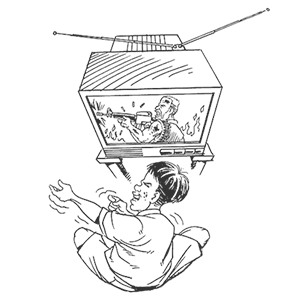
Cultivation theory is a social theory which examines the long-term effects of television. Developed by George Gerbner and Larry Gross of the University of Pennsylvania. They were ‘concerned with the effects of television programming (particularly violent programming) on the attitudes and behaviors of the American public.’
Gerbner asserts that the overall concern about the effects of television on audiences stemmed from the unprecedented centrality of television in American culture. He posited that television as a mass medium of communication had formed into a common symbolic environment that bound diverse communities together, socializing people in to standardized roles and behaviors. He compared the power of television to the power of religion, saying that television was to modern society what religion once was in earlier times.
read more »
Posted in Health, Science, Technology |
1 Comment »
February 26, 2012
The Monroe Institute (TMI) is a nonprofit education and research organization devoted to the exploration of human consciousness, based in Virginia. TMI, which claims a policy of no dogma or bias with respect to belief system, religion, political or social stance, was founded by Robert Monroe after he experienced an ‘out of body experience,’ now also commonly referred to as OBEs. Activities includes teaching various techniques, based on audio-guidance processes, in order to expand consciousness and explore areas of consciousness not normally available in the waking state.
Controlled studies of the Institute’s technology suggest that it is effective as an analgesic supplement and can reduce hospital discharge times. The Institute has an affiliated professional membership, and also publishes scientific papers on a subset of its own studies of altered states of consciousness. In its in-house laboratory, these states or focus levels are typically induced by delivering Hemi-Sync signals to subjects performing relaxation procedures inside a shielded, sense-depriving isolation tank. Progression through states is detected and monitored by measurement of peripheral skin temperature, galvanic skin response and DC skin potential voltage.
Posted in Health, Technology |
Leave a Comment »
February 25, 2012
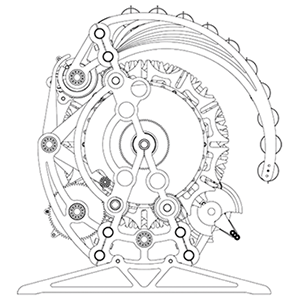
The Clock of the Long Now is a proposed mechanical clock designed to keep time for 10,000 years. The project to build it is part of the Long Now Foundation, a private organization that seeks to become the seed of a very long-term cultural institution. The project was conceived by American inventor Danny Hillis in 1986: ‘I want to build a clock that ticks once a year. The century hand advances once every one hundred years, and the cuckoo comes out on the millennium.I want the cuckoo to come out every millennium for the next 10,000 years.’
The first prototype of the clock began working on December 31, 1999, just in time to display the transition to the year 2000. At midnight on New Year’s Eve, the date indicator changed from 01999 to 02000, and the chime struck twice. That prototype, approximately two meters tall, is currently on display at the Science Museum in London. The first full-scale clock’s manufacture and site construction is being funded by Jeff Bezos, who has donated $42 million, and is located on his Texas land.
read more »
Posted in Money, Technology |
Leave a Comment »
February 25, 2012

A monofin is a type of swimfin typically used in finswimming and free-diving. It consists of a single surface attached to footpockets for both of the free-diver’s feet. Monofins were introduced in 1972, by a Ukrainian finswimming club, and have been used for finswimming competitions since, allowing monofin swimmers to reach speeds of 12km/h. Monofins can be made of glass fiber or carbon fiber. The diver’s muscle power, swimming style, and the type of aquatic activity the monofin is used for determines the choice of size, stiffness, and materials.
To differentiate between the use of monofins and conventional fins, the latter are sometimes referred to as stereo fins or bi-fins. The monofin swimmer extends arms forward, locking hands together, locking the head between the biceps. The undulating movement starts in the shoulders, with maximum amplitude towards the hips, the legs almost don’t bend to transfer the movement to the monofin. This technique is called the dolphin kick.
Posted in Games, Technology |
Leave a Comment »