November 24, 2011


Overengineering is when a product is more robust or complicated than necessary for its application, either (charitably) to ensure sufficient factor of safety, sufficient functionality, or due to design errors.
Overengineering is desirable when safety or performance on a particular criterion is critical, or when extremely broad functionality is required, but it is generally criticized from the point of view of value engineering as wasteful. As a design philosophy, such overcomplexity is the opposite of the minimalist school of thought.
read more »
Posted in Money, Technology |
Leave a Comment »
November 24, 2011

Software bloat is a process whereby successive versions of a computer program include an increasing proportion of unnecessary features that are not used by end users, or generally use more system resources than necessary, while offering little or no benefit to its users.
Software developers in the 1970s had severe limitations on disk space and memory. Every byte and clock cycle counted, and much work went into fitting the programs into available resources. Achieving this efficiency was one of the highest values of computer programmers, and the best programs were often called ‘elegant’; —seen as a form of high art.
read more »
Posted in Money, Technology |
Leave a Comment »
November 24, 2011

Shovelware is a derogatory computer jargon term that refers to software noted more for the quantity of what is included than for the quality or usefulness. The term is also used to refer to software that is ported from one computer platform or storage medium to another with little thought given to adapting it for use on the destination platform or medium, resulting in poor quality. The metaphor implies that the creators showed little care for the original software, as if the new compilation or version had been indiscriminately created / ported with a shovel, without any care shown for the condition of the software on the newly created product. The term ‘shovelware’ is coined with semantic analogy to phrases like shareware and freeware, which describe methods of software distribution.
Shovelware was often used to refer to conversions in the manner floppy disc collections were aggregated onto CD-ROMs. Today there is potential for similar shovelware in converting PC websites into mobile websites with little thought to optimizing for the new platform or the conversion of console games to PC games. The practice of shovelware has largely decreased due to the wide availability of high speed networking and software downloading and the limited capacity of removable media in modern computers compared to the growing massive file sizes of newer software packages. It continues in some cases with bundled or pre-installed software, where many extra programs of dubious quality and usefulness are included with a piece of hardware, often called derisively ‘crapware.’
Posted in Games, Money, Technology |
Leave a Comment »
November 21, 2011

Steve Haworth is a body modification artist based in Phoenix, Arizona. He is responsible for the invention and popularization of subdermal and transdermal implants, such as the ‘Metal Mohawk.’ He designed specialized medical instruments called dermal elevators for this process. He has also done pioneering work with surface bars, ear shaping, tongue splitting, magnetic implants, and artistic branding (using electrocautery units). He has worked on individuals noted for their extensive modifications such as The Enigma, Katzen, Stalking Cat and The Lizardman. Many other respected artists in the body modification community cite Haworth as an inspiration. Fellow body modification artist Samppa von Cyborg says that ‘He’s the most important, most respected body modder out there.’ Shawn Porter of body modification blog ‘Scar Wars’ explains, ‘I directly credit Steve’s branding as a main influence on the newer generation of scarification artists; his high detail branding (which caused a stir when it was featured in ‘In the Flesh,’ ‘Body Art,’ and ‘Bizarre’) showed people that you could do more than just dots, chevrons and geometric shapes.’
Haworth’s father was a manufacturer of surgical equipment, and he continued in the family business, eventually branching into piercing jewelry and body modification instruments. Currently he is retired from regular piercing, preferring to concentrate on 3D implants and other types of body modification. He continues to manufacture body jewelry and tools for body modification. He and his business partner Jesse Jarrell create unique silicone jewelry for large-gauge piercing with their company Kaos Softwear. Haworth travels around the country and the world frequently, and conducts seminars on his body modification techniques. He founded the body suspension group ‘Life Suspended’ and performs suspensions with them on regular basis. He is also the co-founder of the production company ‘Horns & Halos,’ which puts on several fetish-themed events every year.
Posted in Art, Health, Technology |
Leave a Comment »
November 21, 2011
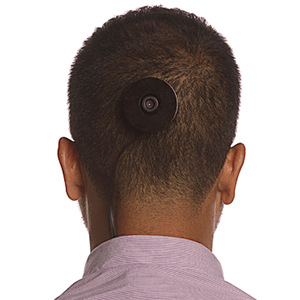
In body modification, an implant is a device placed under the human skin for decorative purposes. Such implants may be subdermal (beneath the skin) or transdermal (partially below and partially above the skin). In the context of body modification, some may consider injections of silicone and other substances a type of implant as well. Some types of implants may be performed by doctors or other medical professionals, while others are performed by body modification artists.
Examples include collarbone piercing, deep chest piercing, eyeball implants, flesh stapling, genital beading, magnetic implants, and scrotal implants. A clavicle or collarbone piercing is a very deep piercing that passes beneath the collarbone, and therefore enters the body cavity. These are highly prone to rejection as the collarbone placement is a high movement area.
read more »
Posted in Art, Health, Technology |
Leave a Comment »
November 21, 2011

The Immortality Drive is a small memory device which was taken to the International Space Station in a Soyuz spacecraft in 2008. The Immortality Drive contains digitized DNA sequences of a select group of humans, such as physicist Stephen Hawking, comedian Stephen Colbert, Playboy model Jo Garcia, game designer Richard Garriot, Pro Wrestler Matt Morgan, and athlete Lance Armstrong.
The microchip also contains a copy of ‘George’s Secret Key to the Universe,’ a children’s book authored by Stephen Hawking and his daughter, Lucy. The intent of the Immortality Drive is to preserve human DNA in a time capsule, in case some global cataclysm should occur on Earth.
Posted in Science, Technology |
Leave a Comment »
November 20, 2011

Car Talk is a radio talk show broadcast weekly on National Public Radio stations throughout the United States and elsewhere. The hosts are brothers Tom and Ray Magliozzi, also known as Click and Clack, the Tappet Brothers. Car Talk is structured as a call-in radio show: listeners call with questions related to motor vehicle maintenance and repair. Most of the advice sought is diagnostic, with callers describing symptoms and demonstrating sounds of an ailing vehicle while the Magliozzis make an attempt at identifying the malfunction.
While the hosts pepper their call-in sessions with jokes directed at both the caller and at themselves, the depth and breadth of their knowledge of automobiles is extensive, and they are usually able to arrive at a diagnosis and give helpful advice. Also, if a caller has an unusual name, they will inquire about the spelling, pronunciation, and/or origin of their name. They may also comment about the caller’s hometown.
read more »
Posted in Humor, Language, Technology |
Leave a Comment »
November 19, 2011
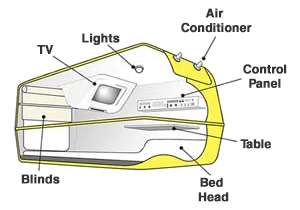

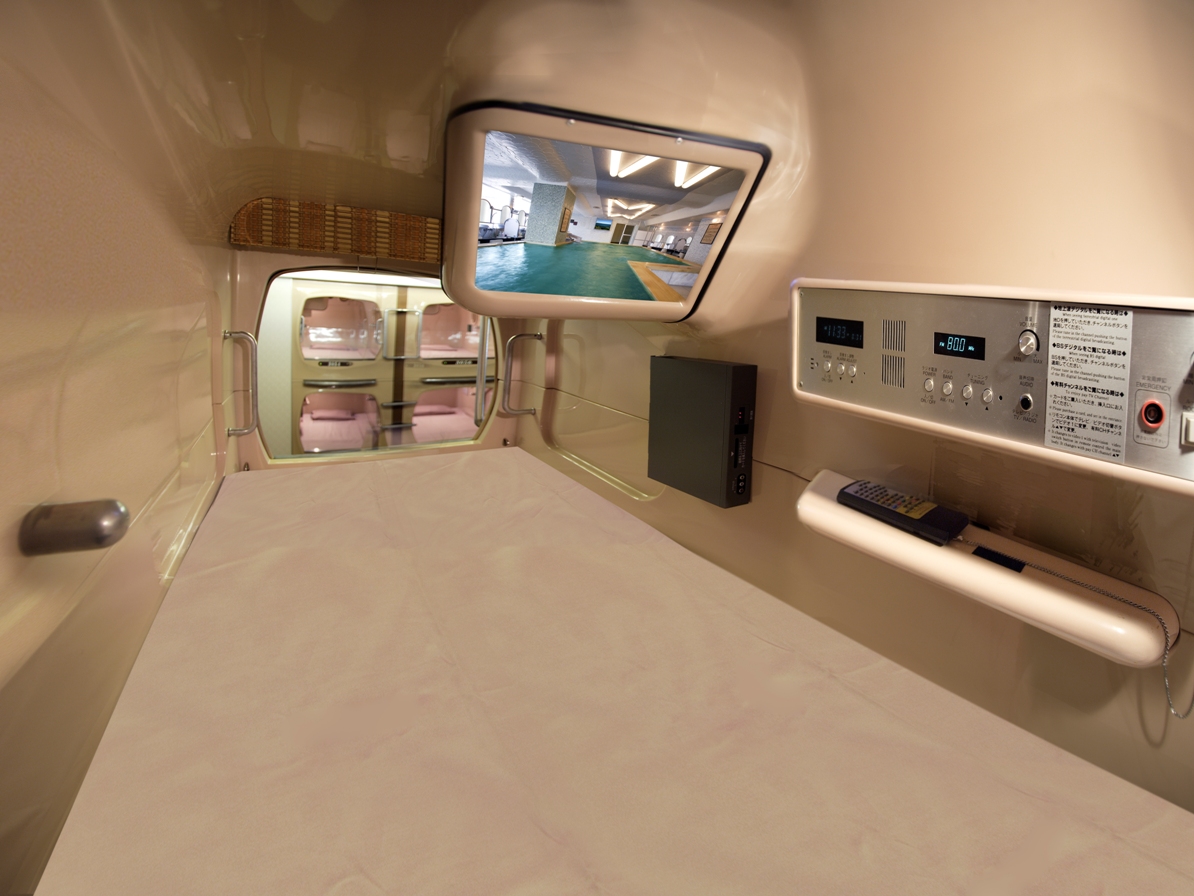
A capsule hotel is a type of hotel with a large number of extremely small ‘rooms’ (capsules) intended to provide cheap and basic overnight accommodation for guests not requiring the services offered by more conventional hotels. The guest space is reduced in size to a modular plastic or fiberglass block roughly 2 m by 1 m by 1.25 m. Most include a television, an electronic console, and wireless internet connection. Capsules are stacked side by side and two units top to bottom, with steps providing access to the second level rooms. Luggage is stored in a locker. Privacy is ensured by a curtain or a fiberglass door at the open end of the capsule. Washrooms are communal and some hotels include restaurants (or at least vending machines), pools, and other entertainment facilities.
This style of hotel accommodation was developed in Japan and has not gained popularity outside of the country, although Western variants known as ‘Pod hotels’ with larger accommodations and often private baths are being developed. Guests are asked not to smoke or eat in the capsules. Capsule hotels vary widely in size, some having only fifty or so capsules and others over 700. Many are used primarily by men. There are also capsule hotels with separate male and female sleeping quarters. Clothes and shoes are sometimes exchanged for a yukata (a casual summer kimono) and slippers on entry. A towel may also be provided. The benefit of these hotels is convenience and price, usually around ¥2000-4000 (US$26–52) a night.
Posted in Money, Technology, World |
Leave a Comment »
November 19, 2011
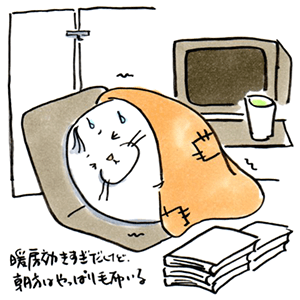
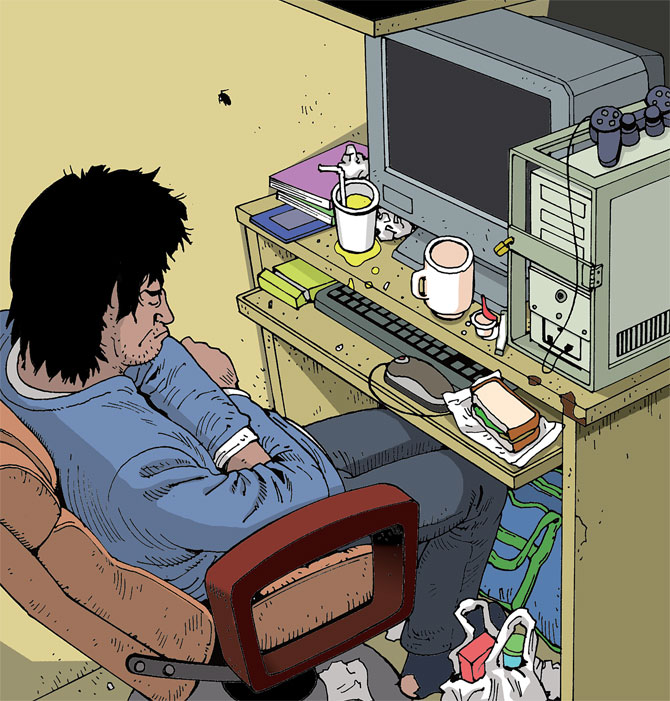
Net cafe refugees, also known as cyber-homeless, is a term for a growing class of people in Japan who do not own or rent a residence and thus have no permanent address and sleep in 24 hour Internet or manga cafés. Goods and services offered at these establishments has grown to include food, undergarments and other personal items, and showers. They are often used by commuters who miss the last train, but a growing number of people use net cafes as a temporary shelter. The fee of 1400-2400 yen (US $18-31) for a night—which may include free soft drinks, TV, comics and internet access—is less than for capsule hotels. Some cyber-homeless may also be freeters, a Japanese expression for people between the ages of 15 and 34 who lack full time employment or are unemployed, excluding housewives and students.
According to a Japanese government survey, those staying have little interest in manga or the Internet, and are instead using the place because of the low price relative to any of the competition for temporary housing, business hotels, capsule hotels, hostels, or any other option besides sleeping on the street. It was also estimated that about half of those staying have no job, while the other half work in low-paid temporary jobs, which paid around 100,000 yen ($1000) per month – lower than what is needed to rent an apartment and pay for transportation in a city like Tokyo.
Posted in Money, Technology, World |
Leave a Comment »
November 19, 2011

Drunk dialing is a pop-culture term denoting an instance in which an intoxicated individual places phone calls that he or she would not likely place if sober. The term often refers to a lonely individual calling former or current love interests. Kurt Vonnegut once said, ‘I have this disease late at night sometimes, involving alcohol and the telephone. I get drunk, and I drive my wife away with breath like mustard gas and roses.
And then, speaking gravely and elegantly into the telephone, I ask the telephone operators to connect me with this friend or that one, from whom I have not heard in years.’ ‘Drunk texting’ is a related phenomenon, and potentially yet more embarrassing for the sender as, once the message is sent, it cannot be retrieved; the message will most likely be misspelled (due to being drunk), and it might be reviewed and shared among many.
read more »
Posted in Drugs, Humor, Technology |
Leave a Comment »
November 19, 2011


A hacker is a member of the computer programmer subculture originated in the 1960s in the United States academia, in particular around the MIT’s Tech Model Railroad Club (TMRC) and MIT Artificial Intelligence Laboratory. Some members of the ‘hacker’ community most emphatically differentiate the term ‘hacker’ from malicious hackers (whom they very strongly prefer to call ‘crackers’).
Other hackers make no such distinction. The latter hackers’ view that hackerdom is not inherently moral/immoral or ethical/unethical is broadly similar to the concept or attitude of a ‘grey hat’ hacker. By contrast, ‘white hat’ hackers use their computer security related skills and knowledge to learn more about how systems and networks work and to help to discover and fix security holes, and ‘black hat’ hackers use the same skills to author harmful software (like viruses, trojans, etc.) and illegally infiltrate secure systems with the intention of doing harm to the system.
read more »
Posted in Language, Technology |
Leave a Comment »
November 19, 2011

Hacktivism (a portmanteau of hack and activism) is the use of computers and computer networks as a means of protest to promote political ends. The term was first coined in 1998 by a member of the Cult of the Dead Cow hacker collective. If hacking as ‘illegally breaking into computers’ is assumed, then hacktivism could be defined as ‘the nonviolent use of illegal or legally ambiguous digital tools in pursuit of political ends.’ These tools include web site defacements, redirects, denial-of-service (DoS) attacks, information theft, web site parodies, virtual sit-ins, typosquatting, and virtual sabotage.
If hacking as ‘clever computer usage/programming’ is assumed, then hacktivism could be understood as the writing of code to promote political ideology: promoting expressive politics, free speech, human rights, and information ethics through software development. Acts of hacktivism are carried out in the belief that proper use of code will be able to produce similar results to those produced by regular activism or civil disobedience.
read more »
Posted in Humor, Politics, Technology |
Leave a Comment »